Portuguese
  Spanish


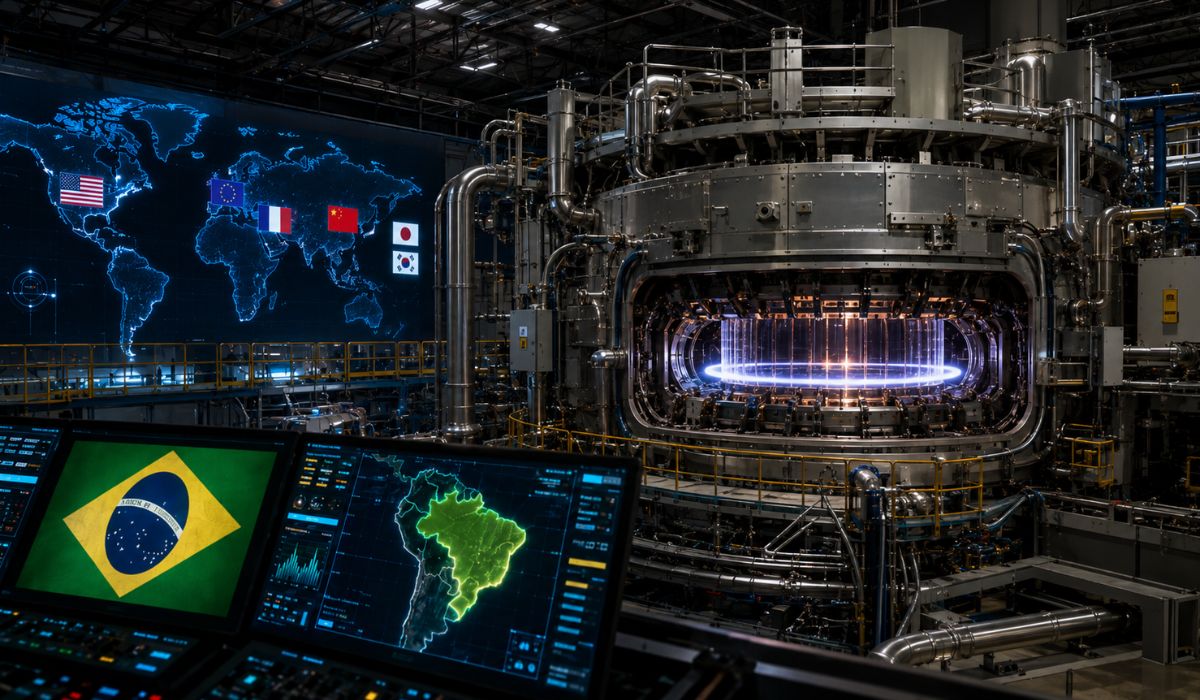

The race for nuclear fusion brings together laboratories, governments, and companies in search of a clean energy source, while Brazil tries to expand its presence with research in tokamaks and plasma physics.
Research in nuclear fusion is advancing in public laboratories, universities, and private companies in different countries, with the goal of reproducing in a controlled manner the physical process that powers the Sun.
According to the International Atomic Energy Agency, there are fusion projects in about 50 countries, in an area that has not yet reached commercial electricity generation, but mobilizes investments and large-scale experimental structures.
In Brazil, the main equipment in operation is the TCABR, a tokamak installed at the Institute of Physics of the University of São Paulo, described by USP as the only facility in the Southern Hemisphere that operates this type of machine.
-
Iraq floats and sinks under an arm of the Euphrates 10 giant concrete boxes of 46,000 tons and 125 meters each to assemble a 2.4 km submerged tunnel and open a new land route between Asia and Europe.

-
Scientists use more than 20,000 artificial birds and solar speakers to “trick” seabirds, reactivate nesting routes, and revive a colony on an island that seemed abandoned.

-
She spent 73 years breathing inside an iron lung, survived the aftereffects of polio, and became the last woman in the United States dependent on the equipment before dying at 78 years old.
-
Brazilian students created a $1 filter using pine bark, cotton, and 3D-printed parts to clean cassava wastewater, reduce the toxicity of a hazardous waste, and transform contaminated water into biofertilizer.



Nuclear fusion occurs when light atomic nuclei combine to form a heavier nucleus, releasing energy in the process.
The mechanism is different from that used in current nuclear power plants, based on fission, where heavy nuclei are split.
In the most studied experiments for energy production, the fuels are hydrogen isotopes, such as deuterium and tritium.
Because of this physical difference, fusion is researched as a possible source of energy with low direct greenhouse gas emissions.
The technology, however, remains in the experimental phase.
The challenge is not to demonstrate that the reaction can occur, but to sustain it long enough, with stability and a useful energy balance for a future power plant.
How nuclear fusion reproduces a star’s reaction
Inside the Sun, fusion happens under extreme gravitational pressure.
In the laboratory, this condition needs to be replaced by artificial heating and confinement systems.
To bring atomic nuclei closer and overcome the electrical repulsion between them, the equipment raises the fuel to temperatures above 100 million degrees Celsius.

In this condition, matter transitions to the plasma state, formed by electrically charged particles.
Since no solid material can withstand direct contact with this environment, tokamaks use magnetic fields to keep the plasma confined within a vacuum chamber, without touching the equipment’s internal walls.
Physicist Gustavo Canal, a professor at USP, explained in an interview with Olhar Digital that fusion follows the inverse logic of fission.
According to him, instead of “taking a large nucleus and splitting it into two small ones,” fusion allows “taking two small nuclei, for example of hydrogen, and fusing them to generate a larger nucleus.”
The comparison summarizes the central difference between the two technologies.
The choice of fuel also helps explain the scientific interest.
Deuterium can be obtained from seawater, while tritium can be produced with lithium in systems designed for this purpose.
Even so, the production, control, and refueling of tritium still appear among the technical points that need to be resolved before widespread commercial application.
Plasma control is a critical step for the “artificial sun”
The term “artificial sun” is often used to explain nuclear fusion to the public, but the experiments do not reproduce the Sun on a reduced scale.
It is an engineering system in which temperature, density, and confinement time must reach specific values.
When one of these conditions is not sustained, the reaction loses efficiency or stops.
The channel stated that researchers need to master “very hot” plasmas and use intense magnetic fields to prevent contact with the reactor walls.
This confinement is necessary because plasma can exhibit instabilities, and small changes in the system can affect the continuity of the experiment.
Raising the temperature also increases internal pressure.
In some scenarios, a sudden loss of stability can damage machine components.
Therefore, fusion research combines plasma physics, computational simulations, high-precision sensors, neutron radiation-resistant materials, and real-time control systems.
NIF milestone showed progress, but did not create a power plant
One of the most cited results in the area occurred on December 5, 2022, when the National Ignition Facility, in the United States, announced that it had achieved ignition in an inertial confinement fusion experiment.
In that shot, 2.05 megajoules of laser energy were delivered to the target and produced 3.15 megajoules of fusion energy, according to Lawrence Livermore National Laboratory.
The result indicated a gain relative to the energy applied directly to the target, but it did not represent a power plant capable of delivering electricity to the grid.
The facility consumes energy in other systems, such as lasers and auxiliary equipment, which are not included in this specific calculation.
Since then, NIF has repeated ignition in new experiments, but continuous operation on a commercial scale has not yet been demonstrated.
This difference is important to avoid misinterpretations.
For fusion to reach the market, it will be necessary to produce net energy considering the entire system, operate for prolonged periods, maintain competitive costs, and efficiently convert the released energy into electricity.
Companies and governments compete in the nuclear fusion race
Fusion research is no longer concentrated solely in academic programs and public laboratories.
ITER, under construction in France, brings together countries and economic blocs in an international initiative to test the scientific and technological viability of fusion on a larger scale, although the project does not aim to sell electricity commercially.

In recent years, private companies have also started raising funds to develop different technological routes.
According to the Fusion Industry Association, companies in the sector raised US$ 2.64 billion in the 12 months ending July 2025, and the total funding reported by 53 companies reached US$ 9.766 billion.
Reuters reported the same figures when detailing the advance of global investment in the area.
Among the companies tracked by the sector is Commonwealth Fusion Systems, linked to the MIT ecosystem, which is developing SPARC as a demonstration machine.
The company also presented plans for ARC, a commercial plant project planned for the 2030s.
Helion Energy is taking a different approach and announced an agreement to supply electricity to Microsoft, with a stated goal for 2028, although this timeline depends on technical steps not yet demonstrated on a commercial scale.
China also maintains relevant magnetic confinement programs.
The EAST tokamak has recorded long-duration experiments in recent years, an important step for research seeking greater plasma stability.
These results do not equate to commercial generation, but they help test conditions necessary for future reactors.
Brazil tries to advance with tokamak in operation at USP
In Brazil, nuclear fusion research remains concentrated mainly in public institutions and universities.
The TCABR, operated at the USP Physics Institute, is the most cited national equipment in this field.

It is not a power plant and does not produce electricity for consumption, but it allows for the study of plasmas in a tokamak configuration and the training of specialists.
Revista Pesquisa Fapesp reported that the country has three small tokamaks: TCABR, at USP; ETE, at the National Institute for Space Research; and Nova, installed at the Federal University of Espírito Santo.
The same report informed that TCABR was originally built in Switzerland, operated at the École Polytechnique Fédérale de Lausanne between 1980 and 1992, and began operating in Brazil in 1999.
USP states that the Plasma Physics Laboratory of IFUSP is the only facility in the Southern Hemisphere that operates a tokamak.
In an interview published by the institution, Canal also stated that Brazil has the only three tokamaks in the Southern Hemisphere and that the National Nuclear Fusion Program was structured to take advantage of this condition.
The same USP material informs that the program seeks to articulate human resources training, infrastructure modernization, and the creation of a technological environment linked to fusion.
For specialists in the field, Brazilian participation depends on the continuity of laboratories, the training of researchers, and the ability to establish cooperation with international centers.
Nuclear fusion attracts interest in energy transition
Nuclear fusion is researched for combining high energy density with low direct carbon emissions during generation.
Furthermore, unlike fission reactions, fusion does not maintain a chain reaction under the same conditions.
If the plasma loses temperature or confinement, the reaction tends to stop.
Canal summarized this characteristic by stating that, in a fusion power plant, “the most that can happen is for the plasma to go out.”
The phrase refers to the physical behavior of the reaction but does not eliminate other engineering considerations.


Internal components can be activated by neutrons and require radiological management, and materials subjected to these conditions need to resist intense wear.
Another point still under study is the integration of fusion into the electrical system.
For the technology to have commercial use, it is not enough to produce reactions in the laboratory.
It will be necessary to operate stably, generate heat or electricity efficiently, maintain viable maintenance, and demonstrate competitiveness against other energy sources.
For now, timelines vary.
Some companies project demonstrations as early as the late 2020s or early 2030s.
Part of the scientific community works with more cautious timelines for commercial power plants, especially because the obstacles involve physics, engineering, materials, regulation, and funding.
The race for the so-called “artificial sun” is already producing effects outside of electricity generation, by stimulating research in superconductors, high-field magnets, new materials, and control systems.