






 Portuguese
  Spanish
  5 min of reading
  0 comments


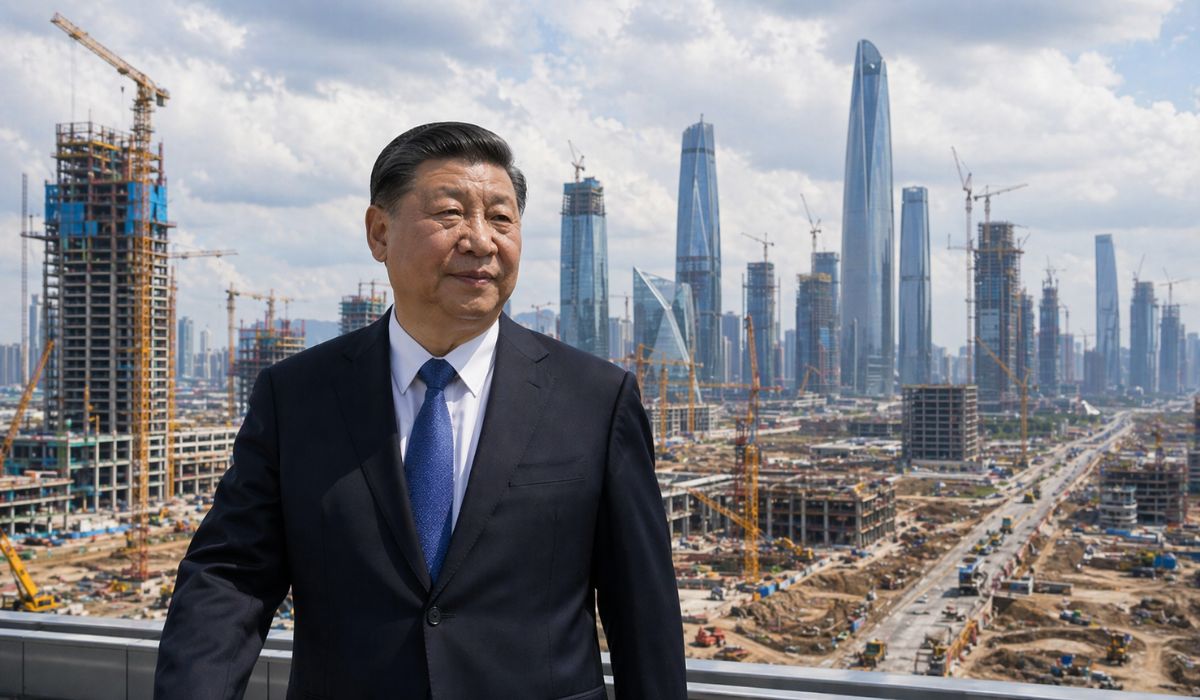
Urban project associated with Xi Jinping advances in Xiong’an with transfer of state-owned enterprises, schools, and services, as Beijing tries to redistribute functions and reduce administrative concentration in the Chinese capital in the coming years.
China’s President, Xi Jinping, called for new advances in the construction of Xiong’an, a mega-urban project under development in Hebei province, about 100 kilometers from Beijing.
The visit, held on March 23, 2026, reinforced the priority given by the Chinese government to the new area, planned to receive administrative, business, educational, and technological functions currently concentrated in the capital.
The Xiong’an New Area was designed to house state-owned enterprises, universities, financial institutions, hospitals, research centers, and innovation-related companies.
-
Chinese students build a 6.06-meter remote-controlled paper airplane, achieve a flight of almost 15 minutes, and turn a school pastime into an engineering project to attempt a world record.

-
He started with a jigsaw, his father’s screwdriver, and many drawings made during classes; years later, the young man who built a roller coaster in his own backyard went viral on the internet, was hired by Cacau Park, and now coordinates Brazilian and foreign professionals in the installation of an attraction weighing 737 tons, 55 meters high, one kilometer long, featuring moments of zero gravity and a speed of 120 km/h, in a journey that turned curiosity, calculations, and persistence into a professional career.

-
Between Egypt and Sudan, Bir Tawil is no man’s land that neither country wants on paper, but in practice has gold mining, nomadic tribes, and even fake “kings.”

-
Swimming champion Shavarsh Karapetyan dove about 40 times into a frozen lake in Armenia to rescue a sunken bus, saved 20 lives, and lost his career because of it.


According to the Chinese government, the transfer of some of these structures aims to reduce pressure on Beijing, which concentrates political, economic, and academic activities on a large scale.
During the inspection, Xi stated that Xiong’an should use “reform and innovation” as a driving force to integrate technology, industry, and urban development.
According to Reuters, the president also urged officials to have the courage to take on responsibilities and “throw themselves into implementation work,” with the goal of presenting results to the Communist Party of China and the public.
Xiong’an and China’s urban planning
Announced on April 1, 2017, the Xiong’an New Area has taken a prominent position in Chinese territorial planning.
The construction of Xiong’an has already received over 1 trillion yuan in investments, a value equivalent to about US$145 billion or more than R$730 billion.
The project is presented by the government as an initiative of national importance, alongside Shenzhen, in the south of the country, and Pudong, in Shanghai, regions associated with previous cycles of economic modernization.
The difference is that Xiong’an was launched under the direct coordination of the central leadership and with participation attributed to Xi in official Chinese documents.
State media describes the city as a long-term initiative, aimed at reorganizing urban functions in the Beijing-Tianjin-Hebei region.
Since the project’s announcement, Xi has visited Xiong’an on four occasions.
He was there in 2017, the year he obtained his second term as general secretary of the Communist Party of China, and returned in 2019, after the 2018 constitutional amendment that removed presidential term limits.
In May 2023, he conducted another inspection of the area, before the new visit in March 2026.
State-owned enterprises and public services in Xiong’an
During his most recent visit to Xiong’an, Xi visited the initial construction area, the headquarters of China Huaneng Group, and the local campus of Beijing No. 4 High School.
Huaneng, a state-owned energy company, transferred more than 1,000 employees to Xiong’an in October 2025, according to information released by Xinhua.
The relocation of public enterprises is part of an effort to move activities considered non-essential to Beijing’s role as the national capital.
Among the companies included in this process are Sinochem, China Satellite Network Group, and other state-owned enterprises managed by the central government.
Some of these structures are already operating in Xiong’an, while others are still under construction.
The educational sector is also part of the occupation strategy.
The Xiong’an campus of Beijing No. 4 High School began operations in August 2023, with support from the Beijing municipal government.
According to Xinhua, the unit had more than 380 students when it received Xi’s visit.
At the school, the Chinese president spoke with teachers and students, and also visited classrooms and the cafeteria.
The inclusion of education, health, and public service facilities aims to serve workers transferred to the new area and their families, in line with the official guidance to form a city with a permanent urban structure.


Xiong’an Development until 2035
Although construction has advanced since 2017, the central region of Xiong’an remains sparsely populated compared to the project’s planned scale.
The official plan stipulates that the city should be basically developed by 2035, focusing on green urbanization, smart infrastructure, and regional integration.
The Chinese government presents Xiong’an as part of the strategy to reorganize the Beijing-Tianjin-Hebei axis.
In this configuration, the new area is expected to host administrative, business, academic, and technological activities that currently contribute to the concentration of functions in the capital.
During the symposium held during the visit, Xi stated that Xiong’an’s main function is to absorb activities relocated from Beijing that are not essential to the city’s role as the seat of central power.
He also advocated for the active, stable, and phased transfer of state-owned enterprises, universities, and hospitals.
His speech aligns with the Chinese government’s priority to enhance innovation capacity in sectors deemed strategic.
Xi called for the early implementation of policies in science, technology, and finance, as well as the development of a business environment guided by market rules and international standards, according to the official agency.

Planned City and Relocation of Beijing’s Functions
The construction of Xiong’an takes place amidst the Chinese effort to combine urban planning, technological innovation, and regional economic reorganization.
The project allows the central government to define everything from territorial occupation to the profile of companies and institutions that should settle in the new area.
Shenzhen and Pudong are frequently cited by state media and official documents as references for urban and economic development.
Xiong’an, in turn, is presented by Chinese authorities as a city model focused on innovation, the relocation of Beijing’s functions, and planned urban management.
The comparison, however, involves different contexts.
Shenzhen grew during a period of economic opening and strong foreign investment presence, while Pudong consolidated itself as Shanghai’s financial and commercial hub.
Xiong’an largely depends on state-coordinated decisions, the transfer of institutions, and gradual occupation by companies, workers, and services.

During the March inspection, Xi stated that progress had been made in the construction of the new area and called for continued execution of the project.
He also called for improved public services, advancement in urban governance, and the adoption of smart management models.
The pace of institutional transfers, the provision of services, and the ability to attract permanent residents are expected to influence the development of Xiong’an in the coming years.





Be the first to react!