






 Portuguese
  Spanish


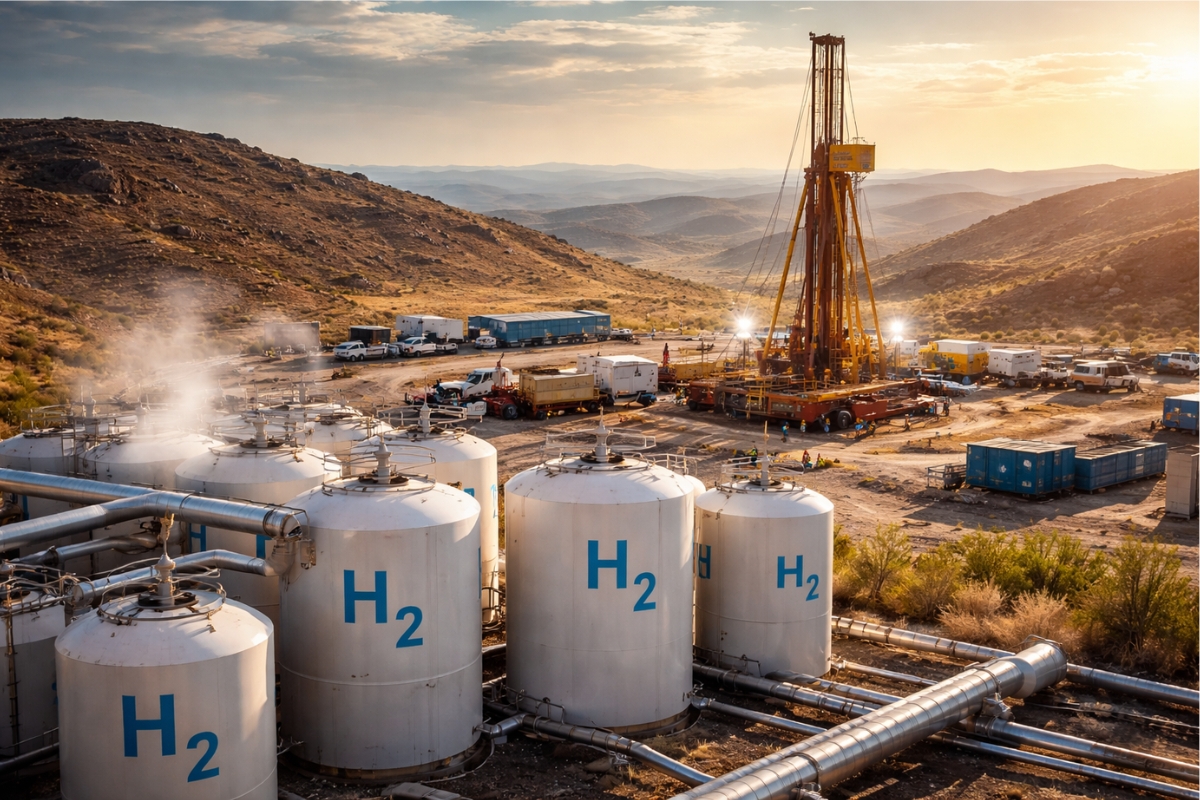


A study published in December 2024 in the scientific journal Science Advances presented the energy world with a number that challenges the imagination: the Earth’s subsurface may contain between 1 billion and 10 trillion metric tons of natural geological hydrogen, with the most likely value pointing to about 5.6 million megatons. This amount represents more stored energy than all the proven natural gas reserves on the planet and is equivalent to 26 times the total volume of known oil.
The research was conducted by geochemists Geoffrey Ellis and Sarah Gelman from the US Geological Survey (USGS), who built the first global probabilistic model to estimate this resource. The methodology combined data on the occurrence and behavior of hydrogen in the subsurface with information from geological analogs to predict where and in what quantity the gas may be accumulated.
What is geological hydrogen and why does it change everything
Geological hydrogen, also called natural, white, or golden hydrogen, is produced by spontaneous chemical reactions between water and iron-rich minerals deep in the Earth’s crust. This process, known as serpentinization, occurs continuously: unlike oil, which formed over millions of years and does not renew, natural hydrogen is being produced now, bringing it closer to a primary renewable source.
-
Brazilian scientists are simultaneously advancing two research projects on clean hydrogen and driving solutions that could transform the energy matrix, enhance industrial competitiveness, and accelerate large-scale emission reduction targets.

-
Advancement in renewable energy: A R$ 150 million project launched by Petrobras and Finep aims to create state-of-the-art electrolyzers for green hydrogen, strengthening national research and preparing Brazil to compete in a billion-dollar energy market.
-
Illiterate or semi-literate grandmothers were trained to repair solar systems, open rural workshops, and light up homes that still depended on kerosene.
-
The world has bet on green hydrogen as the fuel of the future, but now faces the side effect: producing 1 kilogram requires about 9 liters of ultrapure water, and the largest projects on the planet are precisely in the driest regions of the Earth, where water is already scarce for people.





The competitive advantage is direct. Green hydrogen, produced by electrolysis of water with renewable energy, requires large amounts of electricity and expensive equipment. Blue hydrogen, obtained from natural gas with carbon capture, still generates indirect emissions. Geological hydrogen, in contrast, does not require external energy to be produced — it is there, generated by the Earth itself, waiting to be found and extracted.
The study that quantified global potential
According to the published model in Science Advances, the most likely value for the global in-place reserves of geological hydrogen is approximately 5.6 million megatons. Although most of it is likely impractical to recover, a small fraction — on the order of 100 thousand megatons — would be sufficient to meet the projected hydrogen demand necessary to achieve net-zero carbon emissions for about 200 years.
To contextualize the scale, the researchers point out that the energy contained in this accessible fraction is equivalent to approximately 1.4 × 10¹⁶ megajoules — more than double the energy stored in all known proven natural gas reserves in the world. Ellis, the lead author of the study, was straightforward about the practical implication: “With natural hydrogen, you can simply open and close a valve when you need it” — no power plants, no electrolysis, no intermediate industrial processes.
The gold rush that has already begun
The publication of the study accelerated movements that were already underway. Koloma, an American startup based in Denver, founded in 2021, has become the epicenter of this race. The company has raised over $305 million since its founding, with investors including the Breakthrough Energy Ventures fund, created by Bill Gates in 2015, the Amazon Climate Pledge Fund, United Airlines, and Khosla Ventures. Gates’ fund also counts among its supporters names like Ray Dalio from Bridgewater Associates and Richard Branson from the Virgin Group.
Koloma operates in the model of the oil and gas industry: drilling exploratory wells in the Midwest of the U.S., primarily in Kansas and Nebraska, in search of commercially viable accumulations of geological hydrogen. Pete Johnson, CEO and co-founder of the company, summarized the thesis: “We can use the expertise and service providers that traditionally serve the oil, gas, and mining industries and quickly put them to work in discovering carbon-free resources.”
The startup is not alone. About 50 geological hydrogen companies are operating globally, including independent explorers, equipment manufacturers, and oil and gas conglomerates funding research, according to consulting firm BNEF. The Australian mining giant Fortescue spent $22 million to acquire 40% of HyTerra, based in Australia and also operating in Kansas. In Europe, the company Getech is prospecting deposits in Morocco, Mozambique, South Africa, and Togo.
The position of Brazil and Petrobras
Brazil has concrete reasons to closely follow this race. Petrobras announced an investment of R$ 20 million in research on the processes of generation and feasibility of extracting natural hydrogen in the country, with work starting in October 2023, initially in the state of Bahia, with plans to expand to other states. The company has been training its technical staff since 2022 and held the first Natural Hydrogen Workshop at the Research Center (Cenpes) in 2024, bringing together Brazilian and international experts.
The geological context of Brazil is favorable. The country has vast stretches of iron-rich rocks, including the deposits of Serra dos Carajás in Pará and the formations of the Iron Quadrilateral in Minas Gerais — exactly the type of substrate where the serpentinization process occurs. Petrobras, with decades of experience in exploring deep sedimentary basins, has the technical infrastructure and geoscientific knowledge to apply the same oil and gas prospecting tools to the search for geological hydrogen.
Geologist Igor Viegas from Petrobras confirmed that the topic has become part of the company’s strategic planning: “Since 2021, we started looking at various possibilities and geological hydrogen emerged as one of the main ones on our list.”
The challenges that still need to be solved
The euphoria of investors faces technical and economic obstacles that the researchers themselves acknowledge. Most of the hydrogen is likely at depths inaccessible with current technologies, far from the coast or in accumulations too small for economic exploration. There is still no established market for geological hydrogen, which creates a classic dilemma: supply does not develop without demand, and demand does not grow without supply.
There is also the issue of hydrogen as a molecule: being the smallest element on the periodic table, it easily escapes through fissures in rocks and conventional pipelines. Detection, containment, and safe extraction still require technological advancements that do not exist on a commercial scale.
The U.S. Department of Energy has set a goal for the sector to reduce production costs to $1 per kilogram — a threshold that would make geological hydrogen competitive with all other sources. Koloma and his competitors have not reached that point yet, but billions in private investment and government grants — including $20 million from the U.S. Department of Energy for research to stimulate geological production — are accelerating the path.
A new frontier, not an immediate replacement
The study in Science Advances does not promise an immediate energy revolution. It quantifies immense potential and demonstrates that in-depth research is justified — but explicitly acknowledges the uncertainty in the estimates, which vary by ten orders of magnitude depending on the assumptions made.
What has changed is the perception of the sector. Analysts from the consulting firm Rystad Energy describe the current pursuit as a “white gold rush”, referring to the nickname for geological hydrogen. The comparison to Spindletop — the oil well in Texas that, in 1901, ushered in the modern oil era — circulates among experts as a real possibility, not an exaggerated metaphor.
For the oil and gas industry, the irony is strategic: the same drilling techniques, the same geological models, and the same professionals who built the global fossil fuel infrastructure over 150 years may be the protagonists of the transition to the energy that promises to replace them.









