






 Portuguese
  Spanish
  5 min of reading
  0 comments


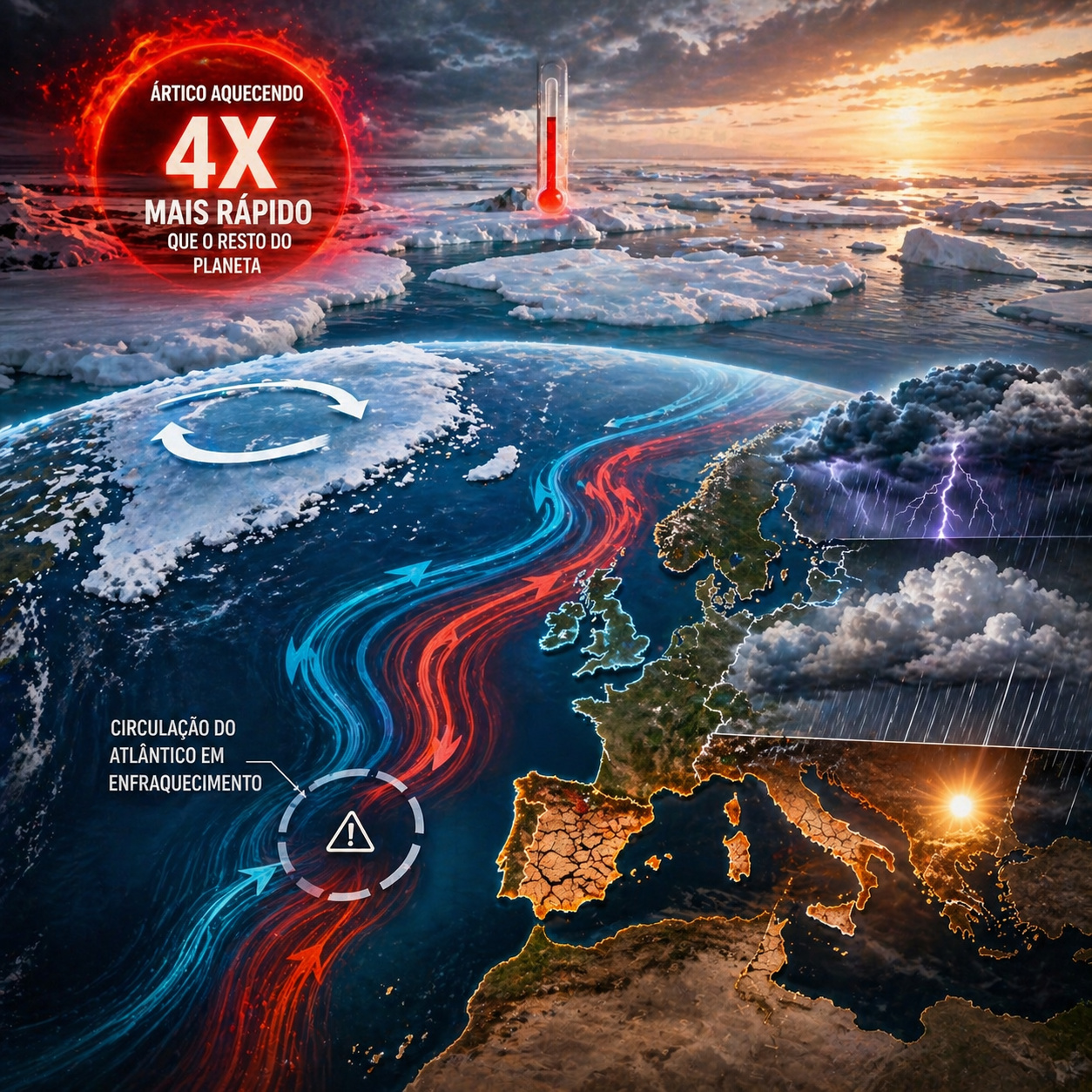
Accelerated Arctic warming and signs of AMOC weakening could alter the climate of Western European countries.
In 2024, the Arctic Report Card from the National Oceanic and Atmospheric Administration, published on November 14, reinforced a warning already supported by recent scientific studies: the Arctic is warming at a much faster rate than the global average, with analyses indicating warming about three times greater since 1980, while a study published in Communications Earth & Environment, from Nature, showed that between 1979 and 2021, the region warmed almost four times faster than the planet. This process, known as Arctic amplification, is linked to the loss of snow and sea ice, which reduces albedo, exposes darker ocean surfaces, and increases heat absorption, creating a feedback loop that intensifies regional warming.
The impact, however, is not restricted to the far north: according to the IPCC, the mechanisms involved include ice loss, changes in humidity, clouds, atmospheric circulation, and heat transport, factors capable of affecting oceanic and atmospheric systems connected to the global climate.
The result is not limited to the Arctic: it triggers effects in oceanic and atmospheric systems that influence the climate on a global scale.
-
Space technology used to search for water on Mars is now hunting for invisible leaks under the streets of São Paulo, using satellites, AI, and chlorine signals to help Sabesp recover up to 6.7 billion liters of water.

-
Japan sends ship to extract mud rich in rare earths at nearly 6,000 meters deep in the Pacific, attempts to lift 350 tons per day from the seabed, and transforms sediments near Minamitori Island into a strategic weapon to reduce dependence on China.
-
Venus Aerospace promises a rotating detonation hypersonic engine that takes the Stargazer to Mach 9 and crosses oceans in 1 hour, but the flight that made history barely surpassed the speed of sound.

-
Brazilian student creates a cheap formula that makes plants grow up to 90% faster and wins an award in a global scientific competition.




Melting ice injects freshwater into the North Atlantic and alters oceanic balance
One of the most relevant effects of this warming is the increased melting in Greenland and Arctic regions, releasing large volumes of freshwater into the ocean.
This water has a lower density than saltwater, which directly interferes with the mechanism that sustains oceanic circulation in the North Atlantic.


The affected system is the Atlantic Meridional Overturning Circulation (AMOC), responsible for transporting heat from tropical regions to the northern part of the planet.
This flow functions as a kind of global “thermal conveyor belt,” redistributing energy and influencing the climate of entire continents.
AMOC shows signs of weakening and raises scientific concern
Recent research indicates that the AMOC may be weakening. Studies based on climate reconstructions suggest that the system may be at one of its weakest levels in centuries or even a millennium, although scientific debate still exists regarding the intensity of this change.
This weakening is associated with a reduction in salinity in the North Atlantic, caused by the increased influx of freshwater from melting ice.
The central concern is that this process could alter the system’s balance, reducing its efficiency in heat transport.
Western Europe depends on this system to maintain milder temperatures
Countries like Portugal, Spain, France and the United Kingdom directly benefit from the Atlantic circulation.
Even though located at relatively high latitudes, these countries have a milder climate than other regions in the same geographical band.
This occurs because the AMOC transports warm water to the North Atlantic, releasing heat into the atmosphere and influencing regional temperatures.
Without this mechanism, the climate of Western Europe would be significantly colder than currently observed.
Possible slowdown could lead to regional cooling on a warmer planet
One of the most complex aspects of this phenomenon is the climatic contrast it can generate. While the planet continues to warm due to increased greenhouse gases, a significant slowdown of the AMOC could cause relative cooling in parts of Western Europe.

This does not mean a return to glacial conditions, but rather a change in the regional climate pattern, with possible impacts on temperature, rainfall regimes, and extreme events.
The scenario represents an unusual combination: global warming coexisting with localized cooling.
Global climate system functions as an interconnected network
The AMOC does not act in isolation. It is part of a global ocean circulation system that connects different regions of the planet. Changes in this system can generate chain effects, influencing climate patterns in various areas.
Changes in Atlantic circulation can affect:
- Heat distribution between hemispheres
- Rainfall regimes in tropical regions
- Frequency of extreme events
This behavior reinforces that the global climate functions as an interdependent network, where local changes can generate broad impacts.
Uncertainties still exist, but the trend of change is clear
Although data points to signs of AMOC weakening, scientists are still discussing the speed and magnitude of these changes.
Climate models indicate different possible scenarios, ranging from a gradual slowdown to more abrupt changes in extreme cases.
Even with these uncertainties, the consensus is that the system is under increasing pressure. The continuous rise in temperatures and the advance of ice melt indicate that the trend of change cannot be ignored.
Potential impacts go beyond temperature and affect economy and society
Changes in the Atlantic climate system can affect not only the environment but also human activities.
Changes in temperature and precipitation patterns can impact:
- Agriculture
- Water availability
- Infrastructure
- Energy systems
Western European countries, highly urbanized and interconnected, may face additional challenges if the climate pattern changes.

The impact of changes in the AMOC goes beyond science and enters the economic and social sphere.
Given this scenario, can the climate system that keeps Europe mild really change in the coming decades?
The accelerated warming of the Arctic, the advance of ice melt, and the signs of weakening Atlantic circulation highlight one of the planet’s most important systems.
Although uncertainties still exist regarding the intensity and pace of changes, the data indicate that the current balance is under pressure.
The question that remains is direct: to what extent will the system that keeps Western Europe milder be able to resist the ongoing changes, or are we facing a structural transformation in the North Atlantic climate?


Be the first to react!