Portuguese
  Spanish


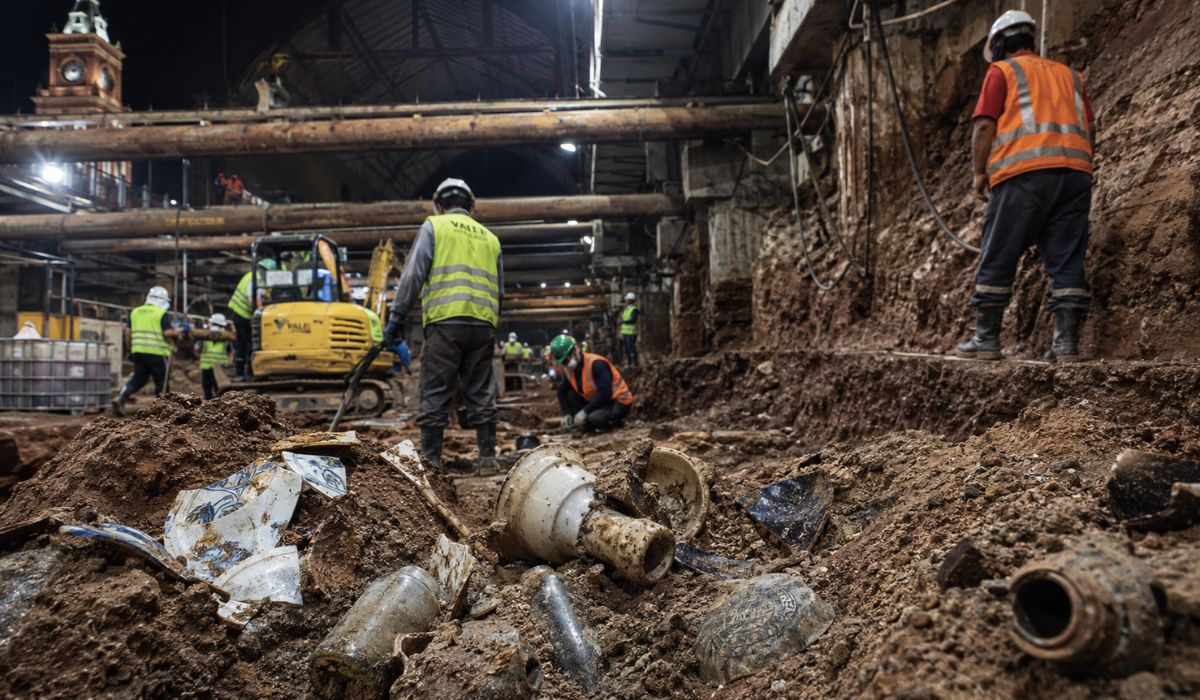


Excavations under the Luz Station revealed thousands of archaeological pieces and reinforced how mobility works can expose preserved records of São Paulo’s urban occupation.
The construction of the new Luz Tunnel, designed to improve the connection between CPTM and Line 4-Yellow at Luz Station, remains at the center of an intervention that combines urban mobility and historical preservation in São Paulo.
The project had its timeline rescheduled and is now expected to be completed by December 2026, after interferences identified at the site and adjustments in the passage’s layout, according to information released about the progress of the work.
It was during this intervention, announced in 2024, that CPTM reported the discovery of more than 6,000 archaeological artifacts buried about two meters below street level, in the Luz Station area, in the center of São Paulo’s capital.
-
400 km² of Greenhouses in Almería, Spain, Astonish American Visitor by Producing Millions of Tons of Produce for Cold-Weather Markets

-
Antarctic Volcano Emits Microscopic Gold Particles That Travel Up to 1,000 Kilometers Across the Continent
-
Little-known Japanese factory is the world’s largest zipper manufacturer, producing 7 billion pieces annually and closing half the world’s pants.

-
Brazilian Factory Recycles One-Third of the Country’s Styrofoam Waste, Matching European Levels with 51,000 Tons Reused Since 2007


The find included small objects and fragments, predominantly ceramic items, some of which are associated with over 100 years of urban history.
The discovery helps contextualize why underground works in old city areas often require specialized technical monitoring.
In regions like Luz, marked by railway stations, historic buildings, and successive urban transformations, the underground can preserve traces of periods prior to the current layout of streets and public facilities.
In the most recent information about the project, archaeological rescue appears among the factors that required rescheduling of the work.
The passage is expected to be about 125 meters long and nine meters wide, connecting the area under the platforms of lines 10-Turquoise, 11-Coral, and 13-Jade to Line 4-Yellow, and also providing a new access via Avenida Cásper Líbero.
Archaeological finds under the Luz Station
The discovery occurred in a part of the city that brings together railway stations, cultural facilities, historic buildings, and areas that have undergone successive urban transformations.
For this reason, interventions under Luz can cross layers of occupation prior to the current design of streets and transport structures.
In archaeological work, fragments of ceramics, crockery, glass, metals, and construction materials help document consumption practices, circulation of goods, waste disposal, and ways of using urban space.
These interpretations depend on the technical analysis of the objects, the soil where they were found, and the relationship between the remains and the excavation site.
In the case of Luz, the artifacts were treated as part of the archaeological heritage associated with the region.
CPTM reported that a specialized company was hired to locate, identify, remove, catalog, and store the materials found during the construction.
This procedure occurred alongside the progress of the intervention, according to the stages planned for this type of archaeological rescue.
The involvement of specialized professionals is necessary to avoid loss of context, as the scientific value of a find depends not only on the object itself but also on the position in which it was located, the depth, and other evidence present in the same section.
Why transportation works find ancient artifacts
Archaeological finds can occur in urban works, especially in central areas, old areas, or those with continuous occupation over long periods.
In São Paulo, excavations for tunnels, stations, ventilation shafts, and underground passages can reach lands that preserve remains of buildings, household objects, landfill layers, and marks of the city’s ancient uses.
Brazilian legislation provides protection for archaeological heritage.
According to Iphan, the federal agency responsible for managing this heritage, archaeological assets are protected by the Federal Constitution and Law No. 3.924, of 1961.
The regulation establishes that archaeological or prehistoric monuments and their elements are under the custody and protection of the public authority.
As a result, materials of this type cannot be discarded during construction.
When a discovery is identified, the occurrence must be reported to the competent authorities, and the area requires a technical evaluation.
From this process, the remains are recorded, analyzed, and sent for appropriate storage, according to preservation requirements.
In the Luz Tunnel, the presence of protected assets in the surroundings added stages to the progress of the construction.
Information released about the schedule indicates that the intervention underwent rescheduling due to interferences found on the site, including the archaeological rescue of the pieces and adjustments related to the passage’s layout.
What the new Luz Tunnel will be like
The Light Tunnel project envisions a passage approximately 125 meters long and nine meters wide.
The structure is expected to connect the area under the platforms of lines 10-Turquoise, 11-Coral, and 13-Jade to Line 4-Yellow, as well as include a new access via Avenida Cásper Líbero.
The purpose of the work is to better distribute the passenger flow at the station and reduce congestion in the current transfer paths.
Luz functions as one of the main integration points for rail transport in São Paulo, making any internal changes relevant for the daily circulation of users.
The deadline mentioned in the original text, however, was outdated.
The delivery forecast for the second half of 2024 no longer corresponds to the schedule released later.
More recent information on the progress of the intervention indicates that completion has been rescheduled for December 2026, after delays associated with site interferences, archaeological salvage, and project revisions.
Line 6-Orange also had an archaeological discovery
The identification of remains at Luz is not the only case recorded in metro-railway works in the São Paulo capital.
In 2023, an archaeological site was located during the works of Line 6-Orange of the São Paulo Metro, in an area related to a ventilation shaft and emergency exit on Rua Senador Felício dos Santos, in the Liberdade neighborhood.
The site was named Sítio Lavapés, in reference to the ancient stream associated with the region.
At the time, archaeologists identified fragments of pottery, glass, construction material, polymers, metals, and other remains that can be attributed to the 19th and 20th centuries, according to information released at the time.
Cases like this show how underground works can record evidence of earlier periods of the city.
In central areas, channeled streams, demolished buildings, landfills, and changes in the urban layout have altered the visible landscape, but part of these records may remain preserved below the streets.
Urban archaeology works precisely with this type of material evidence.
By gathering objects, fragments, and contextual data, researchers can produce information about lifestyles, economic activities, people circulation, and territorial transformations that do not always appear in written documents.
Destination of the pieces found in the CPTM work
The pieces located in the Luz work were sent to an institution responsible for curation and conservation, according to the information released about the case.
The name of the institution, however, was not securely identified in the sources consulted.
Before any public exhibition, archaeological materials usually undergo stages of cleaning, classification, cataloging, technical analysis, and proper storage.
This process allows for the preservation of artifacts and the organization of necessary information for future studies.
Not every item found in excavations is displayed in museums.
Some materials may remain in technical reserves, laboratories, or storage institutions, where they are available for research, specialized consultation, and long-term preservation.
In the case of Estação da Luz, the findings add new material records about a region linked to the railway history and urban expansion of São Paulo.