Portuguese
  Spanish


The aurora borealis may gain unusual visibility in the United States tonight, when a coronal mass ejection launched by the Sun is expected to increase solar activity as it interacts with Earth’s magnetic field. The forecast indicates a geomagnetic storm G1 to G2, with a chance of a greenish glow in the northern United States.
The aurora borealis may appear in parts of 19 states in the United States on the night of this Monday, June 29, 2026, if the predicted geomagnetic activity is confirmed and the sky is clear. The phenomenon is of particular interest to observers in the northern part of the country, where the lights are more likely to appear near the horizon.
According to The Daily Galaxy, the alert involves a coronal mass ejection launched by the Sun, which is expected to approach Earth and interact with the planet’s magnetic field. According to the forecast cited by NOAA, the activity may reach G1 to G2 levels, classified as minor to moderate geomagnetic storms, enough to create favorable conditions in some regions.
The phenomenon can turn an ordinary night into a rare event
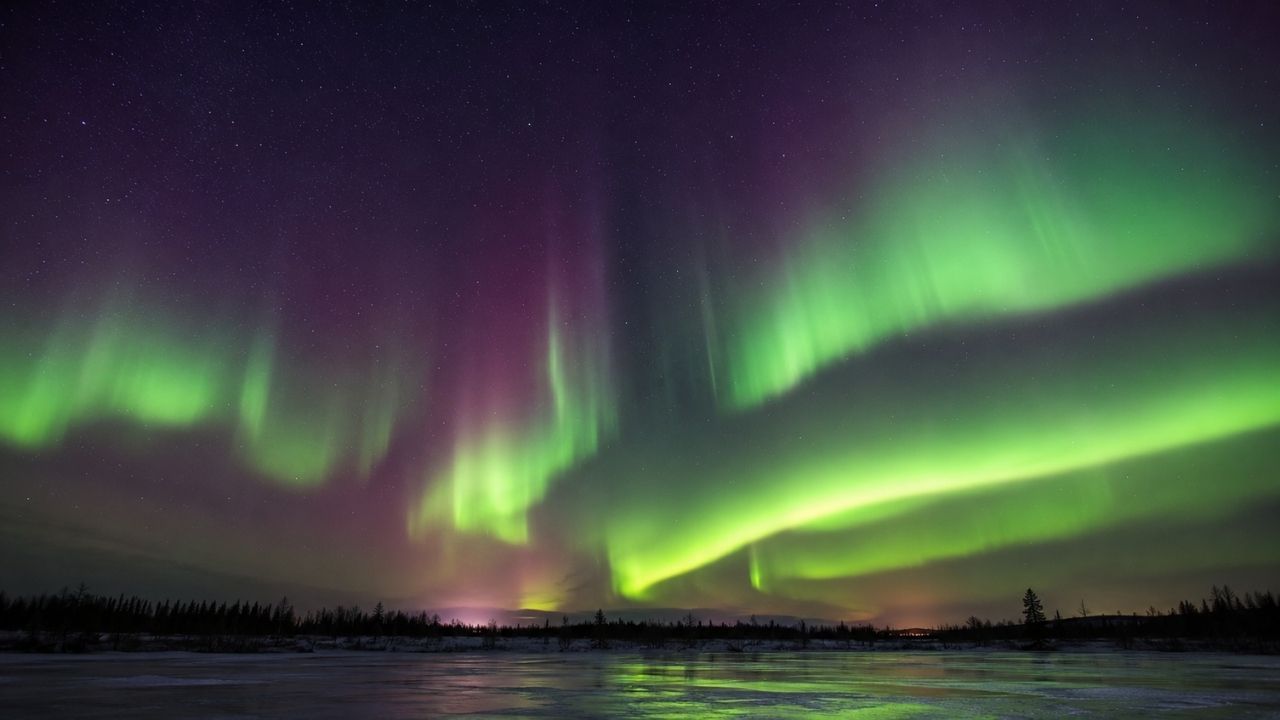
The chance to see the aurora borealis outside the regions closest to the Arctic usually attracts attention because it depends on a difficult combination of factors. It’s not enough to have solar activity: the particle cloud needs to hit Earth with adequate intensity, the magnetic field needs to favor the interaction, and the local sky needs to cooperate.
-
Energy-Efficient Upgrade: Brazilian Utility Offers Discounts to Replace Old Fridges and Bulbs with New Models in Paraná Homes

-
World’s Fastest Tractor, the JCB Fastrac Two, Hits Nearly 247.5 km/h with Over 1,000 Horsepower

-
At 86, mountaineer Carlos Soria becomes the oldest person ever to summit an 8,000-meter peak, reaching the top of Manaslu in Nepal.

-
Brazil Secures Spot in International Mathematical Olympiad as Students Excel in One of the World’s Most Competitive Selections, Highlighting Growth in STEM Education Among Young Talents




When these elements align, charged particles from the Sun come into contact with gases in Earth’s upper atmosphere and produce colorful lights. The result can appear as green bands, soft patches, or luminous curtains in the sky, especially in dark places with a clear view to the north.
The solar ejection is the trigger behind the alert
The event began when the Sun released a coronal mass ejection, also called a CME. This type of phenomenon sends magnetized plasma through space and can take days to reach Earth. Unlike a solar flare observed as intense brightness, the CME carries particles that can alter the planet’s magnetic environment.
Upon nearing Earth, this solar cloud can trigger a geomagnetic storm. In the current case, the forecast predicts levels G1 to G2, which do not represent the most severe categories but can enhance the visibility of the aurora borealis in areas further south than usual. It is a moderate situation, but with significant visual potential.
The 19 states with a chance of observation
The best opportunities are forecasted for regions near the United States-Canada border. The list includes areas north of Washington, Idaho, Montana, North Dakota, South Dakota, Minnesota, Wisconsin, Michigan, and Maine, where geomagnetic activity is usually more favorable.
If the storm strengthens for a few hours, the aurora borealis may also appear more faintly in parts of Oregon, Wyoming, Nebraska, Iowa, Illinois, Indiana, Ohio, New York, Vermont, and New Hampshire. In these locations, the glow may appear low on the northern horizon, requiring patience and good visibility.
Cell phone can reveal what the human eye cannot see
Even when the aurora borealis appears dim to the naked eye, modern cell phone cameras can capture colors that go unnoticed. This happens because photographic sensors can accumulate more light in long exposures, revealing green or reddish tones that the human eye does not always distinguish in dark environments.
For those attempting to observe, it is ideal to find a spot away from light pollution, avoid streetlights and tall buildings, and look towards the northern horizon. The darker the location, the greater the chance of perceiving some structure in the sky, even if the phenomenon appears as a subtle glow rather than intense curtains.
Full moon and summer brightness can hinder
The forecast occurs near the so-called Strawberry Full Moon, which can illuminate the sky and reduce the contrast of weaker auroras. This detail is important because the aurora borealis depends on a dark sky to stand out, especially when the geomagnetic storm does not reach strong levels.
Another obstacle is the prolonged brightness of the period after the summer solstice in the Northern Hemisphere. In regions further north of the United States, the sky takes longer to darken completely at this time of year. This can make the difference between a visible appearance and an almost imperceptible glow.
Forecast may change throughout the night
Space weather is dynamic because the actual intensity of the storm only becomes clearer when the solar cloud approaches and instruments can measure its magnetic orientation. One of the decisive factors is the behavior of the interplanetary magnetic field, especially when it favors greater energy entry into the Earth’s magnetosphere.
Therefore, the forecast for the aurora borealis may improve or weaken during the night. An initially moderate storm can yield broader images if the magnetic conditions align, but it can also frustrate observers if the solar cloud arrives with a less favorable orientation. Uncertainty is part of this type of event.
Why a G1 or G2 storm still matters
G1 and G2 geomagnetic storms are not usually associated with extreme impacts, but they are enough to attract the attention of amateur astronomers and sky watchers. In such events, the aurora borealis can expand to lower latitudes, especially when there is a clear sky, little urban brightness, and sustained solar activity.
Besides the visual interest, the episode shows how the Sun directly influences the environment around the Earth. Even a disturbance considered minor can alter observation forecasts, mobilize astronomy communities, and create rare records in places where the phenomenon does not frequently appear.
Tonight’s sky has become a window of expectation
For millions of people in the United States, the night of June 29, 2026, may offer an unusual chance to observe the aurora borealis without traveling to polar regions. Still, expectations need to be balanced: the forecast indicates possibility, not guarantee, and visibility will depend on spatial and meteorological factors.
The best strategy is to follow updates, seek dark areas, and watch the northern horizon with patience. If conditions align, the sky may reveal a rare green glow in parts of the United States. Have you ever seen an aurora borealis, or do you think this type of alert usually creates more expectation than results? Leave your opinion in the comments.