





 Portuguese
  English
  Spanish
  4 min of reading
  0 comments


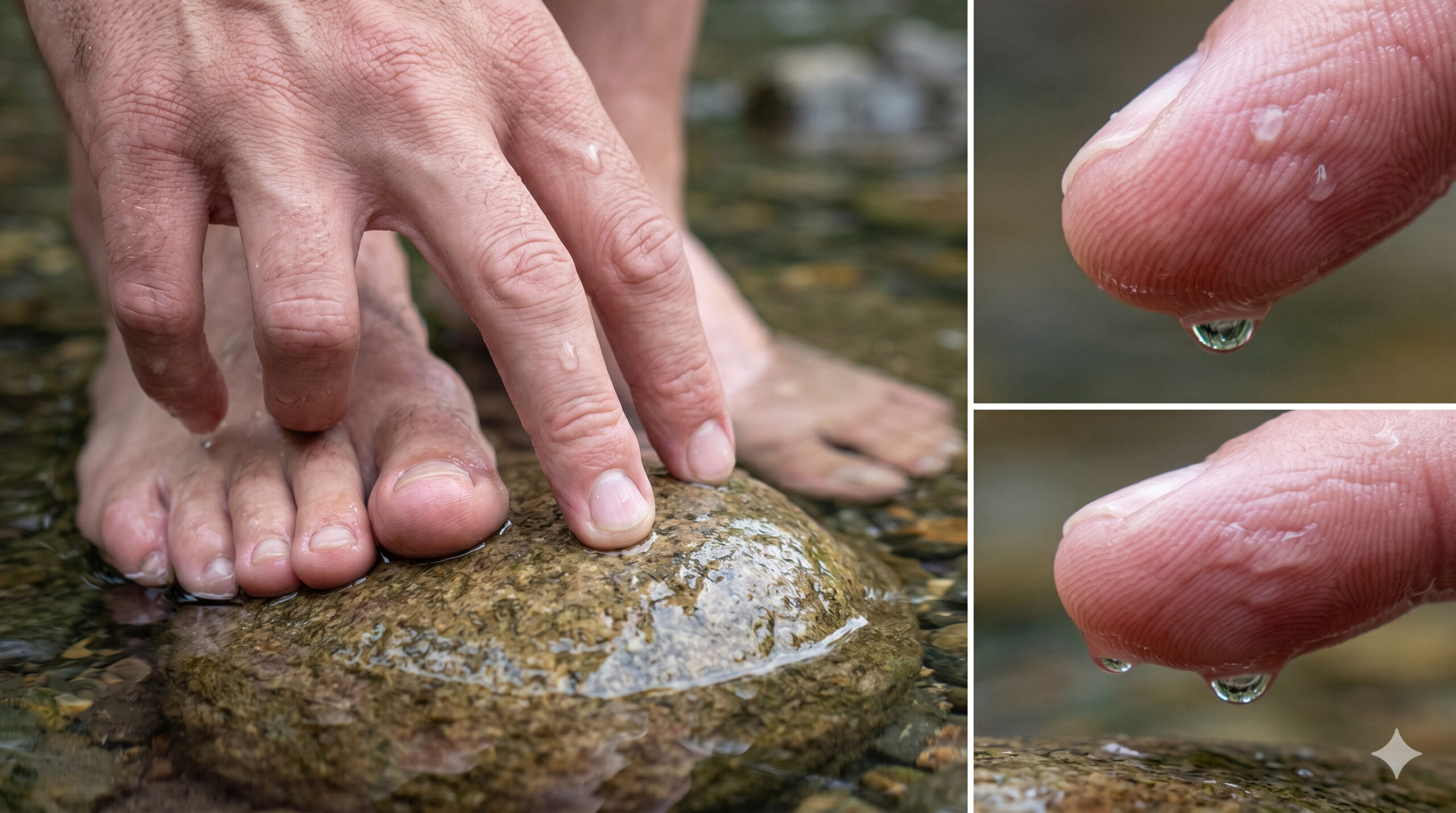
Science shows that wrinkled fingers in water increase grip and function as a natural drag system.
In 2021, a study published in PLOS One and available on PubMed Central reinforced the currently most accepted explanation for a phenomenon as common as it is intriguing: the wrinkling of fingers after prolonged contact with water. Instead of being just a passive effect of water absorption by the skin, the scientific literature describes this process as an active response linked to vasoconstriction and the action of the sympathetic nervous system.
This interpretation changed the way the phenomenon is understood by science. Instead of a simple “side effect” of contact with water, finger wrinkling has come to be seen as a functional mechanism, possibly associated with improved grip on wet surfaces and, therefore, with a potential evolutionary role.
Wrinkling does not happen due to water absorption, but due to nervous action
For a long time, it was believed that fingers wrinkled because the skin absorbed water and “swelled.” However, experiments have shown that this explanation was incorrect.
-
Wendelstein 7-X, the German machine that attempts to replicate the energy of the stars, uses 50 giant magnets to contain plasma hotter than the Sun and test a new path for nuclear fusion without fossil fuel.

-
Submarine cable project for data centers places RN among the most strategic states in the new digital economy; High-capacity international connection can boost artificial intelligence, cloud services, and technological expansion with a strong regional economic impact.

-
Santa Catarina issues a climate alert for 180 days due to the risk of heavy rains, flooding, and possible advancement of El Niño.

-
How to find rare earths on your property: University of Cambridge research creates ‘new atlas’ to help locate critical deposits of these metals




Research indicates that wrinkling occurs due to the contraction of blood vessels under the skin, a process controlled by the autonomic nervous system. This phenomenon, known as vasoconstriction, alters the structure of the skin and forms the characteristic grooves.

One of the most relevant pieces of data is that people with nerve injuries in their fingers do not exhibit this wrinkling, which reinforces that the process directly depends on neural activity.
Grooves function like tires and increase grip on wet surfaces
The most interesting aspect of the discovery lies in the function of these grooves. Experimental studies have shown that wrinkled fingers can manipulate wet objects more efficiently than smooth fingers.
The pattern formed by the skin works similarly to tire grooves, allowing water to drain and increasing contact with the surface.
In practice, this means that:
- objects slip less in the hands
- the grip becomes firmer
- there is greater control when holding wet surfaces
This effect was measured in laboratory tests, where participants with wrinkled fingers performed better when handling wet objects.
Evolutionary advantage may have helped humans survive in wet environments
The most accepted hypothesis among researchers is that this mechanism has an evolutionary origin. In natural environments, especially near rivers, lakes, or wet areas, the ability to hold food, tools, or wet surfaces could represent a significant advantage.
The temporary wrinkling of the fingers would allow the body to quickly adapt to these conditions without compromising sensitivity or skin integrity. Another important point is that the wrinkling is completely reversible.
When the fingers are no longer in contact with water, the nervous system reduces vasoconstriction, and the skin returns to its normal state. This behavior indicates that the body activates the mechanism only when necessary.
This dynamic control reinforces the idea that it is a functional adaptation, not a side effect.
Not all parts of the body show the same behavior
Interestingly, wrinkling occurs mainly at the tips of the fingers of the hands and feet. These areas concentrate a high density of nerve endings and are essential for interaction with the environment, suggesting that the mechanism is directly linked to the function of manipulation and locomotion.

Other areas of the body do not exhibit the same response pattern, even after prolonged exposure to water.
The wrinkling process is not immediate, but relatively quick. Generally, the first signs appear after a few minutes of exposure to water, depending on factors such as temperature, blood circulation, and skin condition.
This response time suggests that the mechanism has been adjusted for practical situations, where adaptation needs to occur quickly.
Phenomenon may have applications in engineering and material design
The discovery has also sparked interest outside of biology. Engineers and designers are studying the possibility of replicating this mechanism in artificial surfaces, such as gloves, tools, and high-friction materials for wet environments.
The idea of a material that automatically changes its texture upon contact with water has potential applications in various fields.
The case of wrinkled fingers illustrates how seemingly simple phenomena can hide complex mechanisms.
The human body, in this case, uses a system controlled by the nervous system to modify the structure of the skin in real time, improving interaction with the environment.





Be the first to react!