Portuguese
  Spanish


In the remote village of Punmu, 700 km from the nearest city in the Australian Pilbara, coordinator John Reudavey and volunteers welded more than 20 metal drums onto wheels and turned them into a tractor-pulled train. Creative recycling became school transportation and brought more children to the classroom.
Imagine the scene. In the middle of the red Australian desert, a group of children runs out of their homes early in the morning to climb into colorful metal barrels, mounted on wheels and pulled by a tractor. It’s not a playground ride; it’s their school transportation. In the tiny aboriginal community of Punmu, in the Pilbara, more than 700 kilometers from the nearest city, more than 20 metal drums that would have been thrown away turned into a little train that takes the kids to the classroom. The story was reported by the Australian government’s portal indigenous.gov.au.
The contraption, nicknamed the Western Desert Express, gained fame around 2016 and 2017, when the Australian press showcased what creative recycling of a humble material had done for that forgotten place on the map. Community coordinator John Reudavey and a handful of volunteers took old drums, mounted each on a metal frame with wheels, connected them all in a row, and invented an improvised school transportation. The effect went far beyond fun. The school attendance of the children increased.
A train of barrels in the middle of nowhere
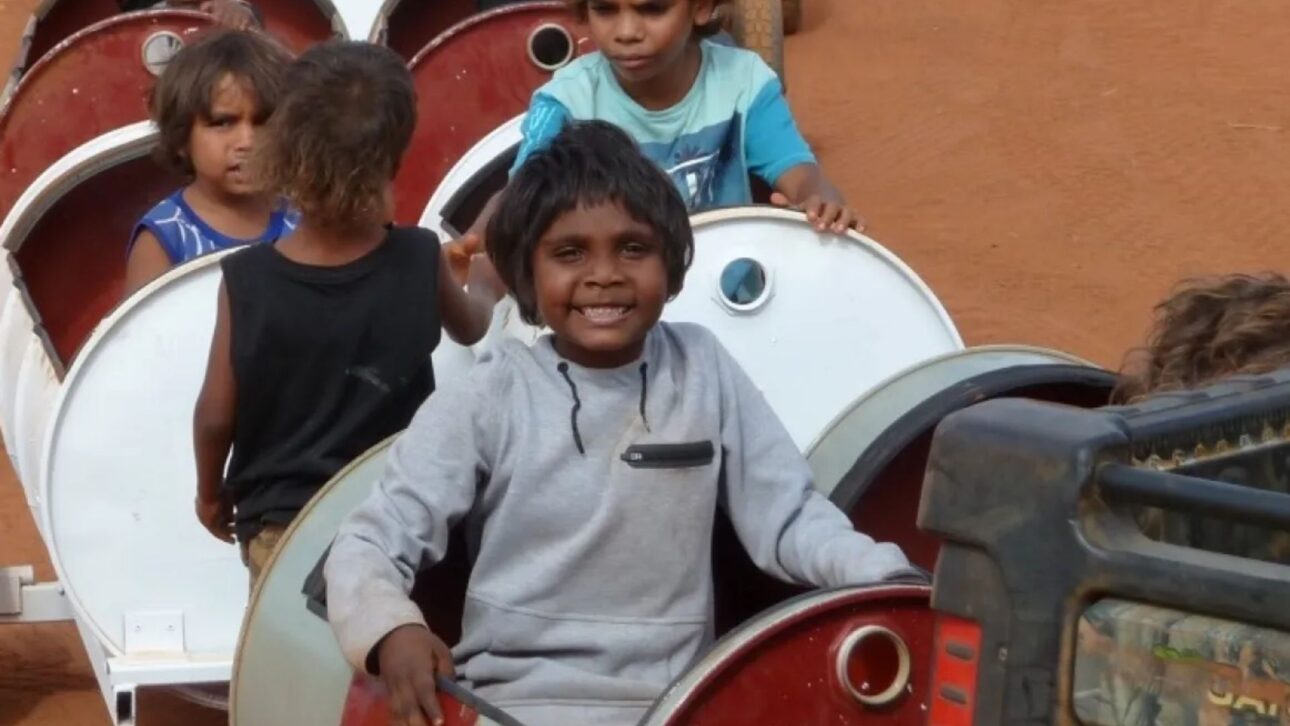
Punmu is not an easy place to reach. It is a community of the Martu people, nestled in the Pilbara, the arid and mining region of Western Australia, about 700 kilometers east of Newman, the nearest city. In such a place, with vast distances and dirt roads, getting children to school every day is no trivial task. It was from this concrete problem that the most creative solution possible was born.
-
21-Year-Old Brazilian Student Turns Homemade Popsicle Hobby into $100,000-a-Month Business

-
Australia Dumps Hundreds of Thousands of Tons of Gravel into Rivers to Restore Natural Barriers and Reverse 150 Years of Erosion

-
Bird-Inspired Robot Glides on Air Currents up to 10 m/s, Balances Itself, and Aims to Save Energy in Industrial Inspections and Meteorological Balloons
-
Eight Artists Secretly Lived in a Hidden 70m² Apartment Inside a Shopping Mall in Brazil for Four Years



The recipe was simple in idea and laborious in execution. Reudavey and the volunteers gathered more than 20 discarded metal drums, those 200-liter industrial barrels, and transformed each one into a wagon. The drums were fixed onto metal frames with wheels and suspension, linked to each other in sequence and pulled by a tractor at the front, forming a convoy that can accommodate more than twenty passengers at once.
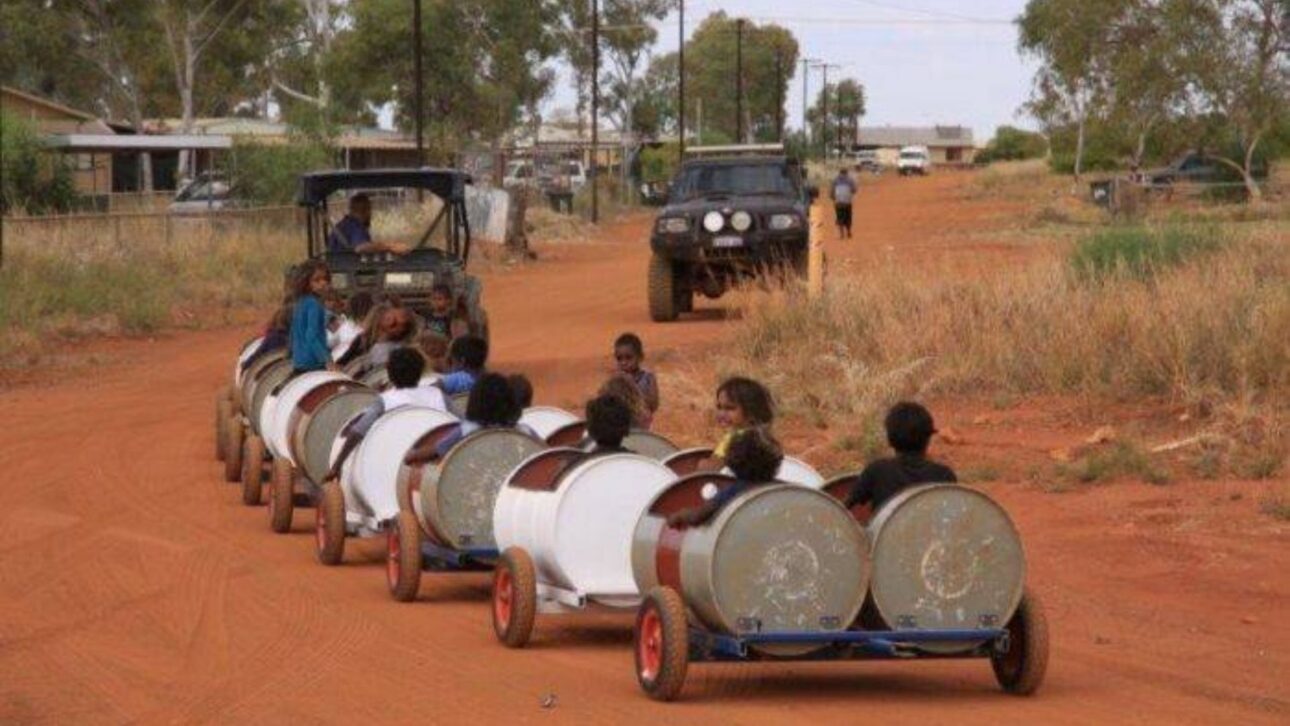
The final touch was left to the children themselves. The wagons were painted and decorated with drawings made by the kids and by residents of the aboriginal community, which gave the convoy a cheerful look and a sense of belonging to everyone there. The result is the kind of scene that seems straight out of a movie but becomes a routine at seven in the morning in that corner of the desert.
Where the Unlikely Idea Came From
The spark came from far away, on a trip. During a vacation in Perth, the state capital, John Reudavey saw a simple attraction on a football field and immediately thought of his own community. “I saw four drums being pulled by a lawnmower, and parents paid two dollars for the kids to take laps around the field,” Reudavey recounted, according to the site BrightVibes, which reported the story in detail.
What was a fairground game turned into a homemade education policy. Back in Punmu, Reudavey adapted the idea to the harsh reality of Pilbara, swapping the lawnmower for a tractor capable of handling the rough terrain. He didn’t do it alone. Volunteers Donald Graham and Peter Doery helped both in the technical assembly and in funding the project, and the entire community embraced the endeavor.
The genius lies precisely in the simplicity. There was no factory, million-dollar funding, or complex engineering project. There was a real problem, a material that was surplus, and people willing to bring the two together. This is the practical definition of creative recycling, taking what would be waste and returning it to the world with a new and useful function.
Why Specifically Metal Drums
The choice of material was not by chance. The metal drums of 200 liters are one of the most common and most resistant objects that exist. They come in large numbers from the fuel, oil, chemical, and food industries, and after being used, they usually become scrap piled up in yards. They are cheap or free, withstand rough handling, have the perfect cylindrical shape for a seat, and protect whoever is inside. For an improvised vehicle, it’s hard to find something better.
There is a beautiful irony in this story, especially because of where it takes place. The Pilbara is one of the most important mining and energy regions on the planet, land of iron, gas, and heavy machinery, exactly the type of activity that produces tons of discarded metal drums. Instead of becoming just another pile of scrap metal, these barrels gained a second life taking children to school. The waste of heavy industry became an educational tool.
This is the point that makes creative recycling more than just a trend. When an abundant and discarded material meets a real need, repurposing stops being just talk and becomes a concrete, cheap, and durable solution. The Punmu train is proof that sustainability is sometimes just ingenuity applied to what everyone throws away.
The effect inside the classroom
The most surprising thing is not the train itself, but what it caused. Once a laborious logistics, the journey to school became the most anticipated moment of the day for the kids. The enthusiasm directly converted into attendance. “Going to school has never been so fun for the students of the small and remote community of Punmu,” reported the portal indigenous.gov.au, which followed the case.
The numbers show the impact. The convoy serves about 40 children who study at the RAWA Community School, an independent school that goes from preschool to the final year, run by Sarah Mortimer. With the daily ride becoming an attraction, school attendance increased, especially punctuality in the morning. According to the same government portal, “the students’ enthusiasm for traveling in a barrel pulled by a tractor led to an increase in school attendance.”
There is even an unexpected side effect. Since the return trip is also fun, many children started staying at school all day, just not to miss the afternoon ride. A school transport made of barrels achieved what campaigns and demands do not always reach: making the school a place where the child wants to be. School attendance stopped being a problem and became a natural consequence of excitement.
Punmu is not alone: the drum becomes a vehicle worldwide


The Australian case is the most charming, but it is not unique. The old 200-liter barrel has already become a vehicle in various parts of the world, proving that ingenuity with discarded material knows no borders. In rural Thailand, for example, videos have been circulating for years of small cars made from cut and adapted barrels, creations by mechanics and farmers who solved transportation with what they had at hand.
The logic is always similar. Where money is scarce and creativity abounds, what the industry discards becomes raw material. Furniture, grills, ovens, boats, and even houses have been made from repurposed barrels, in a movement that has gained the name upcycling in English, but at its core, it’s the old art of not wasting. The creative recycling of barrels is an entire chapter of this culture.
In Brazil, those who live in the countryside or have been near a workshop are well aware of the fate of 200-liter metal barrels, which become everything from trash cans to storage tanks. The difference in Punmu was the ambition of the idea. There, the repurposing didn’t stop at small objects; it extended to the creation of a school transportation system that changed the daily life of an entire village.
What a barrel train teaches about ingenuity
The lesson from Punmu is bigger than the train. It shows that difficult problems don’t always require expensive solutions. An isolated aboriginal community without a surplus budget solved a serious education issue with old barrels, a tractor, and a lot of determination. What was lacking in resources was compensated with creativity, and the impact on the children’s lives was real and measurable.
There is also a message about waste. We live surrounded by materials that we treat as trash but still have plenty of usefulness ahead. The metal barrels of Punmu could have been rusting in a yard. Instead, they run every day full of children, supporting the school attendance of a village in the middle of the desert. When creative recycling finds a purpose, it stops being a symbolic gesture and becomes a driver of change.
In the end, the Western Desert Express is the perfect translation of an idea that seems too simple to work and yet does. Taking from the trash what is still useful, adding ingenuity and will, and transforming it into something that improves the lives of those nearby. The aboriginal community of Punmu did exactly that and became an example worldwide.
And you, would you look differently at what you throw away?
The story of this school transportation made from barrels proves that ingenuity is worth more than a fat budget. A line of discarded metal barrels, pulled by a tractor, managed to take more children to school in one of the most remote places in Australia, just because someone looked at the trash and saw possibility.
Now comes the challenge. Looking around you, what usually goes to waste in your home, at work, or in your city that could gain a second life as it did in Punmu? Share here in the comments the most creative reuse idea you’ve ever seen or had.