






 Portuguese
  Spanish
  5 min of reading
  0 comments


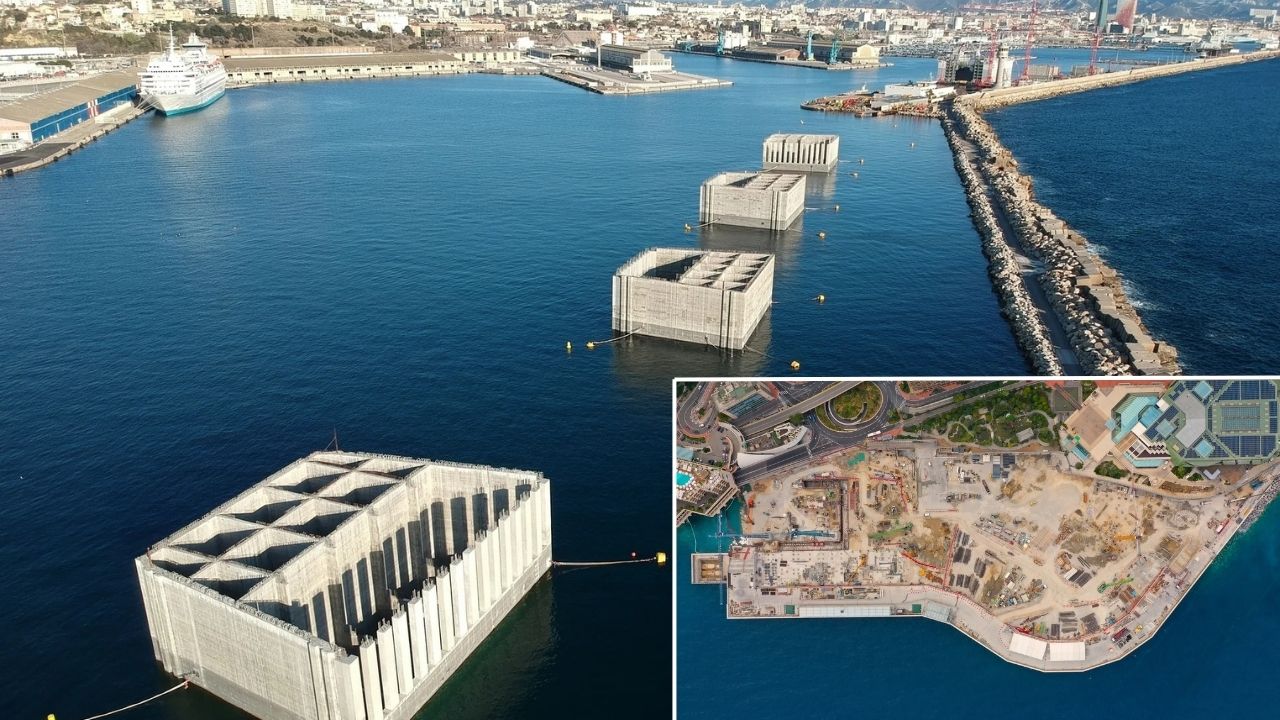
Gigantic concrete coffers were installed at the bottom of the Mediterranean to form a maritime barrier capable of supporting Mareterra, a sustainable neighborhood built on reclaimed sea areas in Monaco.
In the small territory of Monaco, where there is practically no space available for urban expansion, engineers turned to the sea to solve a historical problem of the principality: the lack of land. The result was one of the most impressive coastal engineering projects in Europe, known as Anse du Portier, also called Mareterra.
To create a new neighborhood advancing over the Mediterranean Sea, the Bouygues Travaux Publics project used 18 giant concrete coffers, each weighing about 10,000 tons and measuring approximately 26 meters in height. These structures were sunk off the coast to form a colossal maritime barrier that protects the new area built over the ocean. The development became a symbol of extreme engineering because it practically creates new land in one of the most densely populated countries on the planet.
Monaco decided to advance over the Mediterranean due to lack of physical space
The territory of Monaco is just over 2 km². With one of the highest population densities in the world and strong real estate appreciation, the principality has faced a simple and extreme problem for decades: there is practically no free space to grow. The solution found was to artificially expand the territory over the sea.
-
Bolivian Female Construction Workers Form Association to Combat Discrimination and 38% Pay Gap in the Industry

-
Near Amsterdam, residents buy land and discover they must also build streets, manage drainage, handle waste, and grow food on half their plot.
-
Brazil’s WEG to Open New Factory in China by 2027, Expanding Production of Large Rotating Electric Machines and Low to Medium Voltage Motors in Rugao

-
Chinese Shipyard Secures $1 Billion in Orders for Low-Carbon Container Ships Amid Global Fleet Renewal Efforts


The project, now known as Mareterra, added a new urban strip to Monaco’s coastline. The expansion includes luxury residences, green areas, public spaces, a marina, and coastal infrastructure built on artificial platforms. In practice, parts of the Mediterranean have been transformed into new urban territory.
18 concrete coffers form the maritime wall of the development
The structural heart of the project is formed by the so-called maritime coffers. Each unit was constructed in reinforced concrete and strategically positioned on the coast to form a gigantic barrier against the sea. According to Bouygues Construction, the coffers are about 26 meters high and approximately 10,000 tons each.
The cofferdams were not built directly on the coast of Monaco. The structures were produced in special facilities, floated across the Mediterranean, and then towed to their final location. After precise positioning, each unit was carefully submerged to form the base of the maritime expansion.
Colossal concrete protects new area against waves and maritime erosion
The main function of the cofferdams is to act as coastal protection. They absorb wave impact, reduce erosion, and stabilize the new artificial area built over the sea. Without this maritime barrier, it would be practically impossible to maintain the structural safety of the urban expansion.
Mareterra was conceived as much more than just a territorial expansion. Besides coastal engineering, the project includes high-standard residences, green areas, promenades, and sophisticated urban spaces. This has transformed the expansion into one of the most expensive and exclusive real estate developments in Europe.
New neighborhood expands the territory of one of the smallest countries on the planet
The symbolic aspect of the project is impressive. Monaco literally increased its national territory by creating a new area over the Mediterranean. Few countries in the world resort to this type of artificial territorial expansion on an urban scale.

The construction faced strong environmental scrutiny. As the region has sensitive marine ecosystems, studies were conducted to try to reduce impacts on fauna, flora, and water quality. The project also included the transplantation of marine species and continuous environmental monitoring.
Modern coastal engineering allows the creation of new land over the ocean
Maritime expansion projects have become more sophisticated in recent decades. Coastal countries and cities use dikes, platforms, landfills, and concrete cofferdams to create artificial areas intended for ports, airports, and entire neighborhoods. Monaco’s case is among the most extreme examples of this trend.
During the works, Monaco’s coastline operated as a gigantic maritime engineering environment. Cranes, tugboats, floating platforms, and concrete structures dominated the region’s landscape. The operation required extreme precision due to the limited space and proximity to densely populated urban areas.
Expansion reinforces real estate value in one of the most expensive regions in the world
Monaco has some of the most expensive real estate on the planet. Creating new urban areas in the principality means providing extremely valuable land in a real estate market with practically exhausted space. This helps explain the billion-dollar investments involved in the project.
The concrete blocks used in the project act as monumental maritime foundations. Once positioned, they create a kind of stable underwater wall capable of supporting the areas subsequently reclaimed. This technique is widely used in major port works and coastal expansions.
Project shows how far coastal cities can reshape their own shorelines
Mareterra reinforces a growing trend of artificial coastal transformation in highly valued regions. With modern technology, cities can alter entire coastlines to create new urban areas over the ocean. This raises debates about sustainability, engineering, and maritime occupation.
The expansion shows how extreme engineering can literally create new habitable areas. What was once just open sea now houses streets, buildings, gardens, and urban infrastructure. All supported by giant structures hidden below the surface.

A large part of the work remains practically invisible to those visiting the new neighborhood. The underwater wall responsible for supporting the expansion is hidden under the Mediterranean. But it is precisely this that allows the new territory to exist.
Project shows how some countries are literally building new land over the ocean
The case of Monaco seems futuristic because it alters something normally considered fixed: the national territory itself. Instead of expanding inland, the principality decided to advance directly over the sea using colossal coastal engineering.
The result is a new neighborhood built where there was once only water. Could you imagine that an entire country could increase its territory by sinking 18 giant concrete structures in the Mediterranean to create a completely new neighborhood over the ocean?





Be the first to react!