Portuguese
  Spanish


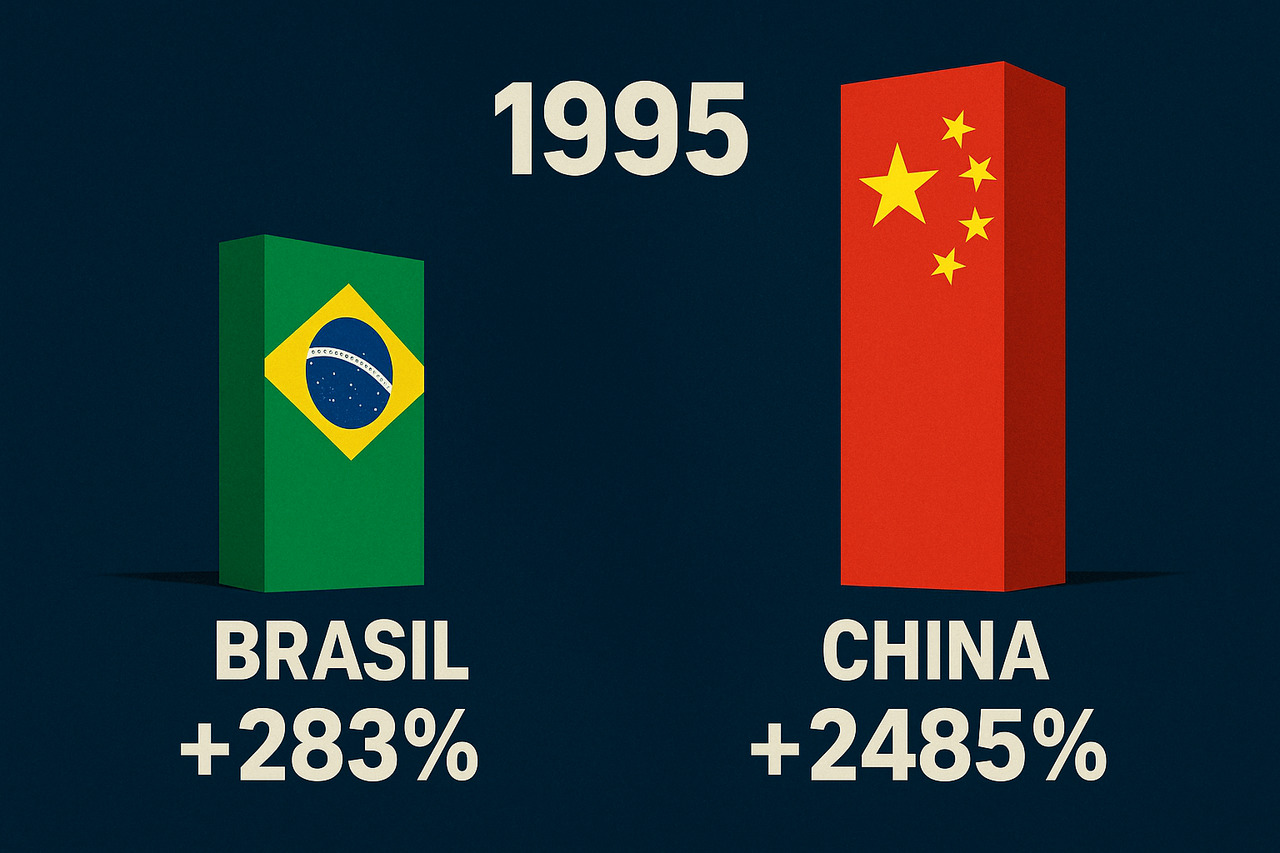


Brazil Once Had a GDP Greater Than China’s, but Lost Ground with Industrial Advancement, Defined Goals, and Focus on Education and Technology
Until 1995, Brazil’s Gross Domestic Product (GDP) was higher than China’s. That year, the Brazilian economy recorded US$ 769 billion, while the Chinese total was US$ 735 billion. It was the last time Brazil was ahead in this indicator.
Since then, the situation has changed drastically. The gap between the two countries has grown year after year. In 2024, China reached a GDP of US$ 18.27 trillion, with a growth of 5.4% in the year. Brazil, on the other hand, reached US$ 2.18 trillion, with an expansion of 3.4%.
The distance between the two countries increased rapidly. Over the last 30 years, China experienced a 2,485% growth in its GDP. Brazil, during the same period, grew approximately 283%.
-
He Left Construction, Partnered with His Wife, and Turned a Homemade Gelato Hobby into Brazil’s Largest Chain with 240 Stores and $100 Million Annually

-
Brazil Faces Caregiver Shortage Despite Having 34.1 Million Elderly, Highlighting a Major Challenge for Families
-
Brazil’s Assaí Generates $4 Billion in Quarterly Revenue, Profits $16.7 Million, Highlighting High Tax Burden

-
Former Marketing Agency Owner Thrives on Foraging for 250 Days, Sampling Over 170 Plants, and Says He No Longer Remembers Supermarkets


China: Reforms and Economic Turnaround
The transformation of the Chinese economy began in the 1980s, during the reforms led by Deng Xiaoping.
The country adopted a model of gradual opening, focused on industrialization. This path became known as “socialism with Chinese characteristics.”
Throughout the 1990s, China established itself as a global manufacturing platform. Special Economic Zones began attracting investments with tax incentives, flexible customs regulations, and less bureaucracy.
Another important moment was the country’s entry into the World Trade Organization in 2001. With this, China began following international standards and started producing goods with higher added value.
Quality and Productive Growth
A statistic that helps to understand this progress is the growth in quality certifications. In 2000, China had 25,657 ISO 9001 certifications. By 2022, this number jumped to 579,447. An increase of 2,258%.
In Brazil, the number of certifications in the same period went from 6,719 to 17,589. The growth was 262%. This means that, proportionally, China’s advancement was ten times greater than Brazil’s.
Planning and Goals
Long-term planning is another point that stands out in the Chinese model. The country adopts five-year plans with defined goals for five-year cycles.
There are also guidelines with objectives for up to 15 years, such as the sustainable growth plan until 2035.
This type of organization allows for the continuity of policies, even with changes in the scenario.
Education and Innovation
Education is a key piece of the Chinese strategy. The system has rigorous exams and strict stages, such as the Xiaokao, the Zhōngkao, and the Gaokao, which select entrants to universities.
The model trains professionals for technical areas such as science, engineering, and technology.
According to engineer Alexandre Pierro, China trains 1.5 million engineers each year. In the United States, this number is 250,000.
In Brazil, only 100,000. In doctoral studies, China also stands out: it trains 50,000 per year, compared to 700,000 in the U.S. and 15,000 in Brazil.
With this, the country invests heavily in technology and innovation. Today, it leads in areas such as electric vehicles, artificial intelligence, internet, retail, surveillance, and even space exploration.
Urbanization and Challenges
The Chinese economic growth was also driven by internal migration. The population shifted from rural areas to cities, propelled by a thriving job market.
Today, the country has 19 cities with over 5 million inhabitants.
The total population of China is 1.42 billion people. Brazil has 220 million. Despite the progress, the Asian country faces obstacles.
Population aging puts pressure on the pension system. There are also trade tensions with the United States and strong social control by the Communist Party.
Lessons for Brazil
According to Pierro, China’s progress relies on three pillars: culture, processes, and technology. The first step is to invest in people’s education.
Next, adopt management and productivity standards. Finally, develop technology to scale results.
With information from Carta Capital.