Portuguese
  Spanish


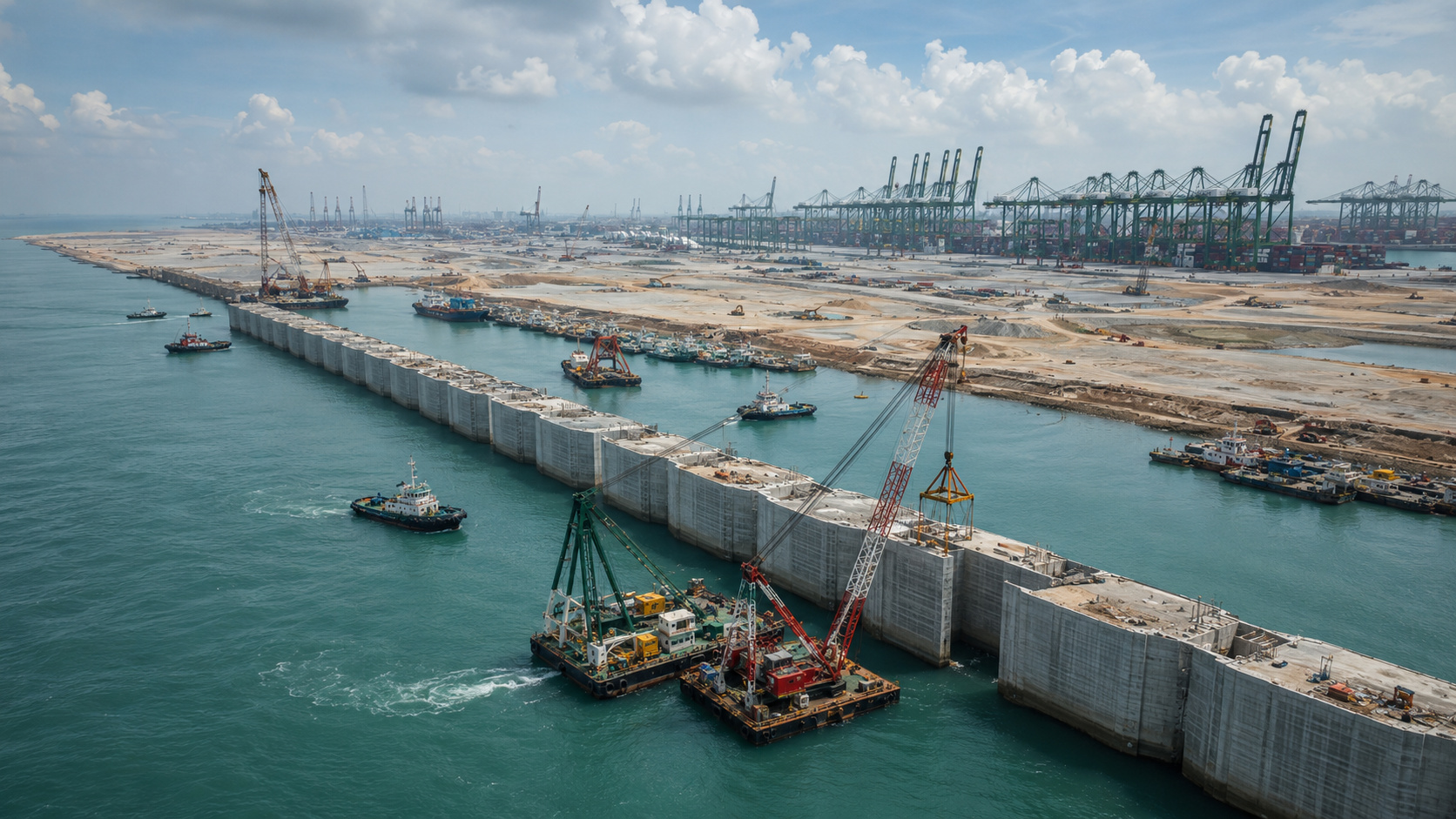

Tuas Port uses hundreds of concrete caissons to create a megaport capable of handling 65 million containers.
On the west coast of Singapore, Tuas Port is transforming the Asian coastline into one of the planet’s largest logistical undertakings, with a port project planned to concentrate the country’s container operations in a single highly automated complex. According to the Maritime and Port Authority of Singapore, in an official publication from July 4, 2019, the second phase of the endeavor involves the construction of an 8.6-kilometer quay structure, formed by 227 concrete caissons manufactured on-site, within the project’s largest land reclamation stage, spanning 387 hectares.
The scale of Tuas Port explains why the project has come to be treated as a showcase of extreme maritime engineering. Singapore’s port authority reports that, when fully completed in the 2040s, the complex will have the capacity to handle 65 million TEUs per year, almost double the 37.5 million TEUs recorded by the country in 2021, in addition to occupying approximately 1,337 hectares, having 66 berths, and 26 kilometers of quay to receive some of the world’s largest container ships.
The most impressive detail lies in the structures submerged in the sea to support this expansion. According to the Maritime and Port Authority of Singapore, cited by Dredging Today on May 26, 2022, the 227 caissons of Phase 2 are about 10 stories high and form 9.1 kilometers of seawall; The Straits Times reported on July 5, 2019, that each structure weighs approximately 13,000 tons.
-
Couple Converts 1925 Detroit Bank into Home, Earns $40,000 Annually on Airbnb

-
Tired of Seeing People Sleep in the Cold, London, Canada Opens First Modular Shelter for Homeless with 60 Cabins, Heating, Meals, and Dog Area
-
Brazil’s $1.3 Billion, 870-Meter Immersed Tunnel to Be Latin America’s First of Its Kind, Featuring Special Public Facilities and Information Center
-
Brazilian Innovator Develops Concrete Blocks from Recycled Plastic, Eliminating Mortar and Reducing Construction Costs


227 concrete caissons form a 9.1 km seawall over the sea
One of the most impressive elements of the project is the maritime containment system. According to the Maritime and Port Authority of Singapore, the expansion uses 227 gigantic concrete caissons to form approximately 9.1 km of seawall.

These structures function as enormous hollow blocks positioned along the coast to create artificial areas protected against the forces of the ocean.
The caissons used in Tuas are impressive in their dimensions. Each unit is tens of meters high, comparable to buildings of approximately 10 stories.
Once positioned in their final location, they are partially filled with ballast materials to ensure stability on the seabed.
Megaport aims to concentrate maritime operations spread across Singapore
Tuas Port is part of a national logistical reorganization. Currently, Singapore operates different port terminals spread across the city-state. The idea is to concentrate a large part of these operations in Tuas over the coming decades.


This should increase operational efficiency and free up strategic urban areas currently occupied by old terminals. Perhaps the most impressive number of the project is its planned capacity.
When all phases are completed, the port will be able to handle approximately 65 million TEUs per year. TEU is the internationally used unit for measuring 20-foot containers. For comparison, many of the largest ports on the planet operate below this scale.
Singapore bets on extreme automation to accelerate port movement
Tuas Port was also designed as one of the most automated ports in the world. Autonomous vehicles, automated cranes, and advanced artificial intelligence systems are part of the planned operation.
The proposal is to reduce handling time, increase efficiency, and keep Singapore competitive in global maritime trade. The growth of container ships has demanded radical changes in the world’s maritime infrastructure.
The Tuas Port was developed to receive gigantic vessels, including ships with a capacity exceeding 20,000 containers. This requires deep channels, reinforced quays, and extremely robust handling equipment.
Maritime engineering transforms part of the ocean into a new port area
A large part of the megaport area was artificially created. The concrete caissons function as barriers that allow advancing over the sea and creating stable platforms for terminals, yards, and logistics infrastructure.
In practice, parts of the ocean are being transformed into operational territory for the port. Singapore occupies one of the most strategic geographical positions on the planet for maritime transport.
The country is close to the Strait of Malacca, one of the busiest trade routes in the world. Tuas Port was designed precisely to maintain this advantage in a scenario of growing global trade and increasing vessel sizes.
Giant maritime caissons are used to withstand extreme ocean forces
The caissons used in the project must withstand intense impacts from the marine environment. Waves, currents, water pressure, and seabed movement require extremely resistant structures.
Therefore, the concrete used in these systems is designed to operate for decades under severe conditions. Automation is a central part of the project.

Intelligent systems help coordinate container movement, maritime traffic, land logistics, and loading operations. This reduces the need for manual intervention at various stages of port operation.
Port expansion is part of the global competition for maritime logistics
International maritime trade has become a strategic area of the world economy. Countries and port cities compete to receive larger ships, accelerate operations, and control global flows of goods.
Tuas Port represents Singapore’s attempt to maintain leadership in this highly competitive sector. The megaport is not being built all at once.
The project was divided into successive phases, allowing for gradual expansion of operational capacity. This helps Singapore continue operating its port system while new areas become operational.
Project combines coastal engineering, automation, and logistics on an extreme scale
Few projects in the world combine so many complex elements at the same time. Tuas Port brings together:

- heavy maritime engineering
- logistics automation
- artificial intelligence
- coastal expansion
- infrastructure for mega-cargo ships
All of this integrated into a single port platform. A large part of the goods consumed worldwide pass through gigantic ports like Tuas.
Even so, few people realize the complexity involved in the global movement of containers. Projects of this magnitude show how maritime logistics depends on colossal infrastructure operating continuously.
Singapore is creating one of the largest logistics machines ever built on the sea
Tuas Port goes far beyond a conventional terminal. The project functions as a territorial-scale logistics machine, created to operate thousands of containers daily with minimal human intervention.
Its dimension helps explain why Singapore continues to be one of the most strategic centers of global maritime trade. The 227 concrete caissons spread along the coast represent more than just maritime engineering.
They are part of an attempt to anticipate the future of global transport, increasingly automated, concentrated, and dependent on giant ships.
Ultimately, Tuas Port shows how entire countries are reshaping their coastlines to remain at the center of the world economy.
Did you imagine that hundreds of concrete structures the height of entire buildings were being sunk into the sea to create a port capable of moving 65 million containers per year?