






 Portuguese
  Spanish


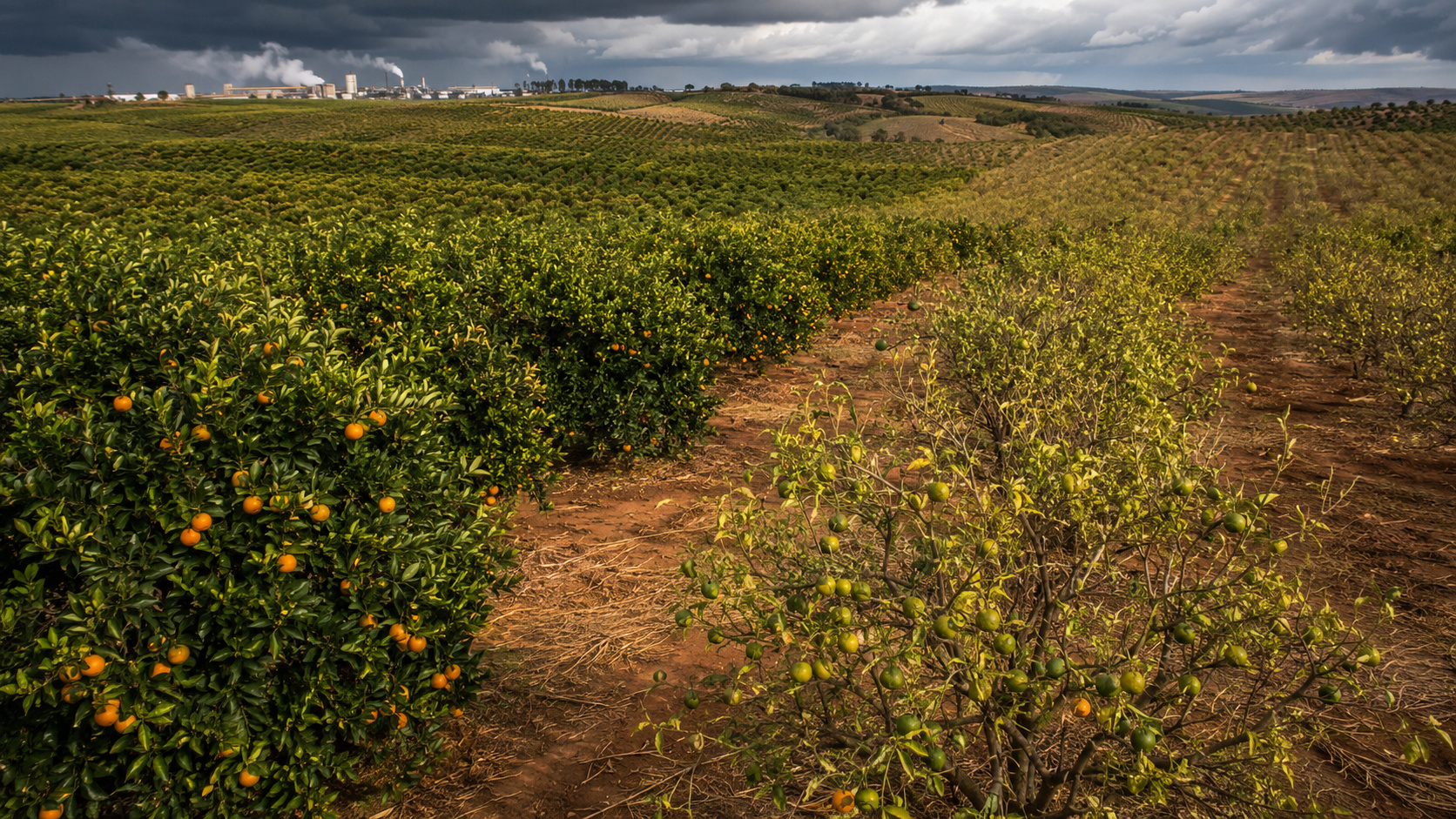
Greening advances over almost half of Brazil’s citrus belt, reduces productivity and threatens the world’s largest orange juice exporter.
The world’s largest citrus power is facing a silent crisis that has already begun to deform entire orchards in the heart of Brazilian production. Greening, a bacterial disease considered the most destructive in global citrus farming, has already affected almost half of Brazil’s citrus belt and is putting pressure on the country that dominates global orange juice exports.
Data released by Fundecitrus and published by Reuters show that the infection has reached approximately 48% of the trees in the citrus belt of São Paulo and Triângulo/Southwest Minas Gerais, the main producing region of the country. The advance occurs at a time when the United States and Europe are increasingly dependent on Brazilian production after successive crop failures in other producing countries.
Disease leaves fruits green, deformed, and unviable for the market
Greening, also known as HLB (Huanglongbing), is caused by bacteria transmitted by the Asian citrus psyllid, a small insect that spreads the disease among trees.
-
Low-Demand Brazilian Beef Offal Gains Popularity Abroad: Indonesia Purchases $19.5 Million, Boosting Revenue and Reducing Waste

-
Soy Expansion in Former Brazilian Savanna Sparks Water and Land Conflicts in Major Agricultural Frontier
-
Mexican Pest Threatens U.S. Cattle Herds at Historic Lows, Potentially Boosting Brazilian Beef Exports as Burger Prices Soar

-
Avocado Boom for European and U.S. Markets Fuels Water Crisis in Drought-Stricken Chilean Region




The effects are devastating:
- fruits become deformed
- part of the peel remains green even when ripe
- the taste becomes bitter
- productivity plummets
- the trees begin to wither


According to information compiled by Reuters and Fundecitrus, the disease compromises both fresh consumption and industrial juice production.
Brazil dominates the global market just as the disease accelerates
The problem has gained international dimension because Brazil occupies a critical position in the global orange supply chain. The country is:
- largest orange producer in the world
- largest global exporter of orange juice
- main supplier to markets like the USA and Europe
According to data from the USDA and the Brazilian citrus sector, Brazil accounts for about 70% of the global orange juice trade in some strong harvest years.
This means that any sanitary problem in the Brazilian citrus belt quickly affects:
- international prices
- beverage industries
- supermarkets
- global food chains
Almost half of the citrus belt is already infected
The number that most worries the sector is precisely the rate of disease progression. According to a survey by Fundecitrus released in 2025:
- greening has already affected almost 48% of the trees
- the infection has been growing for eight consecutive years
- some areas show even more critical levels
The affected region includes:
- interior of São Paulo
- Triângulo Mineiro
- southwest of Minas Gerais
which together form the largest citrus belt on the planet.
Brazilian production has fallen to one of the lowest levels in years
The impacts have already started to appear in the harvests. According to data cited by Reuters:
- the 2024/2025 harvest was estimated at about 230.9 million boxes
- the volume was among the lowest in recent years
- subsequent revisions reduced future projections
Even with the initial expectation of climate recovery, the advance of greening continued to reduce productivity.
Losses have already reached US$ 120 million per year
The economic impact has also become enormous. According to data cited by Reuters based on CropLife Latin America, greening causes annual losses of approximately US$ 120 million in Brazil.

The losses include:
- drop in productivity
- eradication of trees
- chemical control of the vector insect
- replanting
- increase in operational costs
Additionally, producers need to constantly monitor the orchards to remove contaminated trees before the disease spreads further.
United States also suffer citrus collapse caused by greening
The advance of the disease in Brazil is even more concerning because the same problem devastated part of Florida’s production in the United States. In recent decades:
- greening drastically reduced American production
- thousands of hectares were lost
- Florida’s orange production plummeted
This further increased the global dependence on Brazilian juice.
With less supply in the US and recurring climate issues, the international market has come to heavily rely on the Brazilian citrus belt just as the disease accelerates in the country.
Brazilian climate favors bacteria survival
Researchers state that Brazil’s climatic conditions make it difficult to control greening. According to Fundecitrus:
- high temperatures
- constant presence of the vector insect
- vast planted areas
- intense circulation of seedlings
favor the spread of the disease. Combating it requires:
- frequent inspections
- quick elimination of infected trees
- strict control of the psyllid
- constant renewal of orchards
Sector fears continuous advance in the coming years
Although Brazil still maintains global leadership in orange juice production, the continuous spread of the disease has put the sector on high alert.
The industry’s fear is that the country might follow a similar path to Florida, where greening destroyed a significant portion of the productive capacity over the years.
The concern grows because:
- global consumption remains high
- world supply has decreased
- Brazil holds a large share of the market
This makes the health of Brazilian orchards a strategic issue for the global supply of orange juice.
The world’s largest producer faces its greatest biological threat
The case of greening shows how a microscopic bacterium managed to hit the center of one of the most important agricultural chains on the planet.
Today, almost half of the Brazilian citrus belt already coexists with the disease that leaves fruits green, deformed, and unproductive.
And perhaps the most impressive point is precisely this: the country that supports a large part of the global orange juice market has entered a race against time to prevent the largest citrus region in the world from following the same path of collapse seen in other parts of the planet.





Be the first to react!