






 Portuguese
  Spanish
  7 min of reading
  1 comment


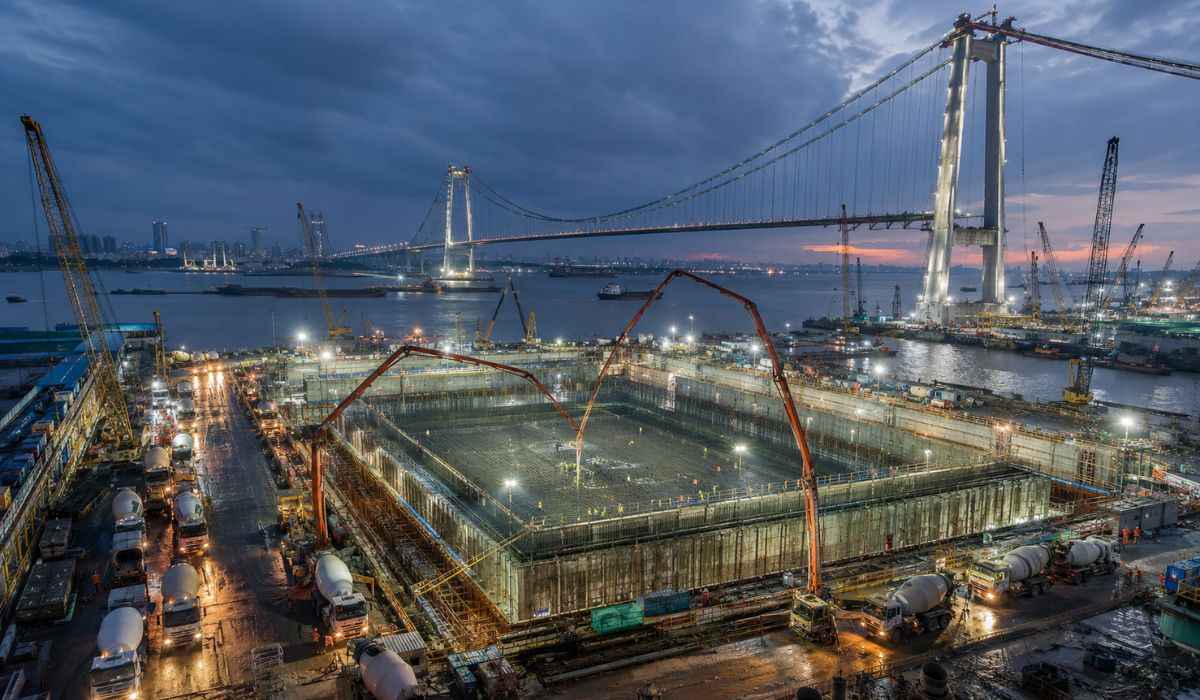


Project in China drew attention for the continuous concreting of a giant foundation over the Yangtze, a stage used to prepare the base of a planned suspension bridge with a main span of 1,600 meters.
China completed a heavy engineering stage in the construction of the Hannan Bridge over the Yangtze River in Wuhan, Hubei Province, by maintaining concrete pouring for 60 consecutive hours on the south anchorage of the structure.
According to the project managers, the operation marked the completion of the first phase of raising the foundation caisson, described by the construction company as the largest in the world in a road project.
In civil engineering, the term “caisson” does not refer to a funerary structure.
-
Without a mansion, without high investment, and without a traditional classroom, a teacher living in a 22 m² house taught students to build a 9 m² studio apartment with the equivalent of R$10,000.

-
Largest bridge in São Paulo reaches 75% completion and is expected to strengthen strategic connection in the interior of São Paulo.

-
Without her own home and pressured by rent, a 25-year-old bought a small 15-meter boat, gradually renovated the interior by herself, transformed the interior with paint, new flooring, a larger bathroom, and started living on the canals, paying much less per month.
-
Tired of seeing families sleeping on the street, São Paulo delivered 18 m² furnished microhouses and took 888 people off the streets: Vila Reencontro became the model social housing for the homeless population.


It designates a large foundation used to support bridges, pillars, or anchorages in projects built on complex soils, flooded areas, or riverbanks.
In the case of the Hannan Bridge, this base will be responsible for helping to absorb and transfer the forces generated by the main cables of the future suspension bridge.
The project envisions a road crossing with a main span of 1,600 meters, two towers, eight traffic lanes, and a steel box deck.
According to Road & Bridge International, a company linked to the state-owned China Communications Construction Company, the bridge was designed to allow speeds of up to 120 km/h and integrate the metropolitan ring road of Wuhan.
The Hannan Bridge is expected to become the 13th crossing over the Yangtze in Wuhan.
The river, considered the longest in Asia, crosses industrial and urban regions of great relevance to the Chinese economy.
Therefore, new road links over its course are usually treated by the local government as strategic projects for transportation, logistics, and regional integration.
60-hour concreting on the Hannan Bridge
The duration of the concreting is related to the size of the foundation and the technical requirements of the process.
In structures of this type, the pouring of concrete needs to follow a planned pace to reduce risks of failures between layers, control temperature variations, and maintain the stability of the piece during execution.
According to information released by Chinese media and agencies linked to the project, the south anchorage caisson measures 76.4 meters by 76.4 meters in plan and 43 meters in height.
The structure is divided into 36 internal cells, a configuration adopted to allow construction stages, sinking, and geometric control during installation.
The stage completed after 60 hours of work corresponded to one of the upper sections of the caisson.
In this phase, thousands of cubic meters of concrete were poured in a continuous operation that required regular material supply, rotating teams, and technical monitoring throughout the period.
To reduce operational risks, the responsible team reported using intelligent monitoring systems, foundation reinforcement techniques in alluvial soil, and a cantilever formwork system.
These resources were cited by the construction company as measures to monitor structural safety and foundation stability during the work.
How the Bridge Foundation Caisson Works
In suspension bridges, the main cables carry a significant portion of the deck’s weight and transmit these forces to the anchorages.
These structures need to withstand the bridge’s own weight, vehicle traffic, wind action, and natural variations in terrain and water level.
The foundation caisson acts at this point of the work.
It is built to be partially buried and serve as a base for the anchorage that will receive the cables.
Instead of functioning merely as a concrete block, the structure is designed to distribute loads and maintain the bridge’s position within the limits defined by the engineering project.
In the case of the Hannan Bridge, the execution involves constructing the caisson in stages and its controlled sinking into the ground.
This method is used in areas of alluvial terrain, such as the banks of large rivers, where the soil composition requires deeper foundations and constant monitoring of the structure’s movement.
During the descent, technical teams monitor parameters such as underground water level, soil pressure, internal stresses, and the inclination of the piece.
This monitoring allows for the correction of deviations and keeps the foundation aligned with the project, according to information released by construction-related agencies.
Bridge over the Yangtze in Wuhan
The construction of a bridge over the Yangtze requires planning due to the natural and urban conditions around the river.
In Wuhan, the crossing needs to consider navigation, vehicle flow, soil characteristics, water level variations, and connection with other existing roads.
The Hannan Bridge was planned to strengthen the connection between Wuhan and neighboring areas of Hubei province.
The complete project includes road access and is part of a strategy to expand the transportation network of the metropolitan region, according to information released by the local government.
With a 1,600-meter main span, the bridge adopts a suspension configuration to span a greater distance over the river without relying on many intermediate supports in the riverbed.
This solution is used in large-scale crossings because it allows for preserving space for navigation and concentrating part of the loads on the towers and lateral anchorages.
The structure was presented by those responsible as the largest eight-lane suspension bridge with two main cables in Hubei province.
The statement refers to the project within the regional scope informed by the authorities and the construction company.
Main towers and progress of the work
The 60-hour concreting was one of the stages of implementing the southern anchorage.
After this stage, the work proceeded to new phases of sinking, additional concreting, preparation of the towers, and execution of the upper elements of the bridge.
In May 2026, Chinese official bodies announced the completion of the two main towers of the Hannan bridge.
The north tower is 230.5 meters, while the south tower measures 228.5 meters.
The height difference was adopted to compensate for the topography of the two banks and maintain the structural alignment defined in the project.
With the towers completed, the schedule began to involve stages associated with the superstructure, such as the installation of temporary walkways, preparation of the main cables, and future assembly of the metal deck.
The forecast informed by local sources is that the bridge will advance towards opening to traffic in 2028.
Although the concreting of the caisson received attention for the execution time, most of this type of foundation will remain out of sight when the bridge is ready.
In suspension works, a significant part of the engineering is in the bases, cables, anchorages, and load control systems, not just in the visible span over the river.
Intelligent monitoring in bridge construction
The execution of the Hannan bridge caisson combined traditional foundation methods with real-time control instruments.
According to the construction company, sensors and digital systems were used to monitor the stability of the structure, the safety of workers, and the behavior of the concrete during the execution stages.
This monitoring is adopted in large-scale works to identify variations outside the expected and guide adjustments during construction.
In deep foundations, small changes in inclination, pressure, or settlement can compromise subsequent stages if not corrected within the parameters defined by the project.
Temperature control is also a sensitive point in large concrete pours.
Large masses of concrete generate heat during the curing process, and internal thermal differences can create stresses in the material.
Therefore, continuous operations of this type require planning of the mix, transportation logistics, and technical monitoring until the stage is completed.
In the case of the Hannan Bridge, those responsible also mentioned the use of a specific technique for reinforcing foundations in alluvial soil.
This type of soil is common in areas near rivers and can present variations in resistance, moisture, and composition.
The solution adopted was reported as part of the structure’s stabilization measures.
What the Hannan Bridge shows about infrastructure
The Hannan Bridge combines characteristics commonly observed in large infrastructure projects: extensive span, high-capacity traffic design, construction over a large river, and foundations adapted to alluvial soil.
These elements help explain why the cofferdam stage was highlighted by those responsible for the construction.
The size of the foundation also allows us to understand the function of the parts that do not appear in the everyday use of a bridge.
Before vehicles can cross the deck, the structure depends on bases capable of transferring loads to the ground, keeping the towers in position, and resisting the forces transmitted by the cables.
The construction is still ongoing, and there is no traffic allowed over the crossing.
Until the opening, the project must go through phases of cable installation, deck assembly, paving, testing, and integration with road access.
Each of these stages depends on the stability of the foundations already executed.
For the public, the image of a continuous concrete pour for 60 hours helps to gauge the scale of a suspension bridge even before the span is complete.







Making of a Great Engineer marvel