






 Portuguese
  Spanish
  6 min of reading
  0 comments


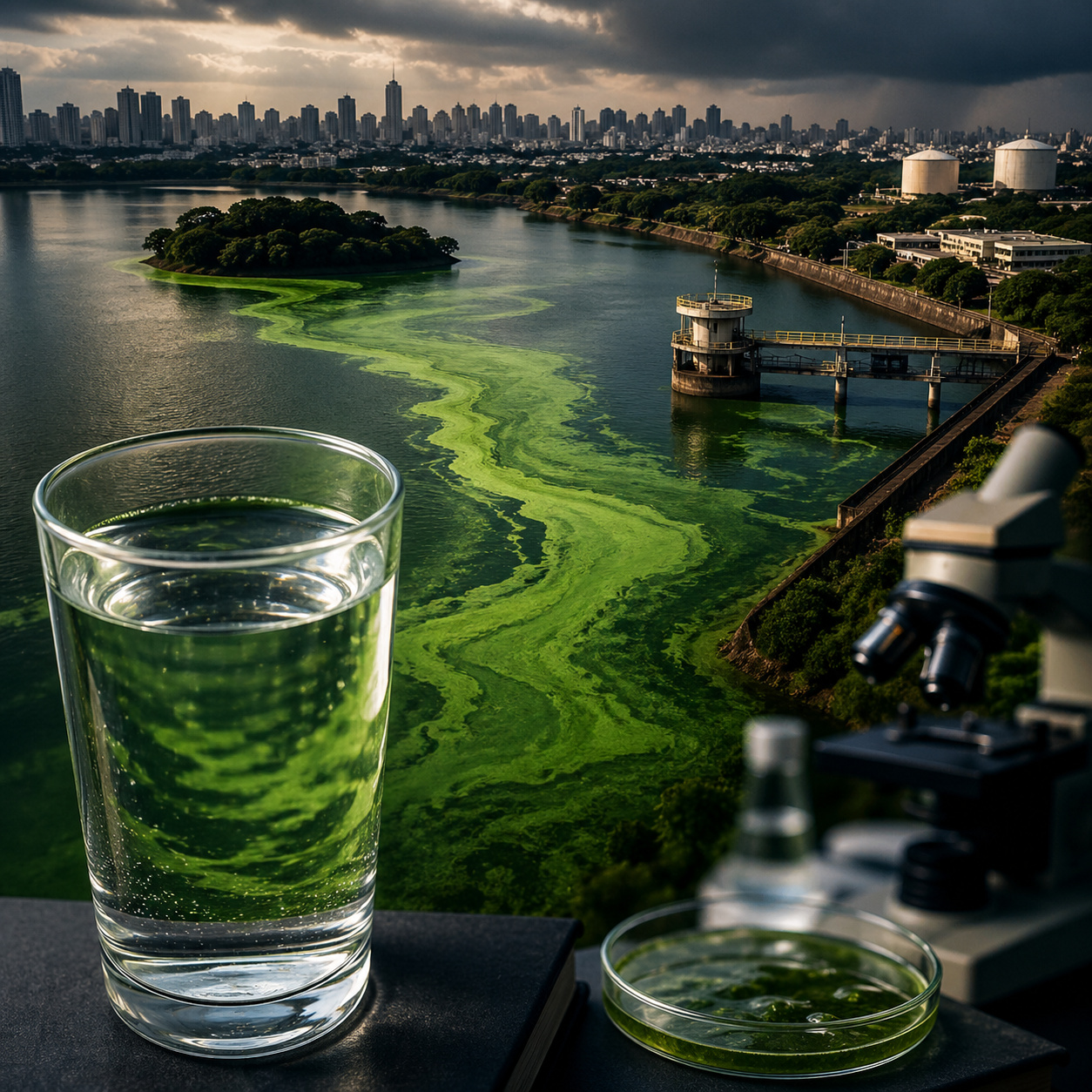
Cyanobacteria blooms advance 340% in Brazil and put the water of millions at risk, while treatment systems still do not efficiently remove toxins.
According to the Virtual Library of FAPESP, the process of proliferation of potentially toxic cyanobacteria is increasing in frequency, magnitude, and duration in Brazilian reservoirs. This advance represents a growing ecological risk and directly interferes with the ecosystem services that support public water supply, irrigation, fishing, and recreation, the multiple uses that justified the construction of large Brazilian dams.
Limnology researchers from universities, research institutes, and sanitation agencies from all regions of the country have been documenting the advancement of the problem with converging data. The diagnosis is straightforward: reservoirs that supply most of the urban population in Brazil are being progressively dominated by organisms capable of producing toxins dangerous to the liver, nervous system, and human skin, while Water Treatment Plants still predominantly operate with conventional processes that were not designed to remove dissolved toxins.
Brazil has already faced this type of systemic failure. In 1996, in Caruaru, Pernambuco, an extreme episode revealed the real risk of this process. The conditions that led to that tragedy remain present, now on an expanded scale and distributed across different regions of the country.
-
Helicopter Drops 180 Tons of Sand and Gravel on Swedish River to Revive Ecosystem Damaged by Decades of Exploitation

-
Brazilian Company Launches Retro Smartphone with 48 MP Camera, T9 Keyboard, and Privacy Features for Social Media-Free Use

-
Self-Taught Chinese Farmer Builds 5-Ton Submarine from Scrap, Launches It in Anhui River
-
Invisible Induction Technology Enables Wireless Power for Blenders, Coffee Makers, and Air Fryers, Reducing Countertop Cables





Continue reading to understand why this phenomenon has ceased to be merely environmental and has become a structural problem of supply and public health.
What are cyanobacteria and why does environmental imbalance accelerate the proliferation of toxic algae in Brazilian reservoirs
Cyanobacteria are photosynthetic microorganisms, popularly known as blue-green algae, although they are technically bacteria. They have been present in aquatic environments for billions of years and play an important ecological role in natural conditions of balance.


The problem arises when this balance is disrupted. These bacteria begin to multiply rapidly when they encounter three simultaneous conditions: elevated water temperatures, high incidence of sunlight, and excess nutrients, especially nitrogen and phosphorus. When these factors persist for prolonged periods, accelerated growth occurs, forming dense blooms that alter the color, odor, and quality of the water.
These blooms can cover large areas of the reservoir surface for days or weeks. In many cases, they are composed of species capable of producing cyanotoxins, chemical substances that pose a direct risk to human and animal health.
Why Brazil combines heat, nutrients, and hydrological conditions that favor proliferation on an increasing scale
The Brazilian territory presents natural and anthropogenic characteristics that favor this process. The tropical climate keeps water temperatures high for much of the year, accelerating the metabolism of these organisms. The high solar incidence further enhances the efficiency of photosynthesis.
Moreover, structural factors amplify the problem. The deforestation of riparian forests reduces the natural capacity to retain nutrients. Soil compaction in agricultural areas increases surface runoff, leading fertilizers directly to rivers and reservoirs. The discharge of untreated sewage completes the cycle, adding large volumes of nitrogen and phosphorus to the water sources.
This set of factors creates an ideal environment for the continuous proliferation of cyanobacteria, turning reservoirs into systems highly vulnerable to eutrophication.
The tragedy of Caruaru in 1996 and the historical warning about failures in the treatment of water contaminated by cyanotoxins
In February 1996, patients in dialysis clinics in Caruaru began to show severe symptoms, such as nausea, vomiting, abdominal pain, and jaundice. Over the following months, 52 people died.

The investigation pointed out that the cause was the presence of microcystin, a toxin produced by cyanobacteria, in the water used in the hemodialysis process. The treatment system employed was not capable of removing this substance.
This episode was the first documented case in the world of large-scale deaths directly associated with cyanotoxins in treated water. It led to the creation of specific regulations in Brazil, including potability standards for these toxins.
Despite this, the complete modernization of treatment systems did not occur at the same speed as the problem advanced.
Limitations of conventional water treatment systems in the face of dissolved toxins
The predominant model in Water Treatment Plants in Brazil follows classic stages such as coagulation, flocculation, sedimentation, filtration, and chlorination. These processes are effective in removing particles, microorganisms, and turbidity.
However, they have limitations when the problem involves dissolved toxins. If cyanobacteria cells rupture, either due to natural processes or during chlorination, toxins are released into the water and may not be adequately removed.
Microcystin, one of the most common cyanotoxins, is not efficiently eliminated by conventional methods when dissolved, requiring additional technologies such as activated carbon, ozonation, or membrane filtration.
Although these solutions already exist and are applied in some units, their adoption is not yet universal, and continuous monitoring of toxins is not standardized throughout the country.
Cantareira System exposes vulnerability between water scarcity, increased nutrients, and cyanobacteria growth
The Cantareira System, responsible for supplying millions of people in the Metropolitan Region of São Paulo, faced one of the country’s biggest water crises between 2014 and 2015.
During this period, the reduction in stored volume increased the concentration of nutrients and water temperature, creating favorable conditions for cyanobacteria proliferation. Blooms were recorded in the Jaguari and Jacareí reservoirs, precisely when the dilution capacity was lower.

Studies indicated the presence of potentially toxic species and microcystin concentrations that, at times, exceeded recommended limits for raw water. The system managed to keep treated water within legal standards, but with high operational effort, including intensive use of activated carbon.
This episode highlights a central point: reservoirs under water stress become more vulnerable to water quality degradation, increasing operational and sanitary risks.
Semi-arid Northeast gathers permanent structural conditions that favor intense and recurrent blooms
In the Northeast, the problem does not only appear in times of crisis, but as a structural condition. Reservoirs remain for long periods with low water renewal, under high temperatures and strong solar incidence.
River basins frequently show significant deforestation and insufficient sanitation levels, increasing nutrient input. Studies in states like Pernambuco show recurrent presence of toxic species in monitored blooms.
The main cyanotoxins identified include microcystins, associated with liver damage, cylindrospermopsin, with hepatic and renal effects, and saxitoxins, which affect the nervous system.
Furthermore, the geometry of the region’s reservoirs, with a large surface area and shallower relative depth, favors heat retention and nutrient concentration, creating an environment highly conducive to the proliferation of these organisms.
How agricultural fertilizers and urban sewage directly fuel eutrophication and the growth of toxic algae
The path connecting agricultural and urban areas to reservoirs is direct. Fertilizers applied to crops contain nitrogen and phosphorus, essential for plant growth. Part of these nutrients is not absorbed by the crops and ends up being transported by rain.
Phosphorus plays a critical role in this process. In many reservoirs, it is the limiting nutrient, meaning it controls the growth rate of aquatic populations. When its concentration increases, growth accelerates significantly.

Another important factor is accumulation in sediments. Phosphorus can deposit at the bottom of reservoirs and be released back into the water under specific conditions, such as increased temperature and reduced oxygen. This phenomenon, known as internal release, keeps the system eutrophied for long periods, even after external sources are reduced.
What science already knows about solutions and why the response still doesn’t match the scale of the problem
Brazilian scientific literature is clear in pointing out solutions. These include the restoration of riparian forests, the expansion of sewage treatment, continuous monitoring of cyanobacteria and cyanotoxins, and the modernization of Water Treatment Plants with appropriate technologies.
These measures are technically viable and have already been tested in different contexts. The main challenge lies in the scale of implementation and the associated cost.
The absence of integrated and continuous public policies keeps the problem expanding, while the response infrastructure advances more slowly.
The documented increase in blooms between 2010 and 2024 indicates that the current system is not keeping pace with the evolving risk. Reservoirs that supply millions of people are becoming progressively more difficult to treat, requiring greater investment, technology, and monitoring.
Caruaru was a historical warning. Current data indicate that the problem not only persists but is growing in intensity and scope.
Given this scenario, the question that remains is direct: is Brazil prepared to treat the water its own reservoirs are producing today?





Be the first to react!