






 Portuguese
  Spanish


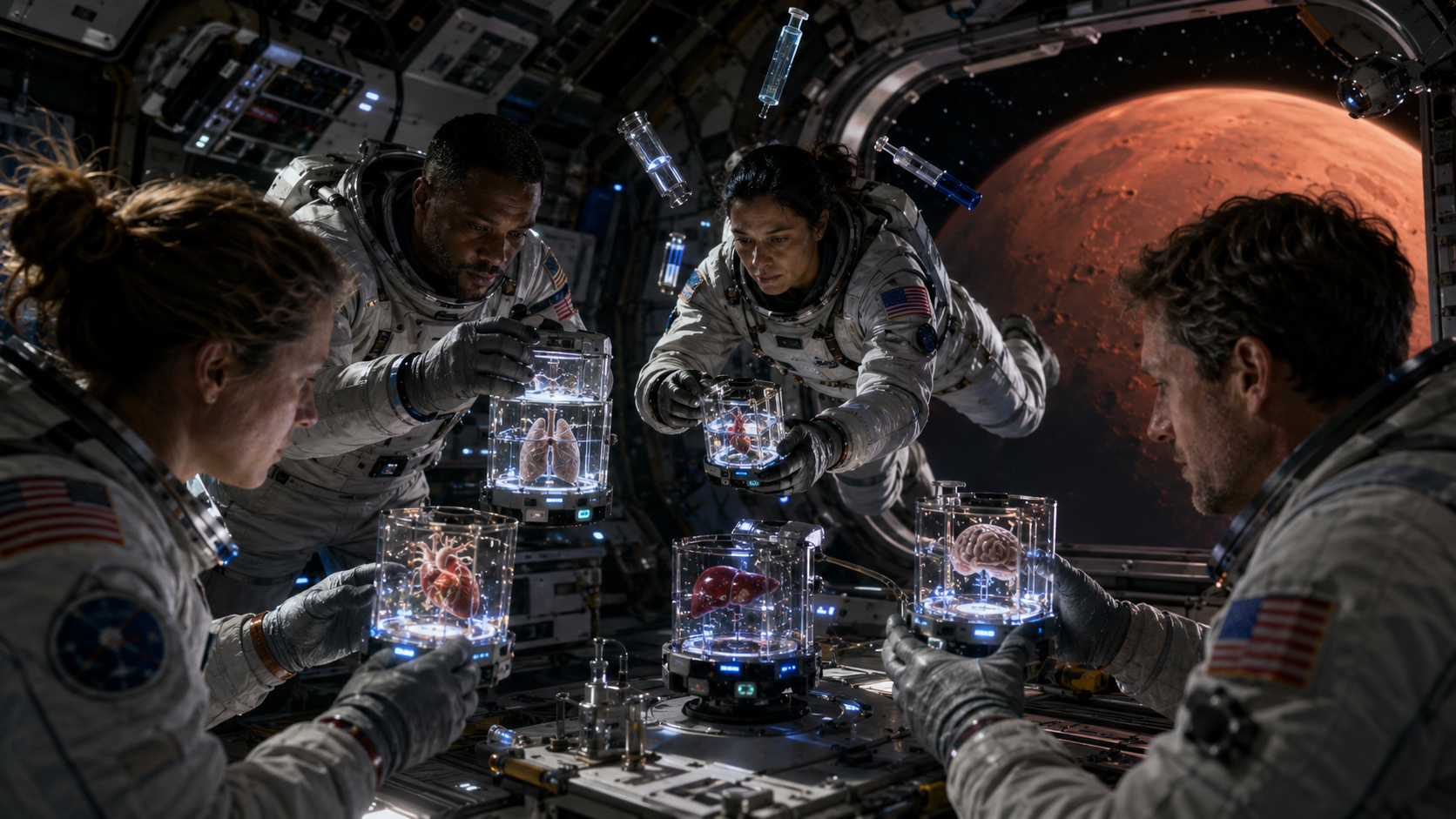

NASA sends organs-on-chips made with astronaut cells to study space radiation damage before future Mars missions.
As space agencies accelerate plans to send humans back to the Moon and, in the future, to Mars, scientists still face a critical question: how does the human body react when spending days outside the natural protection of Earth’s magnetic field, exposed to the combination of microgravity and deep space radiation? To investigate this risk before longer interplanetary missions, NASA carried the AVATAR experiment on Artemis II, an acronym for A Virtual Astronaut Tissue Analog Response, with organs-on-chips devices made from the astronauts’ own cells, according to official material released by the agency on April 8, 2026.
The project uses small chips, approximately the size of a USB drive, with human tissues grown in the lab to simulate real biological functions. In the case of Artemis II, the central focus is on personalized chips with crew members’ bone marrow cells, developed with the participation of the Wyss Institute at Harvard University and the company Emulate, allowing for comparison of tissues sent into deep space with equivalent samples kept on Earth.
According to the Wyss Institute, in a publication dated April 9, 2026, the idea is to observe cellular changes, DNA damage, and biological responses associated with radiation and microgravity.
-
China Develops Custom 140-Ton Electric Mining Truck with 770 kWh Swappable Battery, Deploys 290 Units in Xinjiang’s Largest Zinc Mine

-
Meta to Launch Arena, a New Prediction App Targeting 3.56 Billion Users, Competing with Polymarket and Kalshi

-
Scientist Challenges Famous Human Evolution Theory, Argues Homo Sapiens Evolved Gradually Over Thousands of Years
-
15-Year-Old American Builds Ocean Generator with PVC Pipe and 3D-Printed Propeller for $12, Wins National Prize, Presents at White House, and Makes Forbes 30 Under 30 List




NASA project uses living human mini-organs to investigate biological risks of future Mars missions
So-called “organs-on-chips” are microscopic devices developed to partially reproduce the behavior of real human tissues. According to NASA, these structures use living cells organized in microchannels capable of simulating circulation, nutrient exchange, and physiological responses similar to those observed in the human body.


The idea is to transform these chips into small, advanced biological laboratories, allowing observation of how human cells react to extreme environments without directly endangering astronauts during the initial stages of research. This also allows for continuous monitoring under conditions that would be extremely difficult to reproduce on Earth.
Scientists hope these models will reveal cellular changes invisible in short missions, but potentially dangerous in journeys that could last years outside Earth’s orbit.
Cells from Artemis II astronauts themselves were used to create the organs-on-chips sent into space
One of the most unusual aspects of the experiment is the use of biological material from the Artemis II mission crew members themselves. Instead of using generic lab cells, researchers produced the mini-organs with real cells from the future crew.
This allows scientists to observe biological responses much closer to what astronauts may actually face during deep space travel. In practice, researchers created microscopic versions of tissues belonging to the very humans who will be sent beyond low Earth orbit.
This approach can help identify individual differences in biological resistance, as human organisms do not respond in the same way to radiation or prolonged microgravity.
Deep cosmic radiation worries scientists because space outside Earth’s orbit is much more aggressive
In low Earth orbit, astronauts still receive some protection from Earth’s magnetic field. Outside this region, however, the scenario changes completely. Missions to the Moon or Mars face much higher levels of cosmic radiation, energetic solar particles, and extreme events from deep space.

Researchers want to find out if this continuous exposure can cumulatively damage human tissues over time. Among the biggest concerns are genetic alterations, increased cancer risk, neurological degeneration, and cardiovascular damage capable of compromising crew survival during long missions.
The problem becomes even more serious because, on a trip to Mars, astronauts could spend years away from Earth without immediate access to hospitals or complex treatments.
Microgravity has already been shown to weaken astronauts’ muscles, bones, and cardiovascular system
Previous research conducted on the International Space Station has already shown that the absence of gravity profoundly affects the human body. Astronauts can lose bone density, muscle mass, and experience changes in blood circulation after long periods in orbit.
Scientists are now trying to discover if miniature human organs also undergo structural and functional changes in continuous microgravity environments. The fear is that cardiac, neural, and pulmonary tissues may be affected in ways still poorly understood.
This is especially important because future interplanetary missions could last much longer than any human stay ever recorded in deep space.
Mini-hearts, mini-lungs, and mini-brains attempt to reveal invisible limits of human survival in space
The organs-on-chip sent by NASA include tissues that simulate the functions of the heart, lungs, brain, liver, and blood vessels. These microscopic systems can reproduce real biological responses on a small scale, functioning almost like simplified versions of living human organs.

When exposed to radiation and microgravity, these tissues can reveal molecular alterations that are extremely difficult to detect in humans during short missions. Small cellular changes observed in the chips can indicate serious risks in prolonged exposures.
In practice, these mini-organs function as a scientific line of defense before real astronauts are sent on much more dangerous journeys.
Artificial intelligence helps scientists interpret extremely complex biological signals observed in space
The experiment generates enormous amounts of data related to cellular behavior, gene expression, metabolism, and microscopic physiological changes. To analyze all of this, researchers use advanced artificial intelligence systems capable of identifying invisible patterns amidst the gigantic volume of information.
These algorithms help scientists detect early signs of biological damage before changes become irreversible. Without this automated processing, it would be practically impossible to interpret so much data simultaneously.
The integration between biotechnology, AI, and space exploration shows how future missions will increasingly depend on hybrid systems combining human biology and advanced computing.
Missions to Mars may depend more on human biology than on rocket power
For decades, space exploration was treated primarily as an aerospace engineering problem. Today, scientists are beginning to realize that the most critical limitation may not be in the rockets, but in the human body itself.
Even if it is possible to build ships capable of reaching Mars, there is still doubt as to whether astronauts will be able to biologically survive prolonged exposure to the deep space environment. Questions such as cellular degeneration, neurological damage, and cardiovascular effects remain without definitive answers.
Therefore, experiments like AVATAR are becoming strategic for the future of human space exploration.
The organs-on-chip sent by NASA may determine how far humanity will be able to travel in space
The most impressive aspect of the project is perhaps precisely its preventive function. Before risking human lives on extremely long journeys, NASA is using living human tissues to map the biological limits of space exploration.
These tiny microscopic chips can help answer fundamental questions about human survival outside Earth, including which organs suffer the most damage, which tissues can adapt best, and which risks still make deep space missions too dangerous.
Ultimately, the mini-organs sent into space may end up deciding how far humanity can go in the Universe without the human body itself becoming the greatest obstacle to space exploration.







