






 Portuguese
  Spanish
  4 min of reading
  0 comments


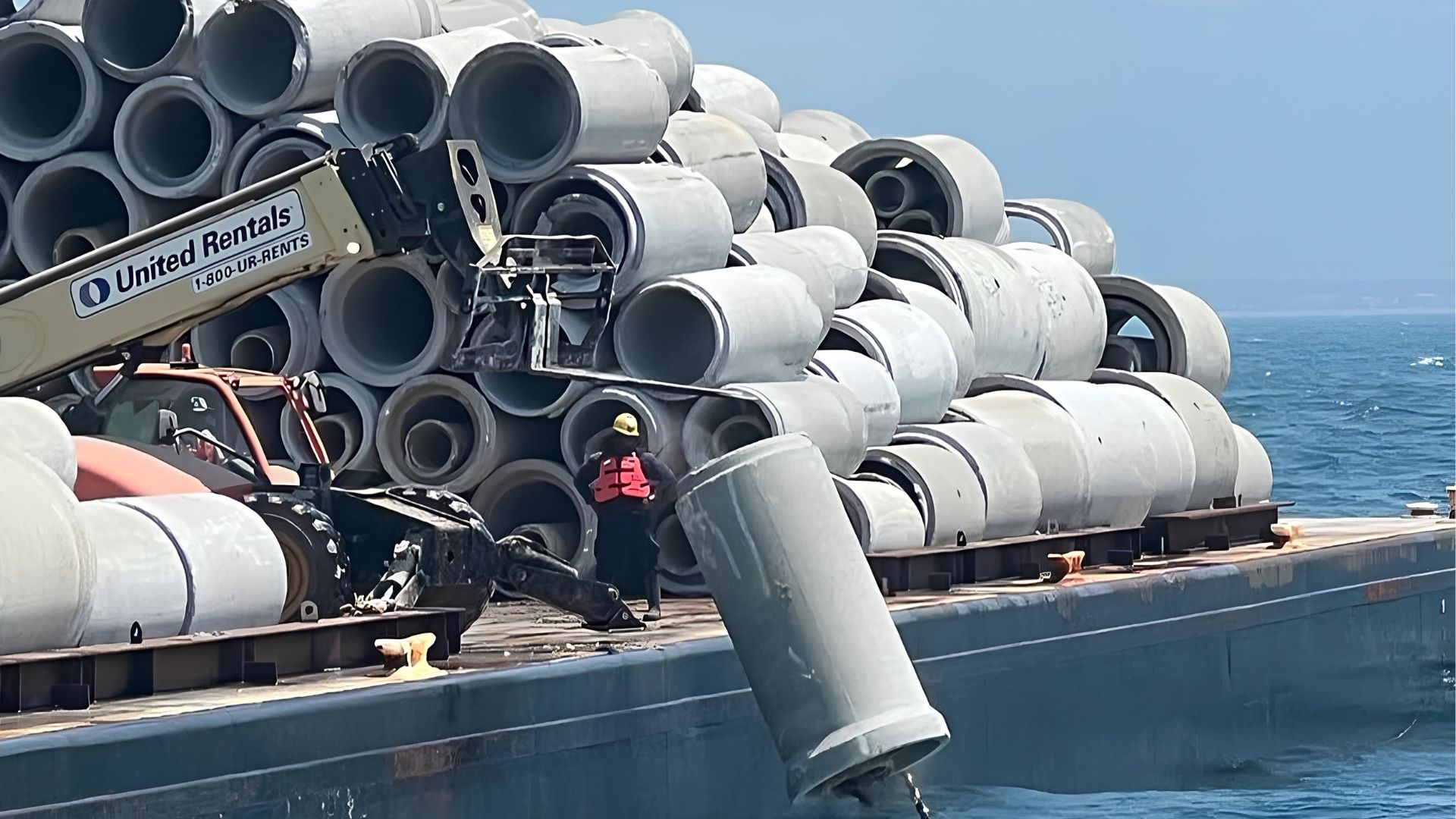
North Carolina repurposed 80,000 tons of concrete from a demolished bridge to create eight artificial reefs in the Atlantic.
One of the largest marine debris repurposing operations in the United States transformed a demolished bridge into a gigantic underwater structure distributed throughout the Atlantic. After the end of the old Herbert C. Bonner Bridge in North Carolina, the concrete from the structure was not sent to landfills or crushed as common waste.
According to the North Carolina Division of Marine Fisheries, the project used 68 barge loads to transport approximately 80,000 tons of concrete from the old bridge to eight different artificial reefs along the state’s Atlantic coast. The agency classified the operation as the largest project in the history of the state’s artificial reef program.
The demolished bridge was 55 years old and crossed Oregon Inlet
The old Herbert C. Bonner Bridge connected Hatteras Island to the rest of the Outer Banks and crossed Oregon Inlet, one of the most dynamic and aggressive coastal areas in North Carolina.
-
Bolivian Female Construction Workers Form Association to Combat Discrimination and 38% Pay Gap in the Industry

-
Near Amsterdam, residents buy land and discover they must also build streets, manage drainage, handle waste, and grow food on half their plot.
-
Brazil’s WEG to Open New Factory in China by 2027, Expanding Production of Large Rotating Electric Machines and Low to Medium Voltage Motors in Rugao

-
Chinese Shipyard Secures $1 Billion in Orders for Low-Carbon Container Ships Amid Global Fleet Renewal Efforts


After about 55 years of operation, the structure was replaced by the new Marc Basnight Bridge, inaugurated in 2019. The old bridge was eventually demolished after reaching the end of its structural lifespan.
Instead of sending the material to landfills, conventional crushing, or industrial disposal, the state decided to reuse the concrete in planned underwater structures.
68 barges transported concrete from the bridge to eight areas in the Atlantic
The project required heavy maritime transport logistics. According to the North Carolina Division of Marine Fisheries, 68 barge trips were needed to move the bridge remains to the ocean deposition points. The total amounted to about 80 thousand tons of recycled concrete.
The materials were distributed across eight artificial reefs:
- AR-130
- AR-140
- AR-145
- AR-160
- AR-250
- AR-255
- AR-320
- AR-340
These points are located near areas such as Oregon Inlet, Ocracoke Inlet, Beaufort Inlet, and Bogue Inlet.
The bridge concrete became permanent underwater infrastructure
The recycling was not improvised. According to state environmental agencies, parts of the bridge such as:
- concrete spans
- pillars
- pilings
- guardrails
- structural blocks
were placed on the seabed to form permanent artificial reef structures.
The goal was to transform a massive amount of heavy engineering waste into stable long-term underwater structure.
Project avoided massive landfill disposal
The coordinator of the North Carolina artificial reefs program, Jordan Byrum, stated in an interview with Public Radio East that crushing, transporting, and disposing of all the concrete in landfills would cost “millions and millions of dollars.”

According to him, using the material in the artificial reefs drastically reduced the disposal cost for the state.
Besides financial savings, the project also avoided sending tens of thousands of tons of concrete to land disposal areas.
North Carolina has been using demolished bridges in reefs for decades
The repurposing of the Bonner Bridge didn’t come out of nowhere. Historical documents from the state program show that North Carolina has been studying since the 1980s the use of demolished bridges as material for artificial reefs.
An official state plan explicitly mentions the cooperation between the Department of Transportation and the Division of Marine Fisheries to reuse old coastal structures in the ocean.
The document itself cites that the remains of the old Atlantic Beach Bridge had already been previously used in artificial reefs.
The project became the largest in the history of the state program
The Division of Marine Fisheries stated that the 80,000 tons of concrete associated with the old Bonner Bridge represented the largest volume ever used in a single project of the state artificial reef program.

This put the operation on another scale:
- dozens of barges
- eight underwater areas
- thousands of tons per site
- repurposing an entire bridge
According to official maps of the program, North Carolina maintains dozens of artificial reefs distributed from estuarine areas to oceanic regions nearly 38 miles off the coast.
Heavy engineering turned into underwater reconstruction
The final image of the project seems almost surreal. A gigantic bridge that spent decades supporting cars over the ocean ended up dismantled, loaded onto barges, and redistributed on the Atlantic seabed.
In total, there were:
- 68 maritime trips
- 80,000 tons of concrete
- eight artificial reefs
- one of the largest structural repurposing operations ever undertaken by North Carolina
And perhaps the most impressive aspect is precisely this: a structure originally created to withstand the sea ended up gaining a second life within it, transforming demolition debris into permanent underwater infrastructure.





-

-

-

-

-

-

12 people reacted to this.