






 Portuguese
  Spanish
  5 min of reading
  0 comments


Community First! Village in Austin, Texas, is a planned community of 20,000 meters that already houses more than 420 former chronic homeless individuals in micro-homes, houses, and trailers. With a garden, clinic, and even a chapel, the village aims to reach 1,900 residents and offer permanent housing to those who lived on the streets.
There are villages for people who lived on the street, and then there’s Community First! Village, which is so large it has practically become an entire neighborhood. In Austin, Texas, the initiative occupies 20,000 meters, equivalent to dozens of football fields, and has already transformed the lives of more than 420 former chronic homeless individuals, according to a report by The Texas Tribune. It is a planned community from scratch to restore dignity to those the world had discarded.
The project is not an emergency shelter; it is a place to truly live. Created by the organization Mobile Loaves & Fishes, under the leadership of founder Alan Graham, the village offers micro-homes, houses, and trailers to people who spent years sleeping under bridges, according to the official site of Mobile Loaves & Fishes. And the ambition is huge: to reach 1,900 residents in permanent housing.
A 20,000-meter neighborhood for those who lived on the street
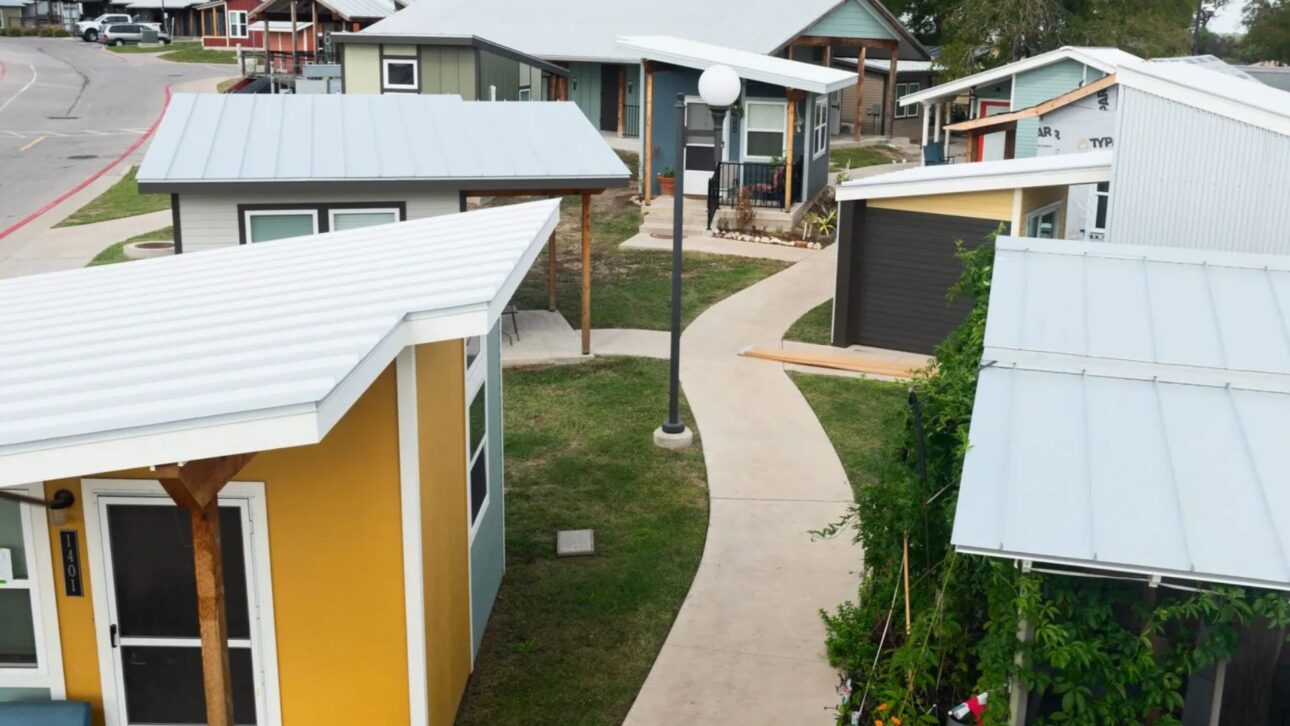
With 20,000 meters, Community First! Village is large enough to have streets, squares, and neighborhood life, currently housing more than 420 former homeless individuals, according to the official site. It is not a cluster of tents; it is a planned community with small-town infrastructure.
-
Chinese Shipyard Secures $1 Billion in Orders for Low-Carbon Container Ships Amid Global Fleet Renewal Efforts

-
Minneapolis Warehouse Transformed into Village of 100 Tiny Homes, Helping 851 Homeless People and Securing Permanent Housing for 343
-
Vancouver Addresses Housing Crisis with 606 Modular Homes Offering Kitchens, Bathrooms, and 24-Hour Support

-
Say Goodbye to Warped Wooden Decks: Composite Flooring Made from Recycled Plastic and Sawdust Offers a Low-Maintenance Outdoor Solution


The organization even has a name for its design. Called “Neighborhoods of Knowingness,” the concept groups homes into neighborhoods of 40 to 50 units around common areas, according to Mobile Loaves & Fishes. The idea is that no one gets lost in anonymity, and that each resident is known and recognized by their neighbors.
This care addresses a deep cause of life on the street. For Alan Graham, founder of Mobile Loaves & Fishes, the central problem is not just the lack of shelter, but the isolation, the loss of the ties that sustain a person. That’s why the planned community was designed to rebuild connections, not just to stack former homeless people in rooms.
Microhouses, houses, and trailers, each with a porch
Housing comes in various formats, all designed to fit the budget of those with little. The village combines microhouses, manufactured homes, and trailers, and each unit has its own front porch, a simple detail that invites the resident to sit and chat with passersby, according to Mobile Loaves & Fishes. The microhouses can be about 200 square feet, according to The Texas Tribune.
The rent is the most surprising part. Living in Community First! Village costs, on average, about $385 per month, according to The Texas Tribune. It’s a low amount for the American standard, designed so that the former homeless person can pay with a simple job and maintain the dignity of paying for their own home.
Paying for housing, by the way, is part of the philosophy. Instead of giving everything for free, the planned community charges affordable rent because it understands that responsibility is part of the reconstruction. For many former homeless people, signing a contract and having a fixed address is the first concrete step towards permanent housing.
What’s in the village: from the garden to the chapel
Anyone imagining a dull place is mistaken, because the structure is worthy of a condominium. The microhouses are organized around common areas with outdoor kitchens, laundries, and bathrooms with showers, according to Mobile Loaves & Fishes. No one needs to leave the village to handle basic daily needs.
The list of amenities goes far beyond the essentials. Community First! Village has the Genesis Gardens organic garden, a health clinic, an amphitheater that functions as an open-air cinema, a market, a dog park, and even the Hope Chapel, a chapel, according to the official website. It’s a complete neighborhood infrastructure within a planned community for former homeless people.
There is also space to generate income and purpose. The village maintains art and jewelry studios and micro-entrepreneurship programs, and The Texas Tribune reports that residents there rebuild routine and occupation. More than a shelter, it’s an ecosystem designed so that the stay there ends in permanent housing and a stable life.
The Goal of 1,900 and the Planned Community Expansion
What exists today is just the beginning of the plan. Mobile Loaves & Fishes wants to expand the Community First! Village to 1,900 residents, transforming the current planned community into something even larger, according to the official website. For this, the expansion plans include new areas and thousands more units.
The cost of the expansion is as large as the goal. The Texas Tribune reports that the organization aims for nearly 2,000 homes distributed across three locations and estimates that $225 million will be needed to fund the expansion, of which about $150 million has already been raised. It is a public works-sized investment, coming from private initiative and philanthropy.
If the plan is fulfilled, the impact multiplies. Going from over 420 to 1,900 former homeless residents served means quadrupling the number of people taken off the streets into permanent housing. Few initiatives in the world aim for such a leap in a single planned community.
Lifetime Charity: Alan Graham’s Honest Model
What makes the project fascinating is the sincerity of its leader. Alan Graham does not sell the village as a fairy tale. “Practically 100% of the people who move to this village will need to be subsidized for the rest of their lives,” he told The Texas Tribune, acknowledging that leaving the street does not mean becoming self-sufficient overnight.
This realism also appears in the numbers. The Texas Tribune points out a subsidy of about $25,000 per person per year to keep the model afloat. It is a high cost, but the project considers it cheaper and more humane than leaving the former homeless residents cycling between hospitals, jails, and sidewalks.
The founder himself makes a point not to romanticize. “This is definitely not paradise,” said Alan Graham to The Texas Tribune, making it clear that the village does not magically solve all the traumas of those who lived on the street. What it offers is a foundation, a planned community where permanent housing and belonging give a person the real chance to start over.
The Community First! Village shows that tackling homelessness can go far beyond a crowded shelter. With 20,000 meters, hundreds of micro-houses, a garden, clinic, and chapel, the planned community in Austin, Texas, has already restored dignity to over 420 former homeless residents and aims to reach 1,900 in permanent housing, without pretending that the path is easy. It is an expensive, honest, and deeply human model.
And you, do you think Brazil should invest in planned communities like this to get people off the streets, even knowing that many will need support forever? Share your opinion in the comments.


Be the first to react!