






 Portuguese
  Spanish


In the interior of Pernambuco, retired teacher Álfio Maciel Campelo, 72 years old, recited 247 digits of Pi from memory in just 1 minute, without making a mistake, and set a Brazilian supermemory record, a memory feat officially validated by Rank Brasil, the country’s record site.
Some people forget where they left their keys, and then there’s Professor Álfio. At 72 years old, the Pernambucan Álfio Maciel Campelo, a retired math and chess teacher, sat in front of the evaluators and delivered 247 digits of Pi from memory, in sequence, in just 1 minute. He didn’t make a single mistake. With that, he entered Rank Brasil, the official record site of the country, as the holder of a national supermemory mark that leaves everyone amazed.
The feat was reported by Só Notícia Boa and went viral due to the mix of age, technique, and merit. Reciting 247 digits of Pi in 60 seconds is not luck or a magical gift, it’s the result of a lifetime of trained memory. The record was validated after audio analysis, which confirmed the sequence spoken clearly within the time, and placed Álfio Maciel Campelo’s name in the gallery of Brazilian memory record holders.
247 digits of Pi in 60 seconds
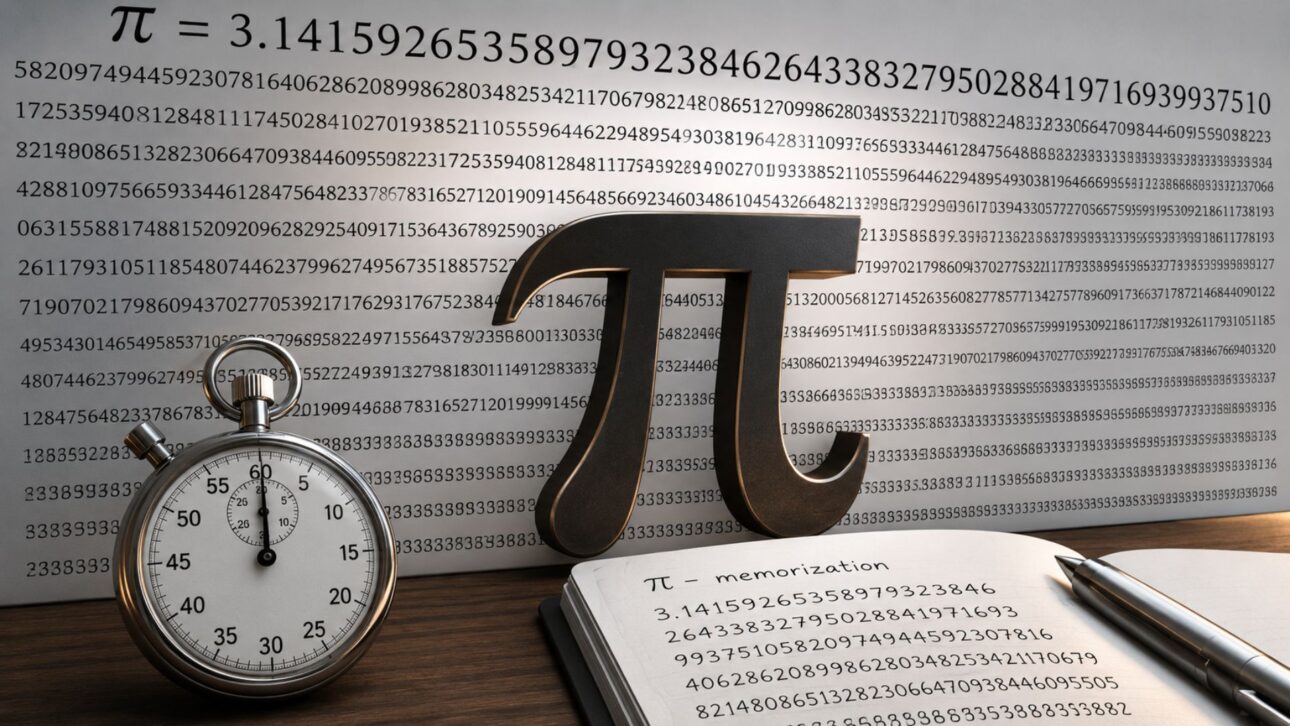
In just one minute, Álfio correctly recited 247 digits of Pi, in the exact order, without consulting anything and without stumbling over any digit.
-
Scientists Discover Microbial Structures Beneath a 42,000-Year-Old Crater in Korea, Shedding Light on How Asteroid Impacts Could Create Life-Friendly Lakes

-
Raised in a Family of 16, Mechanic’s Daughter Overcomes Challenges to Become a Leading Female Figure in Brazil’s Automotive Industry

-
Brazilian Sisters, Aged 103, 104, and 109, Set Guinness World Record as Oldest Sibling Trio, Totaling 316 Years; Attract Scientific Interest for Longevity DNA Study
-
14-Year-Old Australian Entrepreneur Goes Viral After Y Combinator Rejection, Runs Two Startups Including an AI Company After Sock Business Failure


To give you an idea, it’s like memorizing and repeating, without error, a list of 247 randomly selected digits.
Precision is what matters most in this type of test.
In the record, it’s not enough to know many digits, you need to say them in the correct sequence and within the time, because a single number out of place invalidates the attempt.
Speed and accuracy had to go hand in hand, and that’s exactly what he delivered.
This performance places the teacher in a rare category.
The 247 digits of Pi recited in 60 seconds became the Brazilian record in the category, officially registered and recognized.
It’s not a stage trick, it’s an audited record.
What is the number Pi and why is it so difficult to memorize
To understand the magnitude of the achievement, it’s worth remembering what Pi is.
The number Pi, represented by the Greek letter π, is the ratio between the circumference of a circle and its diameter, and is approximately 3.14159.
The detail is that Pi is infinite and has no pattern: its digits go on forever, without repetition or logic to help guess the next one.
It is precisely this lack of pattern that makes memorization brutal.
Memorizing a repeating sequence is easy, but Pi doesn’t give that advantage, and each of the 247 digits of Pi must be remembered individually, without shortcuts.
That’s why reciting so many digits is considered an elite memory sport.
Minds around the world compete in this challenge.
Memorizing digits of Pi has become one of the classic tests for memory athletes, and reaching 247 digits with precision, in one minute, places Álfio among the national highlights of this competition.
Pi is the Everest for those who train their brains.
A memory trained since childhood
Álfio’s talent didn’t just appear now, it comes from childhood.
As a child, in the interior of Pernambuco, he was encouraged by his father to memorize the train stations between Recife and Salgueiro, an exercise that planted the seed of super memory.
That childhood game with names and sequences became the foundation of a lifetime of mental feats.
The ease with numbers came early and never left.
From a young age, Álfio Maciel Campelo demonstrated an unusual relationship with sequences, dates, and patterns, something he honed over the years instead of letting it rust.
The gift existed, but the training made the difference.
This beginning explains a lot.
Those who grow up exercising memory in a playful way, as Álfio did in the interior of Pernambuco, build a brain accustomed to storing and retrieving information, an advantage that accumulates decade after decade.
The seed was planted on the tracks of childhood.
Countries of the world, periodic table, and now Pi
Throughout his life, Álfio memorized all the countries of the world and the elements of the periodic table, exercising his memory in very different areas.
He treats his own brain like an athlete treats the body: with ever greater challenges.
Each new memorization raised the bar.
As he approached old age, instead of easing up, Álfio set himself bolder goals and began training to memorize hundreds of digits of Pi, combining speed and precision in a single test.
Retirement became, for him, a time for new records.
His professional career aligns with all of this.
A mathematics teacher at GEO and MOTIVO schools and later a chess teacher at Piedade school in Pernambuco, Álfio Maciel Campelo spent his life in environments that reward reasoning, logic, and memory.
Numbers and strategy have always been his domain.
The validation of Rank Brasil
A record only becomes a record when someone confirms it, and that’s what happened.
Álfio’s achievement was approved by Rank Brasil, the official Brazilian records site, in the category of the largest number of Pi digits correctly recited in 60 seconds in the country.
The validation came after an audio analysis that confirmed each digit said within the stipulated time.
This rigor is what gives weight to the title.
Without the endorsement of an entity like Rank Brasil, the feat would just be a curious story, but with the approval, it becomes an official national mark, comparable and registered.
Álfio’s super memory record became part of the country’s statistics.
It’s the recognition that was missing to crown the effort.
Having his name in Rank Brasil transforms a personal talent into a public achievement, and gives the Pernambucan professor the place he built, digit by digit.
The memory became a record with a stamp.
Memory can be trained at any age
The case of Álfio is of interest far beyond curiosity.
It dispels the idea that memory only worsens with age, showing that the brain, like a muscle, responds to training at any stage of life.
At 72 years old, he broke a record that many young people couldn’t achieve, precisely because he never stopped exercising his mind.
Science is moving in the same direction.
Researchers associate healthy brain aging with constant mental challenges, reading, learning, and memory exercises, exactly the routine that Álfio Maciel Campelo has maintained for decades.
Keeping the mind active is a way of taking care of it.
And there is a practical message in this.
Memorization techniques can be learned by anyone, and Álfio’s supermemory is less a genetic miracle and more the result of method, repetition, and discipline over time.
The secret is to train, and always train.
What the case of Professor Álfio shows
The greatest lesson is about the power of training combined with purpose.
Álfio proved that memorizing 247 digits of Pi at 72 years old is possible for those who make memory a life habit, and not a skill that is set aside.
It was decades of discipline, not a one-day trick.
It deserves honest recognition.
The feat is a Brazilian record in the category, validated by Rank Brasil, and not a world record, and depends on a specific memorization technique that requires a lot of training to reach this level.
It is a remarkable achievement, without needing exaggeration to impress.
Even so, the example truly inspires.
Seeing a retired teacher take on the number Pi as a challenge and emerge victorious is the kind of story that renews the idea that learning and training the mind have no age limit.
From the boy who memorized train stations in the interior of Pernambuco to the supermemory record holder, Álfio showed that the brain also stays in shape with exercise.
And you, could you memorize and recite 247 digits of Pi in one minute, or do you get lost after 3.14? Tell us in the comments how many digits of Pi you know by heart and what you think of Professor Álfio’s memory.


