






 Portuguese
  Spanish


In Thailand, three teenagers from Prince Royal’s College created MalariaX, a low-cost microscope that diagnoses malaria with AI, identifying the 5 species in seconds for villages without a laboratory, and won 1st place in category at ISEF 2026, the world’s largest science fair.
There are health problems that kill not for lack of cure, but for lack of timely diagnosis. Malaria is one of them, and it was at this point that three teenagers decided to act. Students from Prince Royal’s College in Chiang Mai, Thailand, created a low-cost microscope powered by artificial intelligence that identifies the 5 species of malaria in seconds, even in remote villages without any laboratory nearby. The project is called MalariaX, and it won one of the biggest science awards on the planet.
The achievement was announced by the Society for Science, organizer of the Regeneron ISEF, the world’s largest pre-university science and engineering fair. In the 2026 edition, held in Phoenix, United States, from May 9 to 15, MalariaX won the 1st place Grand Award in the Biomedical Engineering category, with a prize of US$ 6,000, beating projects from more than 1,700 young scientists from over 60 countries. An AI malaria diagnosis, made by teenagers, rose to the top.
An AI microscope that diagnoses malaria in seconds
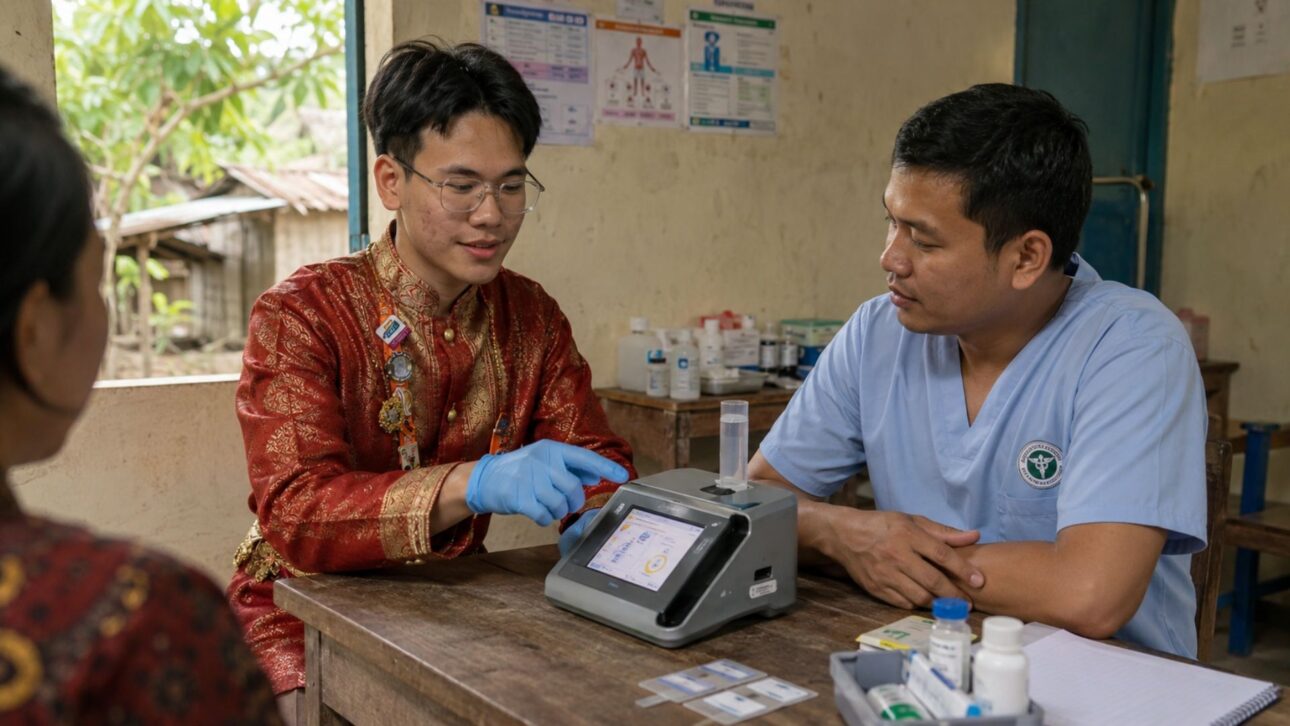
MalariaX is a portable diagnostic platform that combines smart microscopy and artificial intelligence to detect the malaria parasite in blood.
-
Xiaomi Unveils Revolutionary Fridge: Eliminates Odors in 3 Minutes, Sterilizes in 2, Offers 508 Liters in Compact Design, Operates at 31 dB, and Is Smartphone-Controlled.

-
Japanese Teen Inventor Wins $100,000 at World’s Largest Science Fair for Origami-Based Solar Sail Simulator
-
Brazilian Students Develop Solar-Powered AI Trap for Cotton Pests, Defeating Carnegie Mellon and Cornell in Global Agricultural Robotics Award
-
Brazil’s Bahia Digs Over 1.5 km Deep Vertical Shaft for “Giant Elevators” in Copper Mine to Move 2.2 Million Tons of Rock Annually and Transport 840 Workers Daily in the Vale do Curaçá Complex


Instead of relying on a specialist looking at slide by slide under the microscope, the system does it on its own.
Speed is the great advantage.
The device performs malaria diagnosis with AI in seconds, analyzing blood images and identifying the presence and type of parasite almost instantly.
What in a traditional laboratory would take time and specialized hands, the smart microscope delivers in moments.
All of this in a low-cost package.
The proposal is for the microscope to be accessible enough to reach poor and remote places, where expensive equipment would never enter.
It’s cutting-edge technology designed for those who have never had access to it.
The problem: malaria kills where there is no laboratory
To understand the value of the invention, it’s necessary to look at the problem it addresses.
Malaria continues to kill many people worldwide, and a large part of these deaths occur in remote regions, where there is no laboratory or trained professional to make a quick diagnosis.
Without diagnosis, there is no correct treatment, and that’s where the disease progresses.
The bottleneck is usually the detection.
The traditional malaria test requires an experienced microscopist to identify the parasite on the blood slide, something lacking in isolated villages and precarious health posts.
When the diagnosis is delayed or wrong, the patient worsens and the disease spreads.
This is exactly the gap that MalariaX aims to fill.
Bringing AI malaria diagnosis to the middle of nowhere, without needing a specialist, can mean the difference between early treatment and losing lives.
The technology reaches where the health system does not.
The 5 species and why detecting all matters
A technical detail makes all the difference in the project.
Malaria is not just one disease; it is caused by five different species of the Plasmodium parasite, and each may require specific care in treatment.
MalariaX was designed to identify all 5 species, not just the most common one.
This breadth is what separates a useful test from a complete test.
Detecting the right species allows the health professional to choose the appropriate treatment, avoiding errors that occur when it’s only known that malaria is present, but not which type.
The AI malaria diagnosis of the project delivers this species precision.
This is where artificial intelligence shines.
Trained to recognize subtle differences between parasites, the AI of the microscope makes a distinction that even confuses experienced human eyes.
Specialist precision in a field device.
1st Place at ISEF 2026, the World’s Largest Fair
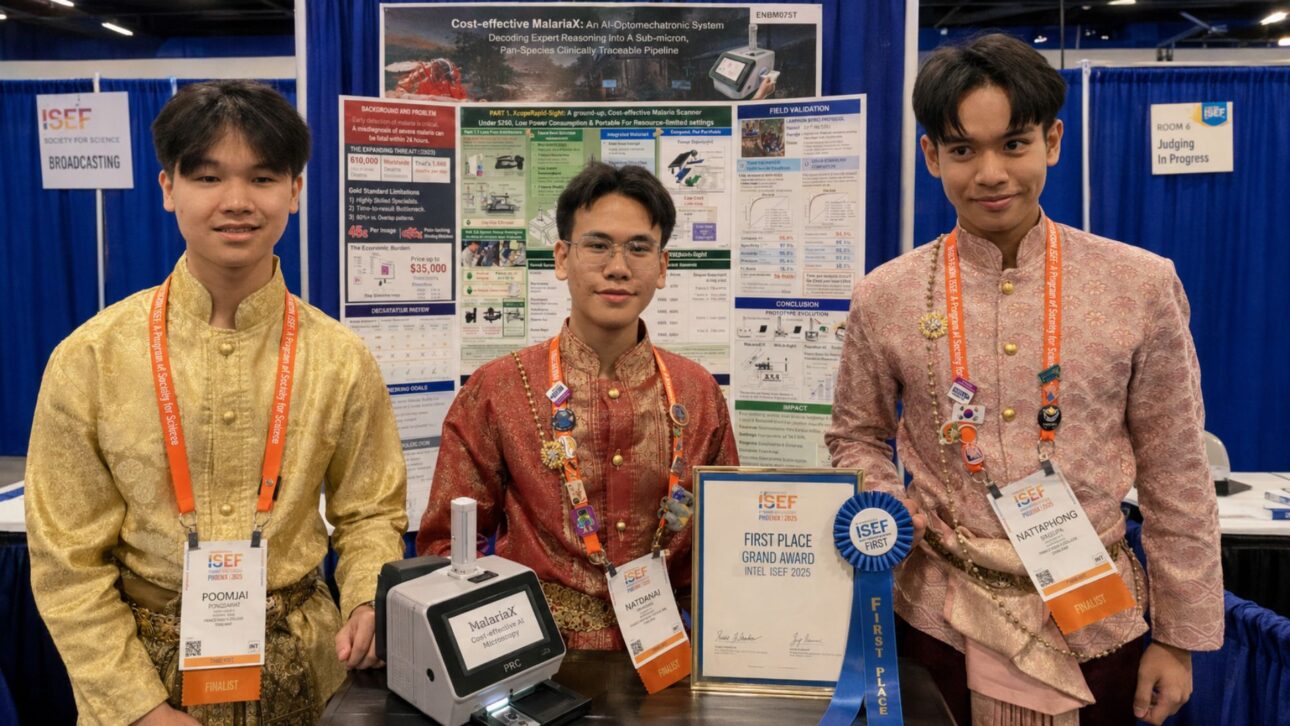
The Regeneron ISEF 2026 brought together more than 1,700 high school students from over 60 countries, in Phoenix, United States, from May 9 to 15, organized by the Society for Science.
It is the largest and most competitive pre-university science fair on the planet.
It was in this setting that the Thais stood out.
The trio formed by Natdanai Suksri, Nattaphong Thaworn, and Poomjai Pongsriwat, from Prince Royal’s College, won the 1st place Grand Award in the Biomedical Engineering category, taking home $6,000, according to HoneyKids Asia.
Winning first place in an ISEF category, among thousands of projects from around the world, is a huge achievement for any student.
It’s worth the honest precision.
The MalariaX won the Biomedical Engineering category, one of the main areas of the fair, and not the unique prize for the best overall project, which is a separate competition.
Even so, being number one in their own category, at an event of this size, places the teenagers at the top of global health innovation.
Low-Cost Technology for Those Who Need It Most
What makes MalariaX special is not just the technology, but the intention behind it.
The microscope was designed from the start for rural and hard-to-reach communities, precisely those that suffer most from malaria and have the least health infrastructure.
Making diagnosis cheaper is democratizing access to it.
This logic reverses the market rule.
Instead of creating an expensive device for large hospitals, the students aimed for the opposite: a simple and cheap AI malaria diagnosis that fits in a village health post.
Technology that serves those who are usually left out.
This is where social impact meets engineering.
An intelligent microscope that costs little can lead to a number of lives saved that no luxury equipment, restricted to a few, would achieve.
The value lies in scaling for the forgotten.
From Thailand to the world: young people solving real problems
The story of MalariaX is bigger than a science fair.
It showcases a generation of teenagers using artificial intelligence to tackle concrete human problems, instead of just playing with technology.
These young people did not create a fun app, they created a tool that can save lives.
The scope of the problem is global.
Malaria affects dozens of countries, including Brazil, where the disease is still a real concern in the Amazon region, making a low-cost AI malaria diagnosis interesting far beyond Thailand.
A solution designed for Asian villages can serve Brazilian forests.
And there is the message about young talent.
When students are given structure and encouragement, even in a school outside major technology centers, they deliver solutions that compete with the best in the world, as proven by ISEF 2026.
A good brain has no fixed address.
What the case of MalariaX shows
The biggest lesson is about uniting technology and purpose.
The three teenagers from Prince Royal’s College took a trendy tool, artificial intelligence, and directed it towards a problem that kills the poorest, AI malaria diagnosis in places without laboratories.
It was engineering with heart, not just with code.
Of course, it’s important to stay grounded.
MalariaX is an award-winning and promising student project, but it still needs clinical validation, approval, and large-scale production to actually reach villages and be used daily.
It’s a brilliant prototype on its way to becoming a product, not a device already operating in health centers.
Even so, the direction is inspiring.
Showing that a low-cost microscope, with AI malaria diagnosis, can be born from the hands of teenagers and win a category at ISEF 2026, the world’s largest science fair, is the kind of news that renews hope in technology serving life.
From Thailand to the world stage, MalariaX proved that a good idea, with AI and purpose, can target the problems that really matter.
And you, did you imagine that a microscope capable of diagnosing the 5 species of malaria in seconds, designed for villages without a laboratory, could be created by three teenagers? Tell us in the comments what you think about this type of low-cost technology serving the health of those who need it most.


