






 Portuguese
  Spanish


Structures of 10 to 20 centimeters were found in the Hapcheon crater, in South Korea, where an impact formed an ancient lake heated by hydrothermal activity. The discovery does not reveal the first organisms on Earth, but helps to understand how environments created by cosmic collisions could have served as a shelter for primitive forms of life.
Scientists identified stromatolites within the Hapcheon crater, in South Korea, in a finding that links asteroid impact, hydrothermal lake, and microbial activity. The rock structures, formed by layers associated with communities of microorganisms, appeared on the northwest margin of the crater.
According to the study published in the scientific journal Communications Earth & Environment, from the Nature group, the crater was formed about 42,300 years ago. After the collision, the depression in the terrain accumulated water and gave rise to a lake with circulation of hot fluids.
The most relevant point of the discovery is not the age of the rocks, but the preserved environment. The South Korean crater offers a recent example, on a geological scale, of how asteroid impacts can create warm lakes, rich in minerals and capable of sustaining microbial communities.
-
Raised in a Family of 16, Mechanic’s Daughter Overcomes Challenges to Become a Leading Female Figure in Brazil’s Automotive Industry

-
Brazilian Sisters, Aged 103, 104, and 109, Set Guinness World Record as Oldest Sibling Trio, Totaling 316 Years; Attract Scientific Interest for Longevity DNA Study
-
14-Year-Old Australian Entrepreneur Goes Viral After Y Combinator Rejection, Runs Two Startups Including an AI Company After Sock Business Failure

-
100-Year-Old Brazilian Sets World Record by Swimming 50 Meters in 1 Minute and 9 Seconds, Inspired by Tarzan Films


This helps researchers investigate an old hypothesis. Instead of seeing every cosmic collision only as destruction, the study shows that some craters may have gone through a second phase, with water, heat, and nutrients available.
What researchers found in the Hapcheon crater
The structures were found in small valleys with intermittent watercourses, in the northwest inner part of the crater. According to information from the Korea Institute of Geoscience and Mineral Resources, researchers identified several stromatolites approximately 10 to 20 centimeters in diameter.
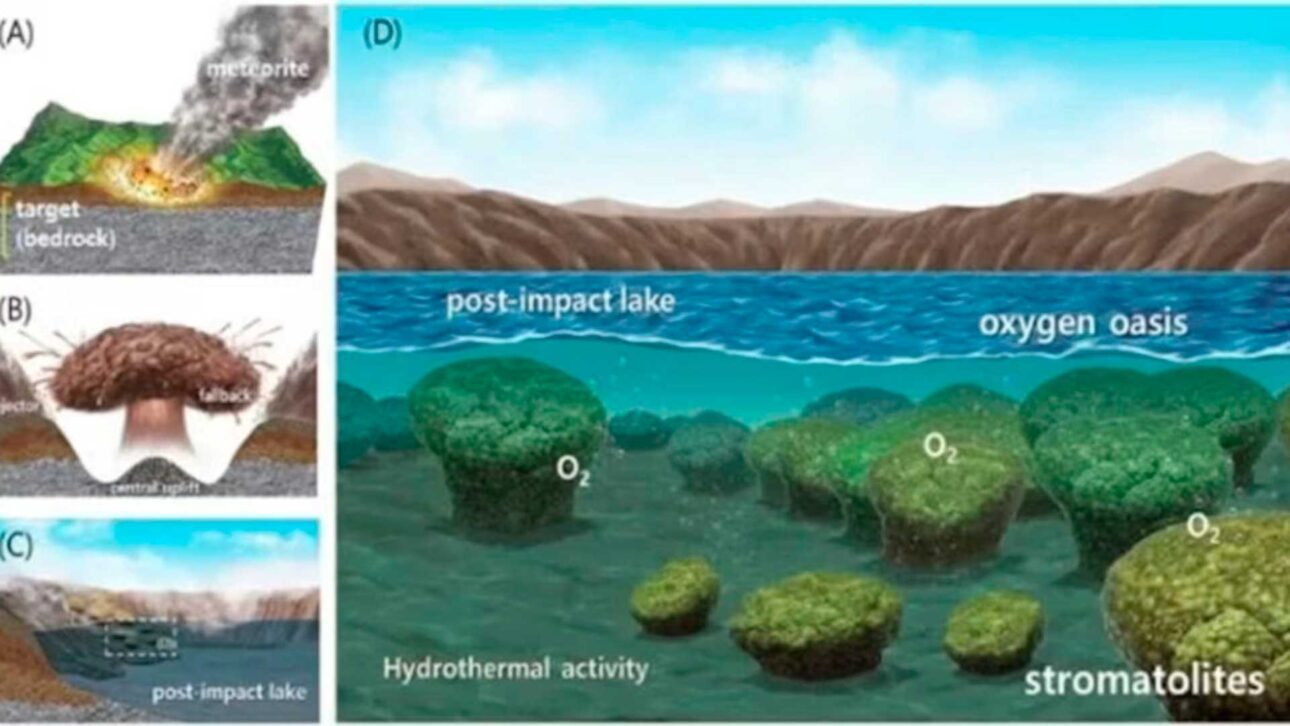
These formations have wavy and laminated layers, a typical characteristic of stromatolites. They form when microbial communities grow over sediments, trap particles, and promote the accumulation of minerals over time.
In the case of Hapcheon, scientists observed stratiform, domal, and columnar structures. In simple language, they are small rock bodies with varied shapes but with the same main signature: successive layers that record growth in an aquatic environment.
The samples were analyzed with techniques such as radiocarbon dating, chemical mapping, microscopy, and isotope analysis. The data set indicated that the stromatolites developed in an ancient lake formed after the impact.
How a violent impact turned into a hot lake
The collision that opened the Hapcheon crater not only deformed the terrain. It would also have heated rocks, fractured underground layers, and created pathways for the circulation of hot water.
Over time, water accumulated in the depression and formed a lake. The remaining heat from the impact, combined with the passage of fluids through altered rocks, created a hydrothermal system. This type of environment usually gathers three decisive elements for microorganisms: liquid water, favorable temperature, and available minerals.
The study points out that hydrothermal signals were stronger in the inner layers of the stromatolites. This suggests that they began to form in a hotter phase of the lake when the impact’s influence was still intense.
Later, the hydrothermal activity would have gradually weakened. Even so, the data indicate that this system may have remained active for thousands of years, enough time for microbial communities to establish themselves on the lake’s shores.
Why stromatolites attract so much attention in science
Stromatolites are among the oldest records associated with life on Earth. In other regions of the planet, fossils of this type date back to more than 3 billion years, when microbial communities were already leaving marks in sediments.
These structures are linked to microorganisms capable of living in shallow, illuminated, and mineral-rich environments. In many cases, they appear associated with cyanobacteria, organisms that release oxygen through photosynthesis.
This type of microbial life helped change the Earth’s atmosphere over billions of years. The so-called Great Oxidation Event, which occurred about 2.4 billion years ago, marked the significant increase of oxygen in the atmosphere.
However, the finding in South Korea needs to be read with caution. The Hapcheon crater is much more recent and does not directly prove how oxygenic photosynthesis emerged on primitive Earth. The study’s authors themselves make it clear that the structures found there are not direct evidence of the planet’s first organisms.
The scientific value is in the model. As many rocks from the early Earth have been destroyed, buried, or deformed, more recent craters help researchers understand processes that may have occurred in much older environments.
The chemical clues that link the find to the meteorite
The team found chemical signals compatible with the influence of the space body that hit the region. One of the points analyzed was the proportion of osmium isotopes, used in geological studies to trace material of meteoritic origin.
Positive anomalies of europium, a rare earth chemical element, were also identified. In geology, this type of signature can indicate the influence of hydrothermal fluids, especially in environments where hot water interacts with rocks.
In the inner layers of the stromatolites, the hydrothermal signals appear more strongly. This aligns with the idea that the lake went through an initial hotter phase and then gradually lost thermal energy.
The analysis does not rely on a single clue. The study gathered data from minerals, sediments, isotopes, radiocarbon dating, and layer structure. It is this combination that supports the interpretation that the stromatolites grew in a lake formed after the impact.
What this discovery changes about the search for ancient life
The discovery reinforces a line of research that sees impact craters as possible environments for life, not just as scars of destruction. On early Earth, impacts were more frequent, and some of these collisions may have created temporary lakes with heat and nutrients.
These locations could function as small microbial “oases,” especially during hostile periods in the planet’s history. They would not be stable environments forever, but they could last long enough to host microscopic communities.
The Hapcheon crater also increases interest in Mars. The red planet has many ancient craters, and there is evidence that some of them once held liquid water. If hydrothermal lakes existed there, preserved sediments might hold minerals, structures, or other biosignatures.
This does not mean that the discovery proves life beyond Earth. What it offers is a roadmap for investigation. In future missions, craters with lacustrine sediments, hydrothermal signals, and laminated structures may be more interesting targets for seeking traces of ancient life.
The crater does not hold Earth’s first beings, but helps piece together the puzzle
The age of the Hapcheon crater, estimated at about 42,300 years, is recent when compared to the history of life on the planet. Earth is about 4.5 billion years old, and the oldest records of microbial life are billions of years older than the Korean crater.
Therefore, the discovery should not be treated as proof of the first organisms on Earth. The finding shows something different and equally relevant: a real, preserved, and studyable environment where stromatolites formed after a cosmic impact.
This detail changes the weight of the news. The crater functions as a kind of natural laboratory, where scientists can observe how water, heat, minerals, and microbial activity combined after a collision.
If similar environments existed on early Earth, they may have provided shelter for microorganisms at decisive moments in the planet’s history. And, if they also existed on Mars, they may indicate where to look for preserved traces of a life that perhaps was recorded only in the rocks.
What do you think of this hypothesis? Could asteroid impacts have been not only events of destruction but also created environments where life found space to grow? Leave your opinion in the comments.


