





 Portuguese
  English
  Spanish
  3 min of reading
  1 comment


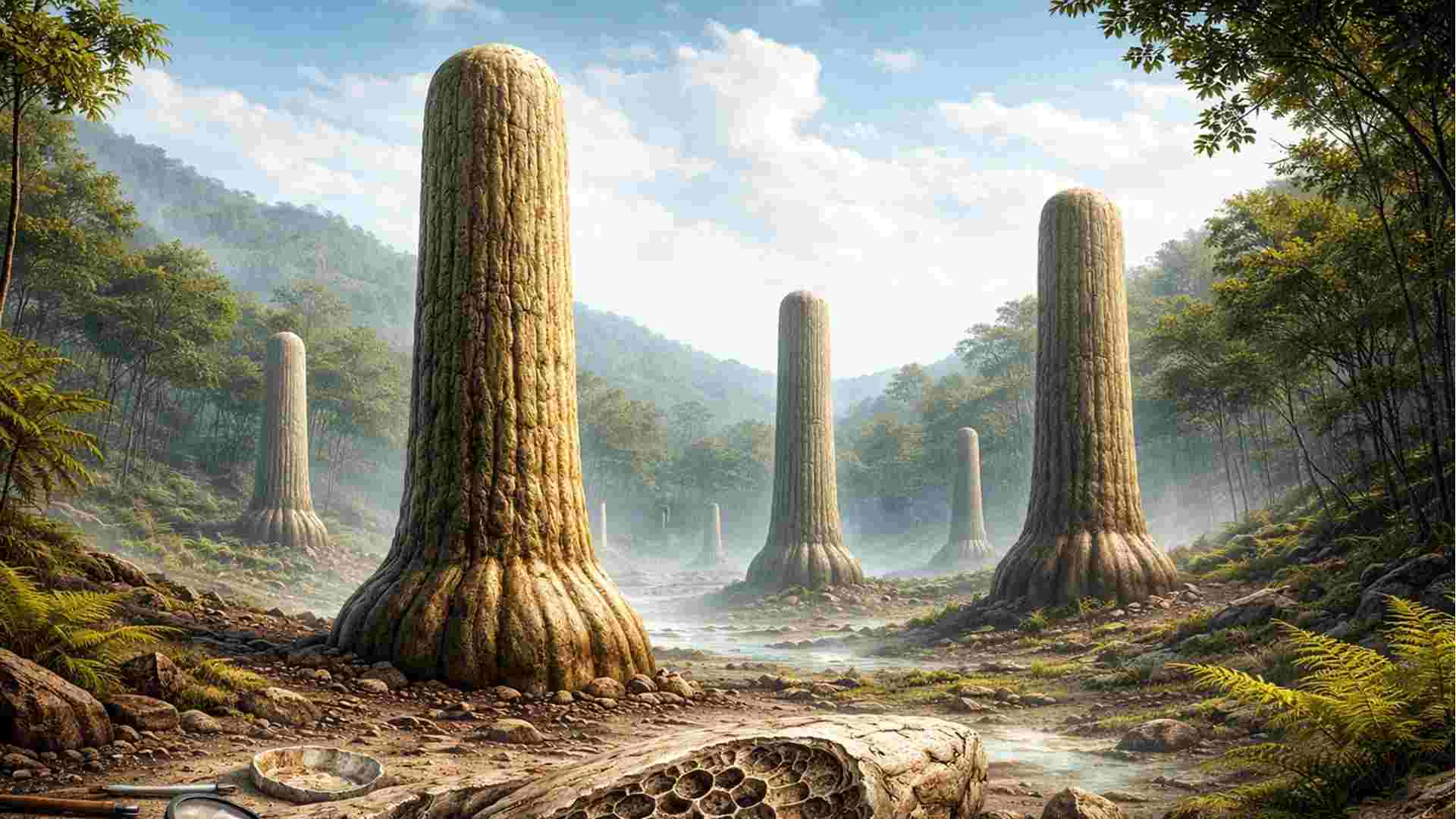


With Up to 8 Meters in Height and Present Around 407 Million Years Ago, Prototaxites Challenged Science for More Than a Century and, After Advanced Structural and Chemical Analyses, Were Classified as Members of an Extinct Eukaryotic Lineage Distinct from Plants and Fungi
Prototaxites, the first giant organisms on land, Reached up to 8 Meters in Height Around 407 Million Years Ago and Were Neither Fungi Nor Plants, According to a Study Published in Science Advances, Which Classifies Them as an Extinct Eukaryotic Branch Previously Unknown.
The Fossils Exhibit Smooth Pillars Similar to Stems, Lacking Branches, Leaves, or Flowers, and Did Not Have a True Root System.
Instead, the Organisms Appeared to Be Fixed to the Soil by a Simple Bulbous Base, Standing Out in Prehistoric Landscapes.
-
An artificial intelligence combed through years of NASA data and uncovered more than a hundred planets outside the Solar System that had gone unnoticed by human eyes.

-
Building a humanoid robot used to cost as much as a house, but Hugging Face launched an open-source project that anyone can 3D print and assemble for $2,500. For now, it’s just a pair of legs that learns to walk on its own.

-
One of the most promising solar technologies in the world has just made a leap in China: researchers combined perovskite and silicon to convert 33% of light into energy and, most importantly, made the cell last, maintaining 90% of the yield after a thousand hours of continuous operation.
-
From a block of ice about six million years old extracted in Antarctica, scientists managed to capture bubbles with the oldest air ever recovered on Earth.



Since Their Discovery in the Mid-19th Century, Prototaxites Have Generated Intense Scientific Debate. Previous Hypotheses Classified Them as Giant Fungi, Large Algae, or Some Primitive Type of Terrestrial Plant.
An Enigma That Spans Centuries
The Absence of Typical Tree Structures, Such as Leaves and True Roots, Has Always Complicated the Classification of Prototaxites in the Tree of Life. Still, Their Monumental Size Indicated a Relevant Ecological Role in Early Terrestrial Environments.
Doubts Persisted for Decades, with Conflicting Interpretations Based on External Morphology and Limited Comparisons with Modern Organisms. The New Study Aimed to Overcome These Limitations through Detailed Internal Analyses.
Analysis of an Exceptional Fossil from Scotland
The Researchers Analyzed a Specimen of Prototaxites taiti Recovered from the Rhynie Chert in Northeastern Scotland, a Paleontological Site Known for the Exceptional Preservation of Plant, Fungal, and Animal Materials.
Using Lasers and Three-Dimensional Imaging, the Team Examined the Interior of the Fossil and Compared Its Chemical Composition with Other Fossilized Organisms Present in the Same Rock, Identifying Relevant Structural and Chemical Differences.

Internal Structure and Unique Chemical Signature
The Internal Anatomy of Prototaxites taiti Revealed Intertwined Tubes That Joined Together in Highly Complex Branched Regions. Laser Scanning Confocal Microscopy Exposed a Three-Dimensional Structure Distinct from the Simple Networks of Hyphae Observed in Fungi.
The Specimen Exhibited Three Different Types of Tubes and Dense Nuclei Where These Structures Connected. Moreover, Chemical Analyses Assisted by Artificial Intelligence Did Not Detect Chitin, a Common Protein in Fungi and Fossilized Insects.
The Team Also Compared the Chemical Signature of the Fossil with That of Known Living Organisms. No Matches Were Found, Reinforcing the Hypothesis of a Distinct Lineage Not Previously Recognized.
Classification as an Extinct Eukaryotic Lineage
Based on Anatomical and Chemical Data, the Researchers Discarded the Possibility of Prototaxites Being Fungi or Plants. The Study Concludes That They Belonged to an Extinct Lineage of Eukaryotes, Organisms with Complex Cells.
According to the Authors, the Integrative Approach Taken Weakens the Hypothesis That Prototaxites taiti Was an Ascomycete or a Member of the Crown Group of Fungi, Supporting Its Classification in an Undescribed Eukaryotic Branch.
The Conclusions May End One of the Oldest Debates in Paleontology, Although the Authors Themselves Emphasize That Additional Analyses and New Fossil Discoveries Will Still Be Necessary to Confirm This Interpretation Definitively.


⁹7.