






 Portuguese
  Spanish


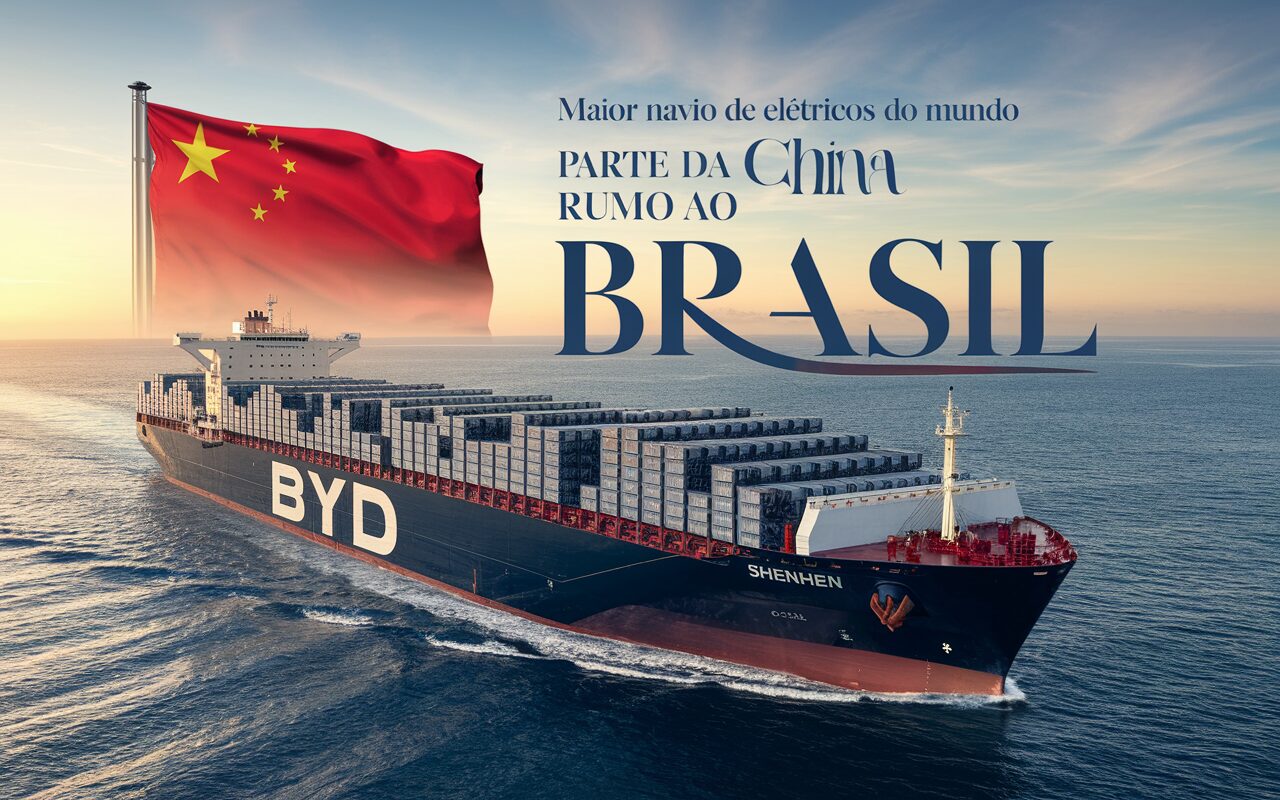


With More Than 7 Thousand Vehicles on Board, BYD Shenzhen Cargo Ship Leaves China for Brazil Marking Global Expansion of the Automaker and Reinforcing Presence in the Brazilian Market.
The Chinese automaker BYD took another step to strengthen its global operation. On Sunday (27), the company announced the departure of the BYD Shenzhen, the world’s largest electric vehicle carrier, on its maiden voyage to Brazil. The cargo ship left the Port of Taicang, in Jiangsu Province, China, carrying more than 7 thousand vehicles from the brand.
According to information from BYD itself, the ship is expected to arrive at the Port of Itajaí, in Santa Catarina, after just over 30 days of navigation. The transport is part of the company’s expansion strategy, which has been increasing its presence in the Brazilian electric vehicle market.
BYD Shenzhen is Part of the Internationalization Plan of the Chinese Automaker
Built by a shipyard of China Merchants Group, the BYD Shenzhen is the fourth ship developed by the company itself for transporting its electric cars. The vessel has a capacity of 9,200 vehicles, which represents an important boost to the automaker’s international logistics.
-
This Massive 12-Meter, 21-Ton Underwater Drone Can Operate Autonomously for Up to Five Days

-
Global Shipping Faces Shortage of Certified Maritime Officers, Salaries in the U.S. Can Exceed $100,000 Annually

-
The FLIP: A 108-Meter Ocean Laboratory That Stood Vertically for 60 Years, Dismantled in 2023
-
North Korean Fiasco: Launch of the Largest Warship Ends in Sinking




The ship, which measures 219 meters in length and 37.7 meters in width, was officially delivered in April of this year in the city of Yizheng, also in China. Equipped with state-of-the-art technologies, the BYD Shenzhen utilizes high-energy-efficiency motors, gas recycling systems, and coatings that reduce fuel consumption.
During the delivery ceremony, Wang Junbao, general manager of BYD’s public business division, emphasized that the new ship will serve as a maritime bridge between Chinese innovation and international markets. According to him, the direct operation of the fleet will ensure greater stability and efficiency in vehicle deliveries, as well as reduce carbon emissions in transportation.
Chinese Electric Vehicle Exports Continue to Grow
The operation of the BYD Shenzhen occurs at a time when vehicle exports from China are reaching record levels. According to data from the General Administration of Customs of the country, more than 6.4 million cars were exported in 2024, keeping China in the global lead for the second consecutive year.
To meet this demand, automakers such as BYD, Chery, and SAIC Motor are investing in creating their own maritime transport fleets. In the case of BYD, only in the first quarter of 2025, its vehicle carriers transported more than 25 thousand electric cars to international markets.
The automaker’s own figures show that its electric vehicles are now present in over 400 cities in more than 100 countries and regions. Brazil stands out as one of the main markets, with sales reaching 76,700 units in 2024 — a 328% increase compared to the previous year.
BYD Shenzhen Ship Expected to Boost Sales in Brazil
The launch of the BYD Shenzhen is seen as strategic for the continued growth of the brand in Brazil. With the new vessel, the expectation is to reduce delivery times, improve the distribution of electric cars, and lower transportation costs.
According to logistics sector experts, having a dedicated fleet of ships provides advantages such as greater operational control, stability in the export process, and increased agility in serving foreign markets.
Source: CarNewsChina


