Portuguese
  Spanish


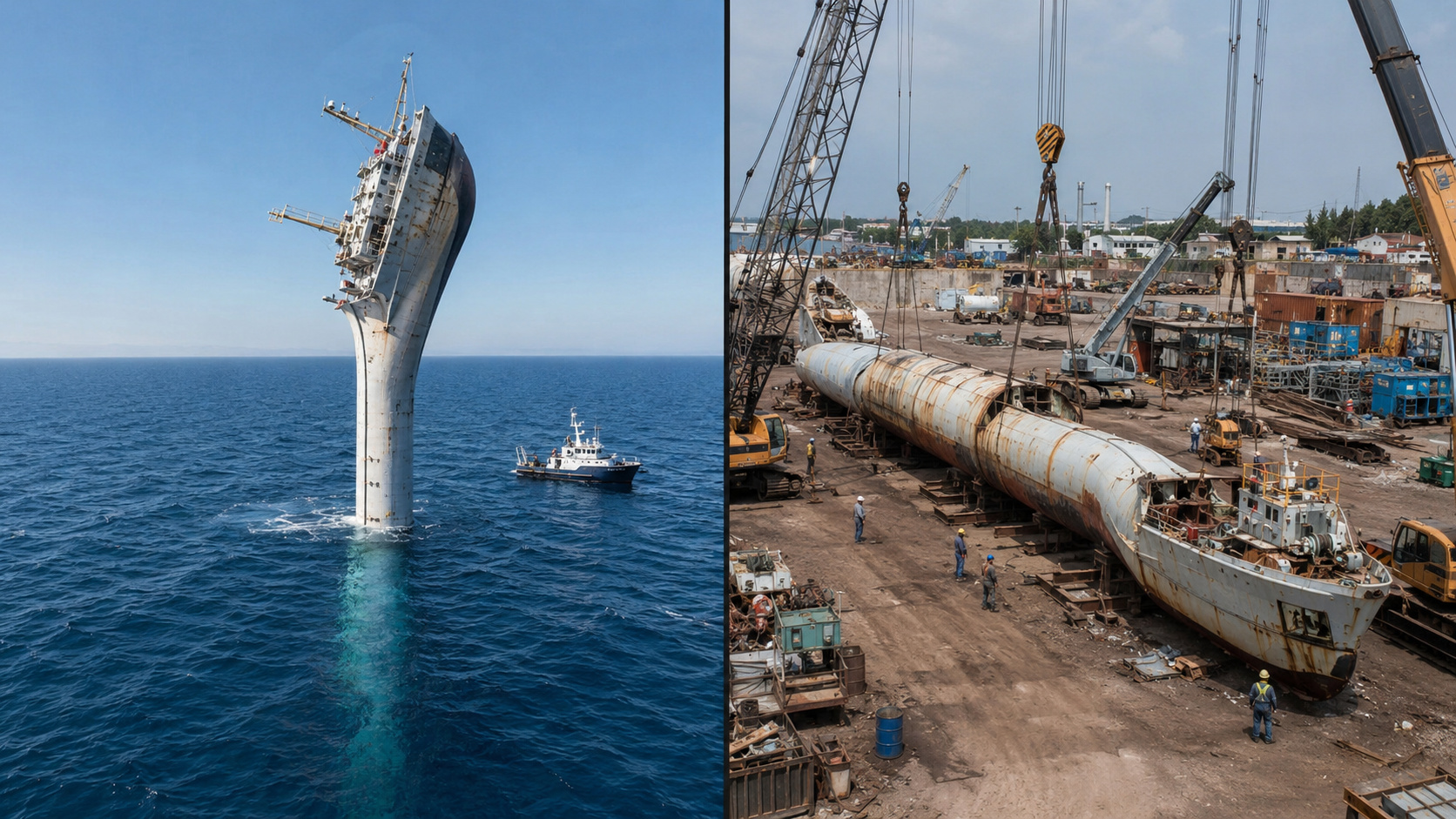

FLIP was the most unusual ocean platform ever created, operated for 61 years and sank 91 meters to become a stable tower in the sea.
The R/P FLIP, short for Floating Instrument Platform, was one of the most unusual structures ever created for ocean research. Although it was often called a ship, the Scripps Institution of Oceanography itself explains that the FLIP was, in practice, a non-propelled research platform, designed to operate as an extremely stable laboratory at sea.
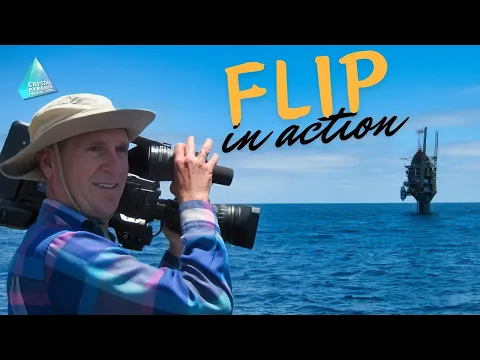
Its most impressive feature was the ability to completely change position in the ocean. Towed horizontally to the work area, the FLIP filled ballast tanks, rotated 90 degrees in less than 30 minutes and began to operate vertically, with 300 feet of its structure submerged, equivalent to about 91 meters, leaving only the upper part above water.
FLIP was born to solve an acoustic problem in the ocean
The origin of the FLIP dates back to the early 1960s, when scientists from the Marine Physical Laboratory at Scripps were seeking a stable platform for research related to sound propagation in the sea and U.S. naval programs. The goal was to reduce the effect of wave motion on extremely sensitive measurements.
-
North Korean Fiasco: Launch of the Largest Warship Ends in Sinking

-
While giant ships still burn heavy fuel and the maritime sector races against climate targets, Maersk and Vale are starting to bet on ethanol as a new route to reduce emissions at sea.

-
China begins construction of the world’s largest LNG ship, a 344-meter giant capable of supplying 4.7 million homes for a month, carrying 271,000 m³ of gas, and placing QatarEnergy in the largest naval order ever recorded in world history.
-
China is designing a container ship with a thorium nuclear reactor that will operate for 40 years without refueling, and the 25,000-container giant from Jiangnan Shipyard will cross oceans without emitting carbon in an industry that burns 300 million tons of fuel per year.




According to Scripps, researchers Fred Fisher and Fred Spiess envisioned a long, narrow structure inspired by so-called spar buoys, tall, thin buoys designed to better withstand surface action. The first conceptual model was tested with a Louisville Slugger baseball bat, a detail that became part of the project’s history.
The idea worked and quickly moved off the drawing board. With technical support from naval architects and funding linked to the Office of Naval Research, the concept transformed into one of the most unique platforms in the history of ocean engineering.
Construction of the FLIP brought together special steel, unusual shape, and low cost for its size
The FLIP was built in just six months and launched on June 22, 1962 at the Gunderson Brothers Engineering Corporation shipyard in Portland, Oregon. According to Scripps, the initial construction cost was less than $600,000, a remarkable amount for a platform so outside the technical standards of the time.
The structure was 355 feet long, about 108 meters, and was made with approximately 700 tons of Tri-Ten steel. The hull was designed to withstand twisting and to reduce wave response when the platform was in a vertical position.
Horizontally, the FLIP already looked strange. Vertically, it became even more impressive, taking the form of a narrow tower rising in the ocean, with such an unusual appearance that it became a worldwide curiosity and the subject of documentaries and reports for decades.
How the FLIP rotated 90 degrees and became a stable tower at sea
The operating principle of the FLIP was based on ballast. Towed to the operation zone, it initially remained lying on the water and then changed its orientation by filling the tanks, slowly transitioning from horizontal to vertical.
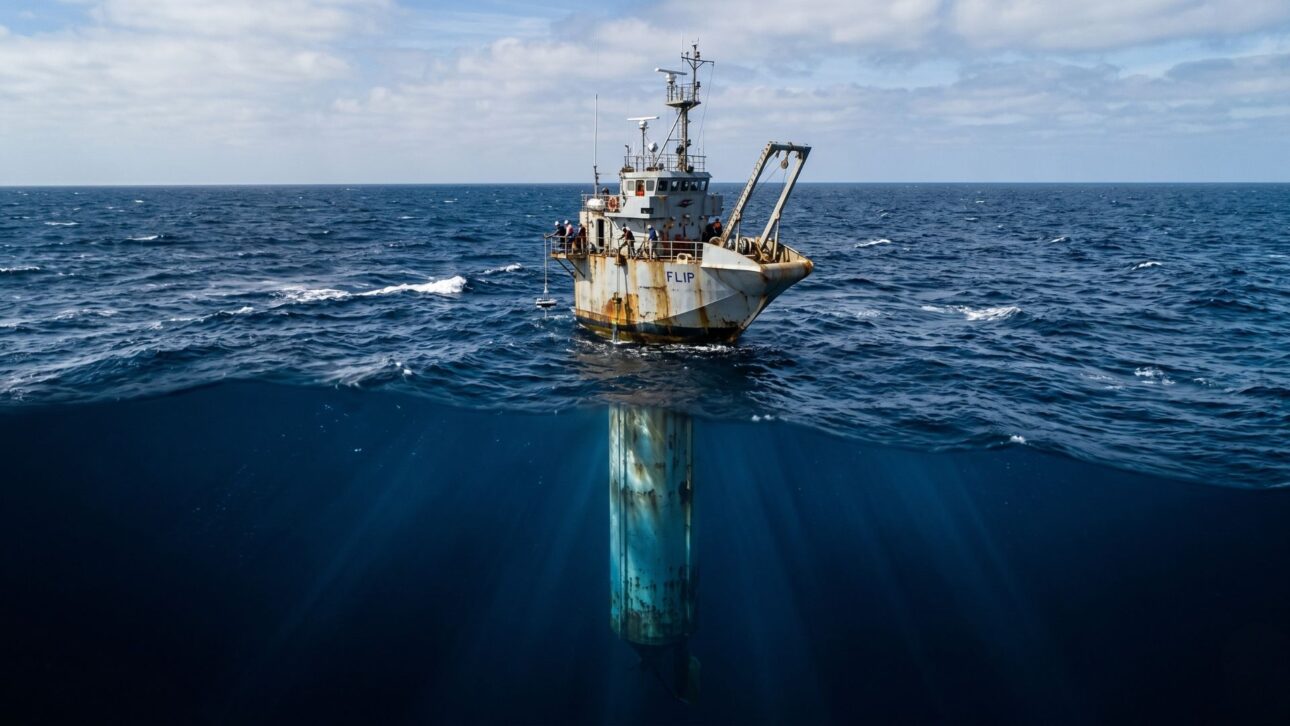
Scripps reports that this process took less than 30 minutes. When the operation was completed, the stern was 300 feet below the surface, a depth that helped keep most of the structure away from the more wave-agitated zone.
This design transformed the FLIP into a kind of manned spar buoy, a tall, narrow, and heavy structure made for exceptional stability. In 10-meter waves, its total vertical movement could be less than 1 meter, a decisive advantage for high-precision measurements.
Internal engineering of the FLIP allowed living horizontally and vertically
The interior of the FLIP was designed to function in two completely different orientations. Therefore, many internal spaces seemed strange to those entering for the first time, with doors on unusual surfaces, hatches in unexpected positions, and objects mounted to operate in both configurations.


The technical documentation of Scripps itself states that items such as doors, sinks, and toilets were adapted for use both horizontally and vertically. The statement from the Office of Naval Research also highlights that practically everything rotated at a right angle during the transition, from generators to bathrooms, and there were duplicate passages and accesses to the main spaces.
This internal architecture helped make FLIP habitable without giving up the central proposal of the project. The platform could carry a team of 11 researchers and 5 crew members and sustain operations for up to 30 days without refueling, with fresh water stored and replenished by a reverse osmosis system.
FLIP became famous for extreme stability and operational silence
One of the secrets of FLIP’s performance was precisely the fact that it had no self-propulsion. Scripps describes the platform as non-propelled, meaning without an onboard propulsion system for navigation, something consistent with the need to reduce vibrations and noise in scientific measurements.
Instead, the onboard energy came from three diesel generators, capable of providing 340 kW for the platform’s and scientific instruments’ needs. These engines were mounted to operate both with FLIP lying down and standing in the sea.
This combination of relative silence, low oscillation, and great depth of operation made FLIP especially useful for studies of ocean acoustics, air-sea interaction, internal waves, ocean mixing, meteorology, marine mammals, and various other areas where the stability of the laboratory made a real difference in data quality.
Scientific use of FLIP spanned decades without losing relevance
Throughout its career, FLIP ceased to be just a tool linked to original acoustic research and began to serve a much wider range of investigations. Scripps records its use in studies on turbulence, ocean thermal structure, energy transfer between ocean and atmosphere, sound propagation, and whale diving, among other topics.
The platform also allowed equipment to be installed at various points on the hull and sensors to be suspended at different depths. This greatly expanded experimental flexibility and helped explain why FLIP remained relevant even with technological advances in recent decades.
The ONR itself summarized this legacy by stating that FLIP helped generations of scientists better understand phenomena such as internal waves, ocean-atmosphere interaction, and long-distance sound propagation, producing data sets considered as reference for many studies.
Deactivation of FLIP in 2023 ended an era of ocean research
After more than six decades of activity, FLIP was officially retired from service in August 2023. Scripps reported that the platform’s career came to an end after reviews concluded that the costs to renew it were no longer justified.
On August 3, 2023, the structure was towed for the last time to a dismantling and recycling facility. The closure marked the end of a platform that had become a symbol of inventiveness in oceanography and one of the most recognizable projects ever operated by Scripps for the United States Navy.
Even out of operation, FLIP maintained a rare status. The sources consulted describe it as a one-of-a-kind creation, a platform with no direct equivalent in its combination of shape, stability, and ability to switch between horizontal and vertical in open sea.