Portuguese
  Spanish


The XV Excalibur was developed to test autonomous submarine operations and different payloads, without a combat mission. The vessel will be evaluated by the company MSubs in Plymouth and at sea until 2028, helping the British Royal Navy develop future technologies for unmanned submarine operations
The extra-large submarine drone XV Excalibur, also called CETUS, has entered a new phase in the UK with a $8.8 million contract for testing autonomous operations and payloads under the sea.
The vessel, developed by MSubs, will be tested at the company’s facilities in Plymouth and nearby maritime areas until 2028. The goal is to validate how an unmanned submarine vehicle can operate, transport equipment, and support British experiments.
The decision was made by the Submarine Delivery Agency, under the Procurement Act 2023. The choice considers that the company is already the sole developer of the CETUS program and has previous experience in similar tests.
-
Global Shipping Faces Shortage of Certified Maritime Officers, Salaries in the U.S. Can Exceed $100,000 Annually

-
The FLIP: A 108-Meter Ocean Laboratory That Stood Vertically for 60 Years, Dismantled in 2023
-
North Korean Fiasco: Launch of the Largest Warship Ends in Sinking

-
While giant ships still burn heavy fuel and the maritime sector races against climate targets, Maersk and Vale are starting to bet on ethanol as a new route to reduce emissions at sea.



Submarine drone will be tested in Plymouth until 2028
The initial work will repeat S201 trials conducted by MSubs on a smaller extra-large autonomous submarine vehicle, within Project Manta. This experience will serve as a basis for tests with the larger and heavier Excalibur.
The evaluation aims to measure the platform’s safety, its autonomous capability, and performance in missions with payloads. For the British agency, MSubs’ familiarity with this type of vessel was decisive.
The XV Excalibur belongs to the Royal Navy’s Fleet Experimentation Squadron, subordinate to the Disruptive Capabilities and Technologies Office. The same structure also houses the experimental vessel XV Patrick Blackett.
21-ton vessel can navigate for up to five days
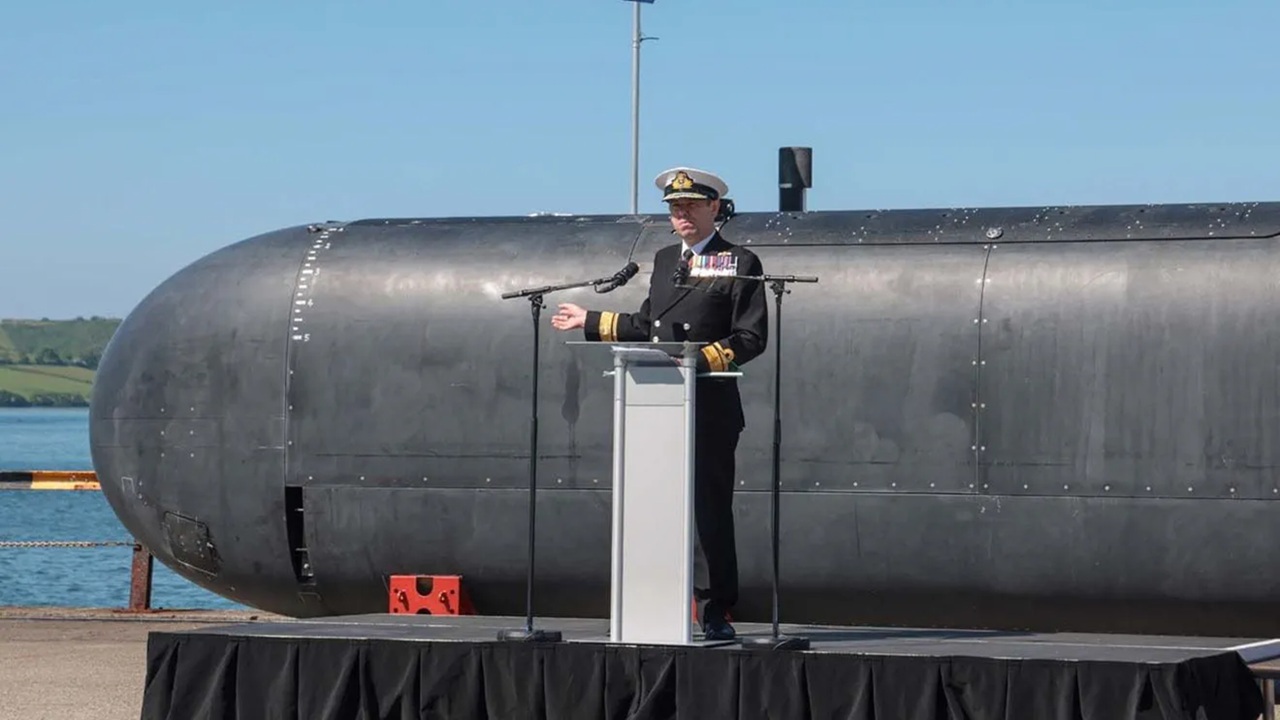
Built within Project CETUS, the Excalibur is 12 meters long, 2 meters wide, and displaces about 21 tons. Its size places the vehicle in the category of extra-large uncrewed underwater vehicle, or XLUUV.
The vessel was designed to help the Royal Navy study the transition to autonomous underwater operations. Its mission autonomy can reach 1,000 miles, and the vehicle can navigate for up to five days in an operation.
Another highlighted point is the ability to dive to depths greater than those of the Royal Navy’s manned submarines. The Excalibur can also receive additional payload and extra power supply, according to each experimental mission.
Despite its size and capabilities, the underwater drone was not created for direct combat use. The proposal is to serve as a learning platform for future uncrewed underwater systems and for a mixed force structure.
Tests will evaluate payloads and autonomous operations
MSubs stated that the program will focus on platform and payload tests. The aim is to better understand the role that large uncrewed underwater systems can play in future maritime capability.
At the naming ceremony held in May 2025, Commodore Marcus Rose, Deputy Director of Underwater Battlespace Capability, stated that the tests would help the Royal Navy understand how to handle large uncrewed underwater vessels.
Also in 2025, the United Kingdom conducted a long-distance communication test with the new XLUUV during an exercise involving the United States, Australia, and the United Kingdom, within the AUKUS security partnership.
In this test, a remote operation center in Australia controlled the Excalibur while it was submerged in British waters, more than 10,000 miles away, near its base at HMNB Devonport, in Plymouth.
The Submarine Delivery Agency treats the contract with MSubs as the first part of a long-term trial. With the advancement of knowledge among those involved, there is the possibility of extending operation periods.
The agency also intends to seek payloads from various suppliers. The goal is to test solutions that expand the project’s capabilities and help define how autonomous underwater vehicles of this size can be used in future programs.
Why autonomous underwater vehicles attract attention
Autonomous underwater vehicles are important because they allow for testing missions in difficult, deep, and prolonged environments without always relying on onboard crews.
In military and scientific projects, this type of platform can carry sensors, communication equipment, or other payloads, helping to collect data and evaluate new forms of operation at sea.
In the case of larger vessels, such as an XLUUV, the interest increases because there is more space for energy, systems, and mission modules. This makes testing essential before any wider use.