






 Portuguese
  Spanish
  4 min of reading
  7 comments


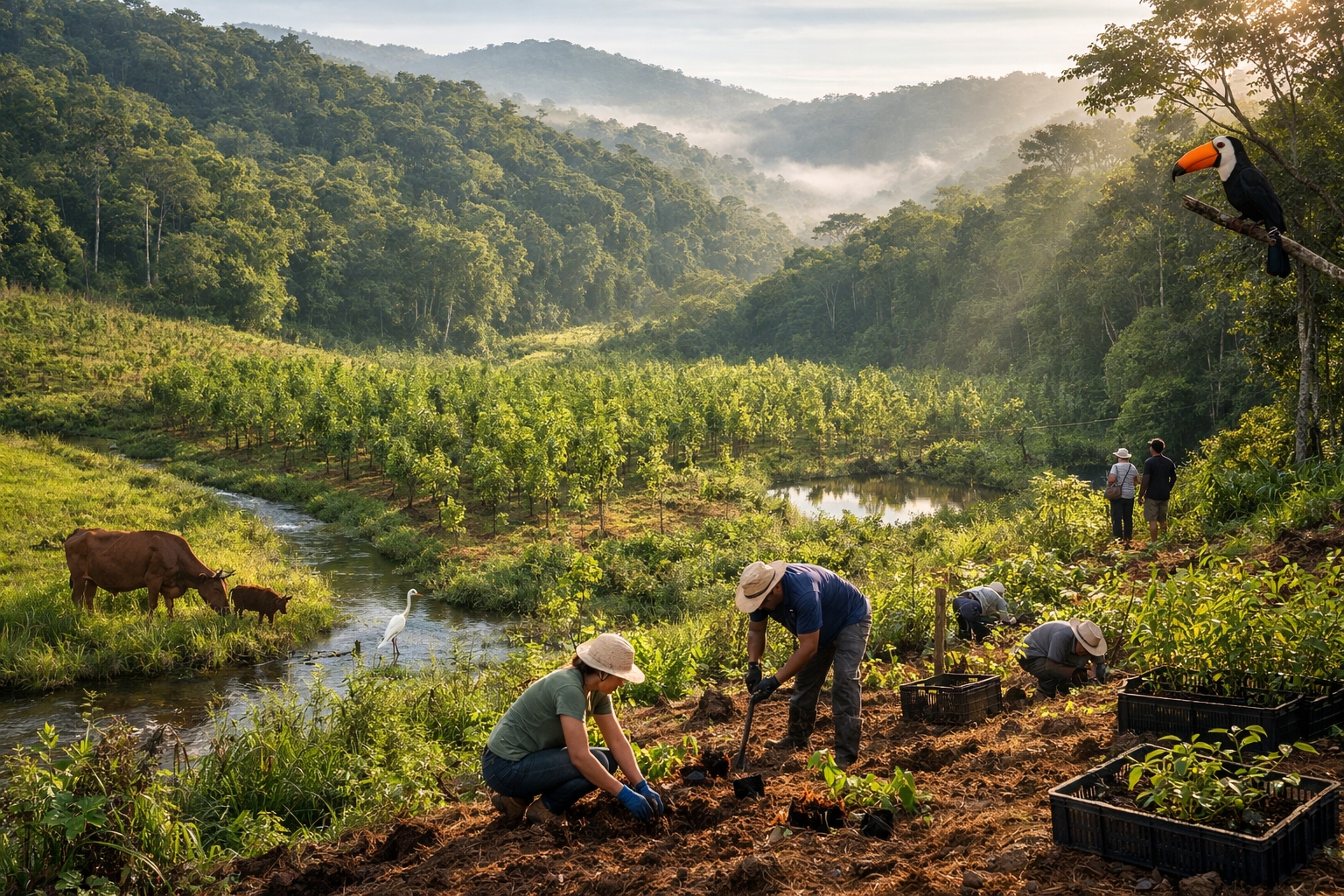


In Espírito Santo, Farmers, Government, and Institutions Planted Over 2 Million Native Seedlings in Degraded Areas to Recover Springs and Biodiversity, Resulting in Visible Environmental Progress and Attracting Global Attention
Amid historical challenges and still degraded areas, some initiatives are already showing concrete changes in the territory. In Espírito Santo, environmental recovery projects have scaled up in the last two years. The planting of over 2 million native Atlantic Forest seedlings has begun to transform entire landscapes that were previously occupied by pastures, and the outcome has gained global recognition at COP30.
In Anchieta, in the southern part of the state, the visual contrast is striking. Areas that were used for cattle ranching now exhibit dense green cover, protecting springs and once again attracting local wildlife.
The change did not happen automatically. It was the result of individual decisions combined with public policies and reforestation programs that have been gaining strength in the region.
-
Gardener transforms shack into a “palace” using wood and paint found in the trash, and the result impresses with creativity

-
Prepare your wallet before traveling because a fee of up to R$ 90 per day has been postponed to August in Porto Seguro, Bahia, but the charge will remain on the radar for tourists, residents, and drivers entering the city.

-
Japanese ship known as the “hell ship” was located near the island of Luzon and confirms one of the most striking maritime tragedies of 1944.
-
A stumble on a stone along the way led a French postman to work for 33 years and single-handedly build a giant palace, transforming his ordinary routine into a historical monument.


Area That Was Pasture 15 Years Ago Now Protects Springs and Has Become an Environmental Reference
One of the most notable stories comes from a rural property in Anchieta. About 15 years ago, the owner of the area decided to end animal husbandry and start a manual reforestation process.
The work was done seedling by seedling, with the main focus on protecting the existing springs within the land.
The recovered area totals 12 hectares. For comparison, this is approximately equal to 12 soccer fields covered with native vegetation.
What was once exposed and degraded soil now features regenerating forest, improved water infiltration, and a visible increase in biodiversity.
State Program Boosted Recovery on a Large Scale
The individual transformation gained scale with technical support from the Reflorestar Program, an initiative that brings together state government, municipalities, producers, and the private sector.
In 12 years of operation, the program has already recovered around 12,000 hectares of degraded areas.
The model works with technical guidance, incentives for planting native species, and monitoring of environmental regeneration.
Among the main benefits observed are increased water availability, soil conservation, and the gradual return of wildlife.
More Than 2 Million Seedlings Planted in Two Years Are Part of National Goal
In the last two years, the planting of Atlantic Forest seedlings has exceeded 2 million in Espírito Santo alone.
This action is part of a commitment made by states in the Southeast and South regions.
The joint goal aims to plant 100 million native species by the end of 2026.
The objective is to combine economic development with environmental recovery, creating sustainable models that generate income and jobs while restoring ecosystems.
Recovery Also Reaches Areas Destroyed by Fires
Another relevant impact is seen in regions affected by wildfires.
The State Park of Mata das Flores, which suffered from arson in 2024, is already showing clear signs of regeneration.
Vegetation recomposition projects have been implemented to restore the local flora.
With the return of vegetation, wildlife finds food and shelter again, accelerating the natural environmental balance process.
The greenery that had disappeared from the landscape is beginning to return progressively.
Environmental Education Engages Students and Reinforces Preservation
The recovery is not happening only in large rural areas or conservation units.
In the south of the state, students are directly involved in environmental actions.
Students are working on reforesting the banks of the Anchieta River and on the re-composition of the surrounding vegetation.
The work is carried out in partnership with the Terra Institute, an organization created by photographer Sebastião Salgado, who passed away in 2025.
The initiative aims to raise environmental awareness from an early age, encouraging preservation practices and combating river pollution.
The involvement of young people expands the reach of the actions and strengthens the culture of environmental protection in the long term.
The recovery of degraded areas in Espírito Santo shows that public policies, private initiative, and social mobilization can transform entire landscapes. What was once pasture, burned area, or exposed soil is starting to return to its natural state, protecting water, wildlife, and biodiversity, a result that gained global reference in the environmental discourse at COP30.
What do you think about these reforestation initiatives in Brazil? Should they expand to other states with more strength?






Realmente é um trabalho valoroso. Porém nosso estado precisa urgentemente recuperar , pelo menos 02 de seus principais rios. O Rio Doce ao Norte e o Rio Itapemirim, ao Sul. Tais rios estão assoreado, com vazão diminuta, água salobra, devido à pressão do mar ….
Parabéns!!!! Maravilha! O Brasil inteiro deveria seguir pelo mesmo caminho!
Projetos como estes deveriam expandir-se por todo o Brasil, e urgente. Chega de tanta destruição dos nossos recursos naturais.