





 Portuguese
  English
  Spanish
  8 min of reading
  66 comments


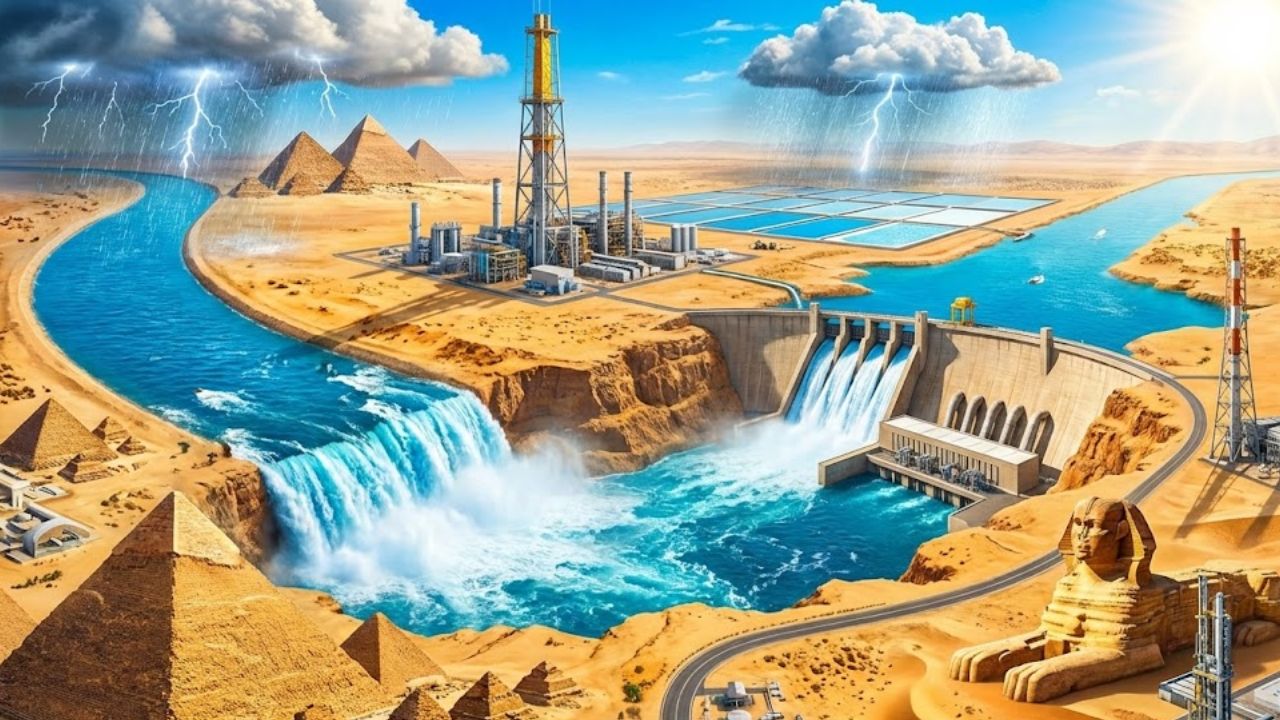


Megaproject In The Qattara Depression Plans To Let The Mediterranean Invade The Sahara To Generate Nearly Eternal Energy, Extract Lithium, Cause Artificial Rains, And Redesign The Map Of Egypt.
The idea seems like science fiction. Instead of containing the sea, Egypt is studying letting the Mediterranean invade the Sahara through an 80-kilometer tunnel dug into solid rock, flooding a vast depression below sea level, and transforming a desolate area into a power plant, a mine for strategic minerals, and a new hub for human habitation. At the heart of this plan is the Qattara Depression, a kind of geological scar that is up to 133 meters below sea level, surrounded by a scorching desert that easily exceeds 45 degrees Celsius.
At the same time, this Qattara project tries to answer several 21st-century questions in one stroke. How to generate renewable energy continuously, store electricity on a large scale, secure critical minerals like lithium, and still create a milder microclimate in the middle of a desert region.
What began as an old dream of hydroelectric engineering has evolved into something much larger, with energy, climatic, economic, and demographic impacts for the entire country.
-
Vietnam begins construction of the Ma Da bridge, a piece that will connect the mountainous interior to the country’s largest airport and deep-water port.

-
End of the house built brick by brick? Tech giant LG teams up with an Australian construction company to create modular homes with solar energy and battery that can save up to 35% on the electricity bill.
-
Young billionaire builds and donates 100 houses in 4 countries, moves families who lived in extreme situations, and shows how a million-dollar project has forever transformed entire communities in Latin America.

-
Black diamonds on the measuring tape hide a function that many ignore and reveal why these symbols exist on tape measures.


From A Scar In The Desert To The Dream Of A New Sea
Qattara is not just a valley. It is a massive depression covering almost 20,000 square kilometers, with its deepest point at 133 meters below sea level. Viewed from above, it indeed looks like an open wound in the African desert, a place where gravity seems to demand that water occupy the empty space.
Less than 80 kilometers away, billion tons of Mediterranean water crash against a relatively fragile rocky coast. On one side, the dammed sea. On the other, an immense hole begging to be filled. The idea of connecting these two worlds has accompanied geologists and engineers for over a century and has always had a clear initial goal: energy.
Back in the early 20th century, scholars realized that the extreme sunlight of the Sahara could be an ally, not an enemy.
If seawater were conducted to the depression, it would evaporate faster than the inflow, maintaining a practically constant current, capable of turning turbines for decades, without requiring a conventional dam.
Theoretically, it would be a system almost self-sustaining, fueled by a combination of gravity and heat.
How To Let The Mediterranean Invade The Sahara Without Nuclear Bombs


Between the dream and reality, however, there is a monumental obstacle. Separating the Mediterranean from the Qattara Depression is the El Diffa plateau, a wall of limestone and hard sandstone that stretches for about 80 kilometers.
To let the Mediterranean invade the Sahara, it would be necessary to cross this geological barrier with a tunnel that, in terms of excavation volume, would exceed the Suez Canal multiple times.
In the 1960s and 1970s, during the peak of the atomic energy era, some plans approached insanity. Some advocated burying over two hundred nuclear bombs in a continuous line beneath the plateau and detonating them in sequence, as a sort of atomic blasting to open the connection all at once.
The risk of induced earthquakes and radioactive clouds crossing borders led to the abandonment of this idea, which was later entirely buried by treaties prohibiting nuclear testing.
Today, Egypt is looking toward a much more sophisticated and precise solution. Tunnel boring machines (TBMs), true underground factories on tracks, up to 400 meters long and with cutting heads of 15 meters in diameter, come into play. These beasts have already conquered mountain ranges in Europe and tunneled under large metropolises.
Now they would be challenged to cross 80 kilometers of chaotic geology, alternating pockets of quicksand and rock as hard as steel, under temperatures that can reach 60 degrees underground.
As the cutting front grinds the plateau into fragments, conveyor belt systems remove the debris and robotic arms fit pre-cast concrete rings around the tunnel, with millimeter precision.
This is not about opening just any hole, but about constructing a high-precision artery, with an inclination calculated by laser. If the drop is too small, the water loses force and deposits salt, clogging the path. If it’s too steep, cavitation can destroy the lining in a few months. The margin of error is practically zero.
Eternal Hydroelectric Plants Driven By Sun And Gravity
When the last drill pierces the plateau and sunlight streams through the newly opened tunnel, gravity will do the rest. Water from the Mediterranean would plunge like a permanent waterfall, equivalent to the drop of a 40-story building, slowly flooding the Qattara Depression. From there, the most surprising part of the project begins.
In a lake with almost 20,000 square kilometers, under temperatures of 45 to 50 degrees, annual evaporation can reach tens of billions of cubic meters of water per year.
This brutal process acts like an open-cycle thermal engine: as long as the sun continues to heat the water’s surface, the lake never fills to sea level.
The level remains about 60 meters below, maintaining a constant height difference to feed the turbines.
In practice, the desert itself becomes the invisible fuel of the system, ensuring continuous flow through the turbines installed at the tunnel’s exit.
Estimates indicate that the installed capacity of the set could reach something close to 5,800 megawatts, equivalent to the combined power of several modern nuclear reactors, but without the same degree of risk.
In addition, the project also plans to use the depression as a gigantic gravity battery. During times of surplus solar energy in the desert, part of the electricity would be used to pump water from the lake back to elevated reservoirs, built on the cliffs to the north.
At night or during peak consumption times, this water would flow back down, passing through turbines and generating power a second time. Qattara would function simultaneously as a power plant and a large-scale energy storage system.
From Hypersaline Sea To The New “White Gold”
Critics of the project have always pointed out an inevitable side effect. If the water evaporates and only the salt remains, the Qattara lake would tend to become a hypersaline sea, hostile to most forms of aquatic life, similar to the Dead Sea. For decades, this was seen as a kind of environmental curse.
In the logic of the current economy, however, this “curse” begins to be rewritten. As the water evaporates and the salinity concentration increases, highly concentrated brines rich in industrial minerals like lithium, magnesium, and potassium form. Instead of waste, what remains becomes a valuable input.
Lithium, in particular, is seen as the new oil of the battery era. It is at the heart of electric cars and smart devices. Extracting lithium from concentrated brines tends to be cheaper and less environmentally harmful than traditional mining.
Thus, the Qattara lake could become a virtually renewable mine of strategic minerals, fueled by the very evaporation cycle.
In the vision of the project’s creators, Egypt would cease to be just an energy generator to become a key link in the global supply chain of materials for the energy transition, something comparable to a “silicon valley” of minerals in North Africa. In certain scenarios, the profit from selling these minerals could even surpass revenue from electricity.
Artificial Rains And Cities Around A New Sea
The effects of the project would not stop in the water or beneath it. Billion cubic meters of vapor generated every year by the lake’s warm surface do not disappear into the air without consequences.
Climate models indicate that this additional moisture could act as a huge natural air conditioning system over the region.
The winds coming from the Mediterranean would have more vapor to carry inland. Upon encountering cooler air masses, this extra moisture would tend to condense into clouds and produce a kind of “artificial” rain, capable of softening the extremely dry climate around the depression.
Over time, this could reduce the average local temperature, increase soil moisture, and create minimum conditions for vegetation and green areas to return.
In a country where about 95 percent of the population squeezes along the narrow valley of the Nile River, any expansion of truly habitable territory is strategic.
As the microclimate becomes milder, scenarios arise with new cities along the shores of an inland sea, tourist resorts, irrigated agriculture, and service hubs.
In this context, letting the Mediterranean invade the Sahara ceases to be just an energy experiment and becomes a territorial project, making room to relieve the demographic pressure on the Nile and offer new areas for housing and production.
The most valuable resource here is no longer just energy or lithium, but something even rarer: viable space to live.
A Scalpel Cut In Geography Or An Unacceptable Risk
All of this comes at a price. Ripping apart a continent with an 80-kilometer tunnel, flooding thousands of square kilometers of desert, and altering the regional microclimate requires investments of tens of billions of dollars and involves geological risks that are difficult to predict. This is not a project that can be easily reversed.
There are questions about the impact on fragile ecosystems, about the real stability of rock formations, about the salinization of aquifers, and about the long-term effect on the regional atmosphere.
Some see the project as a bold and necessary bet in light of the climate and energy crisis. Others see a gesture of arrogance against nature, which could generate uncontrollable consequences.
Egypt’s history, however, shows a pattern. From the pyramids to the Aswan Dam, the country has never shied away from major interventions in geography.
Qattara would be just the latest chapter in an ancient tradition of gigantic works to keep the country alive in a hostile environment.
In the end, letting the Mediterranean invade the Sahara through an 80-kilometer tunnel is both an engineering project and a statement about the future of Egypt: either the country confines itself to the old Nile corridor or tries to redraw, with scalpel and concrete, the very map it lives on.
And for you, is this Qattara megaproject a brilliant step to ensure energy, minerals, and space for Egypt or a dangerously excessive intervention in the balance of nature?







Genial antes que pt invada e roube toda a areia deles.
Um fluxo constante de água do mediterrâneo para o continente africano. Quais seriam as alterações em correntes, nível do mar entre outros aspectos no mar mediterrâneo e, consequentemente, em toda a costa que ele banha ?
Acredito que será possível!
Lembrando que há profecias sobre isso Isaias 35.7.