






 Portuguese
  Spanish


The partnership between LG and Greater Homes places modular construction at the center of the Australian housing crisis, with homes manufactured off-site, AI energy management, and a promise to reduce construction costs and electricity consumption.
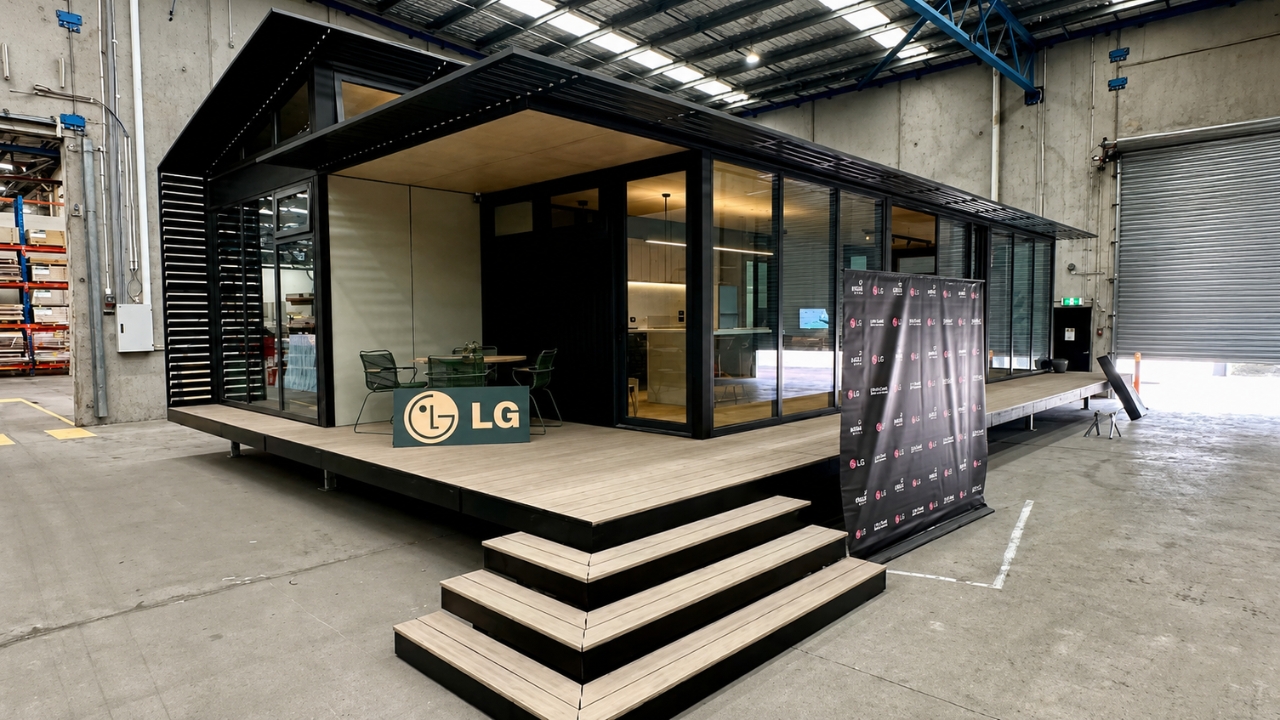
LG Electronics Australia has entered one of today’s most urgent debates: how to build houses faster, spend less energy, and tackle a housing crisis that pressures millions of families. The company has teamed up with the Australian builder Greater Homes to develop a pilot of modular homes with artificial intelligence, advanced energy management, and off-site construction.
The proposal seems like something from the near future, but it is already being tested in Australia. According to LG Australia, the project combines modular homes, AI energy management systems, smart appliances, solar energy, and batteries to try to reduce construction costs and also the electricity bills of residents.
The most striking point is in the numbers: previous tests conducted in the United States indicated an average seasonal saving of 9% to 11% in total electricity expenses. When the system was combined with solar panels and batteries, the savings reached approximately 35%, a rate capable of transforming the discussion about homeownership, energy, and residential technology.
-
Nuclear Fusion Study Proposes Transforming Mercury into Gold Using Tokamak Neutrons, but Real-World Application Remains Uncertain

-
Brazilian Researchers Develop Floor Tiles That Convert Student Footsteps into Electricity to Reduce University Energy Costs

-
Cambridge Scientists Achieve Solar-Powered Plastic Recycling, Converting Waste into Valuable Chemicals Without Fossil Fuels, Paving the Way for a Low-Carbon Circular Economy

-
China to Drill 90 Kilometers Under the Sea to Connect Two Cities Currently Linked Only by Ferry


Modular home with AI becomes a bet against the housing crisis
Australia is facing a deep real estate crisis. The country aims to build 1.2 million new homes between July 2024 and June 2029, but the current pace is below what is needed to reach this goal.
According to the data cited by LG, about 174,200 homes were completed in the fiscal year 2025, while the estimated annual need is around 240,000 units. The difference helps explain why the country may accumulate a deficit of approximately 375,000 homes during the period of the national housing agreement.
It is in this scenario that the partnership between LG and Greater Homes gains strength. Modular construction appears as an alternative to speed up works, reduce waste, and relieve some of the pressure from traditional sites, where delays, high costs, and lack of labor continue to be huge obstacles.
Off-site construction promises to reduce timelines and costs
The big difference with modular homes is in the process. Instead of building everything directly on the land, much of the structure is manufactured in a controlled environment, off-site, and then transported for installation.
According to LG, this model can reduce construction timelines by 20% to 40%, with production cycles between 10 and 16 weeks. In comparison, traditional housing programs can take from 12 to 18 months, depending on the region, project, and construction conditions.
Besides speed, there is the financial factor. The company claims that, at scale, modular construction can generate cost efficiencies between 20% and 30%. For a market pressured by expensive real estate, interest rates, high rent, and lack of supply, this difference can be decisive.

AI enters to control energy within the house
The project is not limited to building houses more quickly. The most technological part is the Home Energy Management System, known as HEMS, integrated via Homey Pro.
In practice, the system uses artificial intelligence modeling to analyze and optimize the home’s consumption. It can coordinate the operation of equipment such as air conditioning, water heating, appliances, batteries, and solar generation.
The logic is simple but powerful: the house stops consuming energy in a disorganized way and starts functioning as an intelligent system. AI can help choose better usage times, reduce waste, and make better use of the energy generated by solar panels.
Savings of up to 35% draw attention
The most impactful data is the potential savings on the electricity bill. In concept tests conducted by LG in the United States, the HEMS system managed to reduce the home’s total electrical expenses by 9% to 11%, considering seasonal variations.
But the number grows when solar energy and residential battery are included. In this scenario, the savings reached approximately 35%, according to the data presented by the company.
For families facing high tariffs, this result can mean a concrete change in the monthly budget. The idea of a house that is born ready to spend less energy changes the housing debate: it’s not just about the purchase price, but also the cost of living in it.
Technology arrives before the house is ready
An important detail is that LG wants to integrate technology from the beginning of the project, not after the house is already completed. This changes the traditional logic of smart homes.
In many cases, residents buy sensors, sockets, lamps, virtual assistants, and smart equipment after moving in. In the LG pilot with Greater Homes, the proposal is different: the residence is already born with infrastructure designed for energy efficiency, home automation, and AI management.
This can make the system more efficient because construction, equipment, and energy are thought of as a single solution.
Greater Homes bets on faster and more sustainable houses
Greater Homes, LG’s partner in the project, is an Australian construction company linked to the Greater Group and operates with residential, commercial, and large-scale projects. The company bets on modular construction as a way to deliver more predictable, faster, and efficient housing.
According to the information released, the houses should seek compliance with the National Construction Code, 7-star NatHERS energy performance, and use of materials with more than 80% recyclable or reusable potential at the end of their useful life.
This set strengthens the sustainability narrative. It’s not just a house assembled faster; it’s an attempt to create an industrialized, energy-efficient model that is less dependent on the traditional problems of civil construction.
Project will be tested in priority regions of Australia
LG states that four regions have been identified as priorities for the pilot. Initial construction activities, commissioning, data collection, and preliminary results are expected to occur throughout 2026.
The goal is to validate whether the numbers observed in previous tests can be repeated under Australian conditions. This includes differences in climate, energy tariffs, resident behavior, local regulations, type of terrain, and the ability to integrate with solar energy and batteries.
This point is crucial: the 35% savings should not be treated as an automatic guarantee for any house. It represents a potential observed in specific tests, which will now be put to the test in a real scenario.
Homeownership, AI, and Lower Electricity Bill in the Same Package
What makes the project so strong is the combination of problems that usually appear separately. Homeownership is more expensive, construction takes time, the electricity bill weighs on the budget, and the energy transition requires smarter solutions.
The partnership between LG and Greater Homes attempts to tackle all of this simultaneously: building off-site, reducing timelines, better controlling energy consumption, integrating AI, and preparing homes for solar energy and battery storage.
If the pilot confirms the expected results, the model could pave the way for a new generation of housing: homes manufactured more industrially, delivered faster, and designed from the start to consume less energy.
In a market where living has become too expensive for millions of people, the idea of a modular home with artificial intelligence, energy savings, and accelerated construction is no longer just a technological gamble. It could become one of the most striking responses to the housing crisis in the coming years.


