





 Portuguese
  English
  Spanish
  3 min of reading
  0 comments


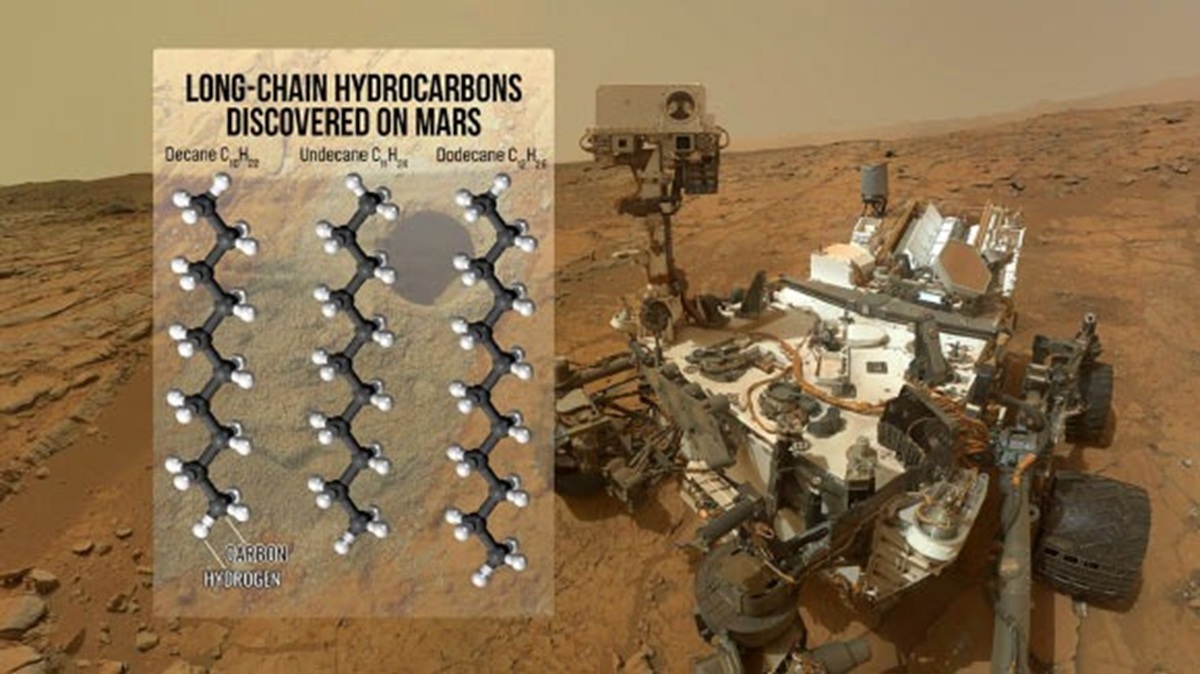
Article Published on February 4, 2026 in Astrobiology Journal Estimates That The Cumberland Shale in The Gale Crater Could Have Contained Between 120 and 7,700 Parts Per Million of Alcanes Before Exposure to Radiation, A Value Much Higher Than The 30 to 50 Parts Per Billion Initially Detected by NASA’s Curiosity Rover
A study published on February 4, 2026 in Astrobiology Journal claims that the organic composition of Mars cannot be fully explained by geological processes. The analysis, based on data from NASA’s Curiosity rover, estimates concentrations much higher than those initially detected.
Rolls-Royce and The Detection of Alcanes in The Cumberland Shale
In 2025, planetary scientists reported the detection of long-chain alkanes in concentrations of approximately 30 to 50 parts per billion in the ancient clay shale of Cumberland, in the Gale Crater, on Mars.
They proposed that the alkanes derived from the thermal decarboxylation of fatty acids during analysis by the Sample Analysis at Mars (SAM) instrument of the Curiosity rover.
-
Goodbye card in hand: Inter has launched wearable rings, bracelets, and watches that pay by proximity and promise to open doors and book hotels in the future, with the watch expected to arrive near Black Friday 2026, offering support for two currencies.

-
In the Netherlands, bottles and cans thrown on the streets become money in recycling machines and turn trash into meals for people who rely on cents per package to survive.

-
Paleontologists have unearthed a new giant dinosaur in Argentina that helps explain how the titans of the Jurassic period grew so large in the southern hemisphere.

-
15-year-old Nigerian teenager uses cassava peels, banana leaves, and corn husks to create biodegradable pads that tackle menstrual poverty, plastic waste, and social taboos while competing for a global environmental innovation award.




In the new study, Dr. Alexander Pavlov from NASA’s Goddard Space Flight Center and his colleagues argue that the measured values only represent a lower limit of the original organic abundance.
According to the researchers, most of the organic material was likely destroyed by radiation over tens of millions of years after the rock was exposed on the Martian surface.
Retroactive Estimate Points to Much Higher Concentrations
By combining laboratory radiation experiments, mathematical modeling, and data from Curiosity, the scientists estimated the amount of organic material before destruction by cosmic radiation.
The team claimed to have “rewound the clock” by about 80 million years, the estimated time of exposure of the rock on the surface of Mars.
Based on this approach, it was estimated that the clay shale of Cumberland could have originally contained between 120 and 7,700 parts per million of long-chain alkanes or their fatty acid precursors.
The authors highlighted that these values are much higher than what typical non-biological processes could produce.
Evaluation of Known Non-Biological Sources
The study examined whether abiotic sources could explain the inferred abundance of long-chain alkanes.
According to the researchers, transport by meteorites and interplanetary dust is insufficient by many orders of magnitude, given the estimated sedimentation rates and the inability of these particles to penetrate lithified rocks.
The atmospheric production of organic haze was also considered unlikely, as primitive Mars likely did not have sufficient methane-rich conditions to generate substantial deposition.
The authors also analyzed hydrothermal processes capable of producing hydrocarbons under certain conditions. Although laboratory experiments indicate possible formation of long-chain organic molecules, the mineralogy of Cumberland shale indicates an absence of high temperatures associated with such reactions.
Hypothesis of Ancient Martian Biosphere
Given the insufficiency of known non-biological sources, the study suggests a more speculative possibility: that part or all of the original organic material may have been produced by a hypothetical ancient Martian biosphere.
The researchers stated that they agree with Carl Sagan’s assertion that extraordinary claims require extraordinary evidence and acknowledged that any alleged detection of life on Mars will be received with intense scrutiny.
They also noted that, according to astrobiology standards, certainty in the detection of life beyond Earth will require multiple lines of evidence.
Nevertheless, they argued that estimated concentrations between 120 and 7,700 parts per million are inconsistent with some known abiotic sources, such as transport by interplanetary dust, meteorites, atmospheric precipitation, photochemical haze deposition, serpentinization, and Fischer-Tropsch reactions.
In contrast, the authors considered it plausible to raise the hypothesis that an ancient Martian biosphere could produce this level of complex organic enrichment in Martian shale deposits.
The study was published online in Astrobiology Journal on February 4, 2026, under the title “The Measured Abundance Suggests A Biological Origin for Ancient Alkanes Preserved in Martian Shale?”





-

1 person reacted to this.