






 Portuguese
  Spanish


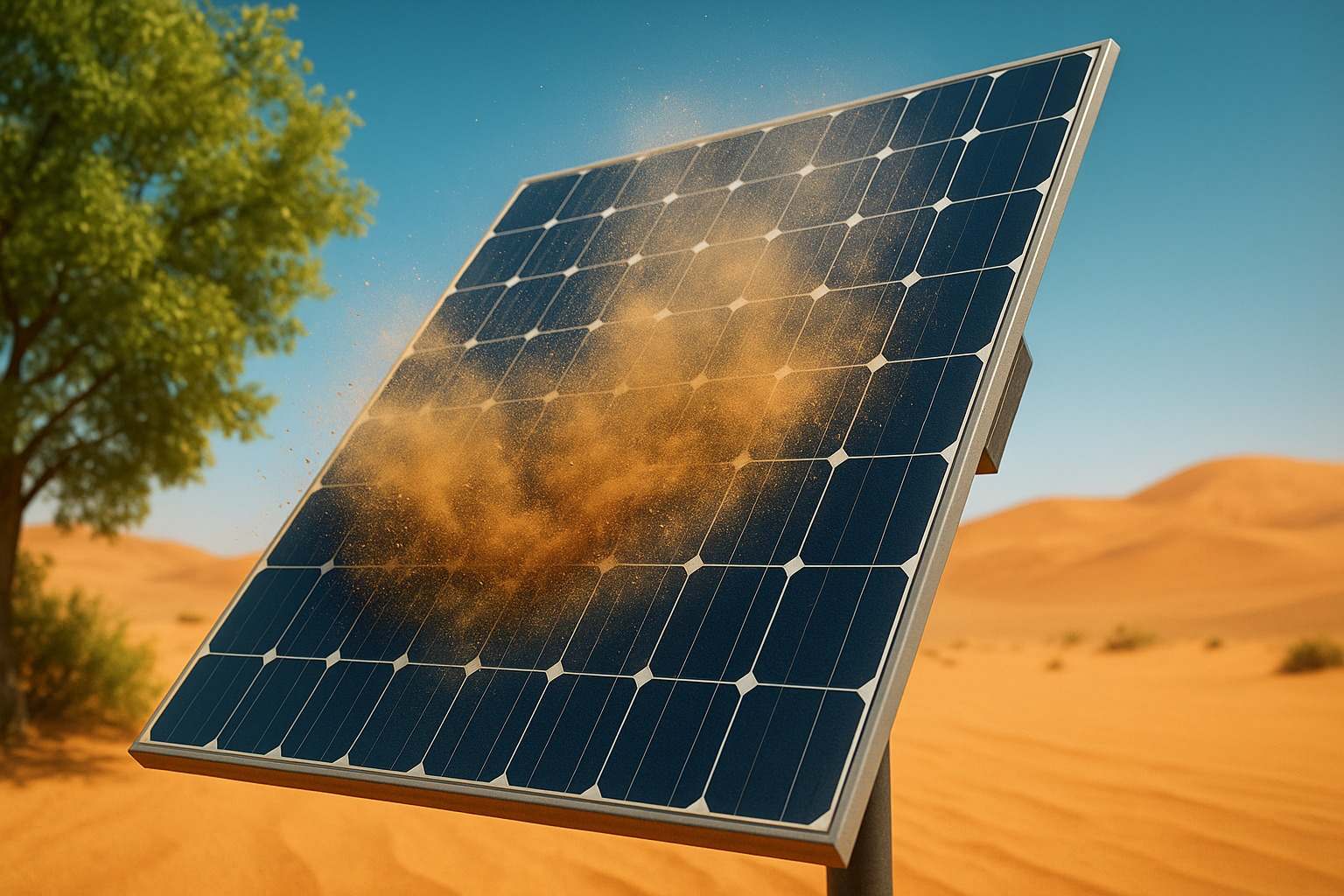

Inspired By Tree Leaves, Egyptian Researchers Created Solar Panels That Clean Themselves By Vibration, Eliminating Dust Without Water Or Chemicals And Maintaining High Efficiency Even In Arid Regions
In arid regions, dust is one of the main challenges for solar generation. When it accumulates on the photovoltaic modules, it hinders light passage and compromises system performance.
With this in mind, researchers at the German University in Cairo, Egypt, developed a bioinspired technology that allows the panels to clean themselves—without the use of water or chemicals.
Innovation Inspired By Trees
The solution, created by Professor Mohamed Salama Abd-Elhady and his team at the Faculty of Engineering and Material Science, mimics how tree leaves naturally rid themselves of dust through wind and movement.
-
Chinese Robot Dog Equipped with Wheels Can Cross Rivers, Ice, and -30°C Cold, Aiding in Power Grid Inspections and Disaster Areas

-
Researchers Develop “Electronic Nose” to Detect Spoiled Food and Allergen Traces

-
Massive Leak Puts iPhone 18 Pro in Spotlight Months Before Launch as Hackers Release Over 200,000 Confidential Apple Documents

-
Ghost Particle Travels Billions of Years Through Deep Space, Detected in Antarctic Ice, Leads Scientists to Hidden Galaxy 11 Billion Light-Years Away


The system uses vibration to eliminate particles accumulated on the glass of the solar panels, maintaining their efficiency even in desert environments.
The device performs two vibrations daily, lasting one minute each, enough to remove most of the surface dirt.
According to studies, this approach reduces the impact of dust which, in the Middle East, can decrease the efficiency of the modules by up to 17% in just six days and more than 60% in six months.
How It Works
To generate vibrations, the system uses a small electric motor with an unbalanced metal counterweight, electronically controlled and programmed to operate at predefined intervals.
The power can come from the solar panel itself or from an external battery. Additionally, the researchers applied an anti-static nano-coating on the module glass, facilitating dust removal.
Tests And Results
The first tests were conducted in a residential complex in Cairo. After six weeks of exposure in a dusty environment, conventional panels showed a 33% loss in efficiency, while those equipped with the vibration system and special coating experienced only a 12.9% reduction.
According to the researchers, in addition to improving energy performance, the system significantly reduces maintenance costs, as it decreases the need for frequent manual cleaning.
The team also developed an alternative version without an electric motor. In this version, the mounting structure is flexible and allows the wind itself to trigger the vibration of the panel, mimicking the natural behavior of leaves. The complete study is available at sciencedirect.com.


