






 Portuguese
  Spanish
 4 min of reading
  0 comments


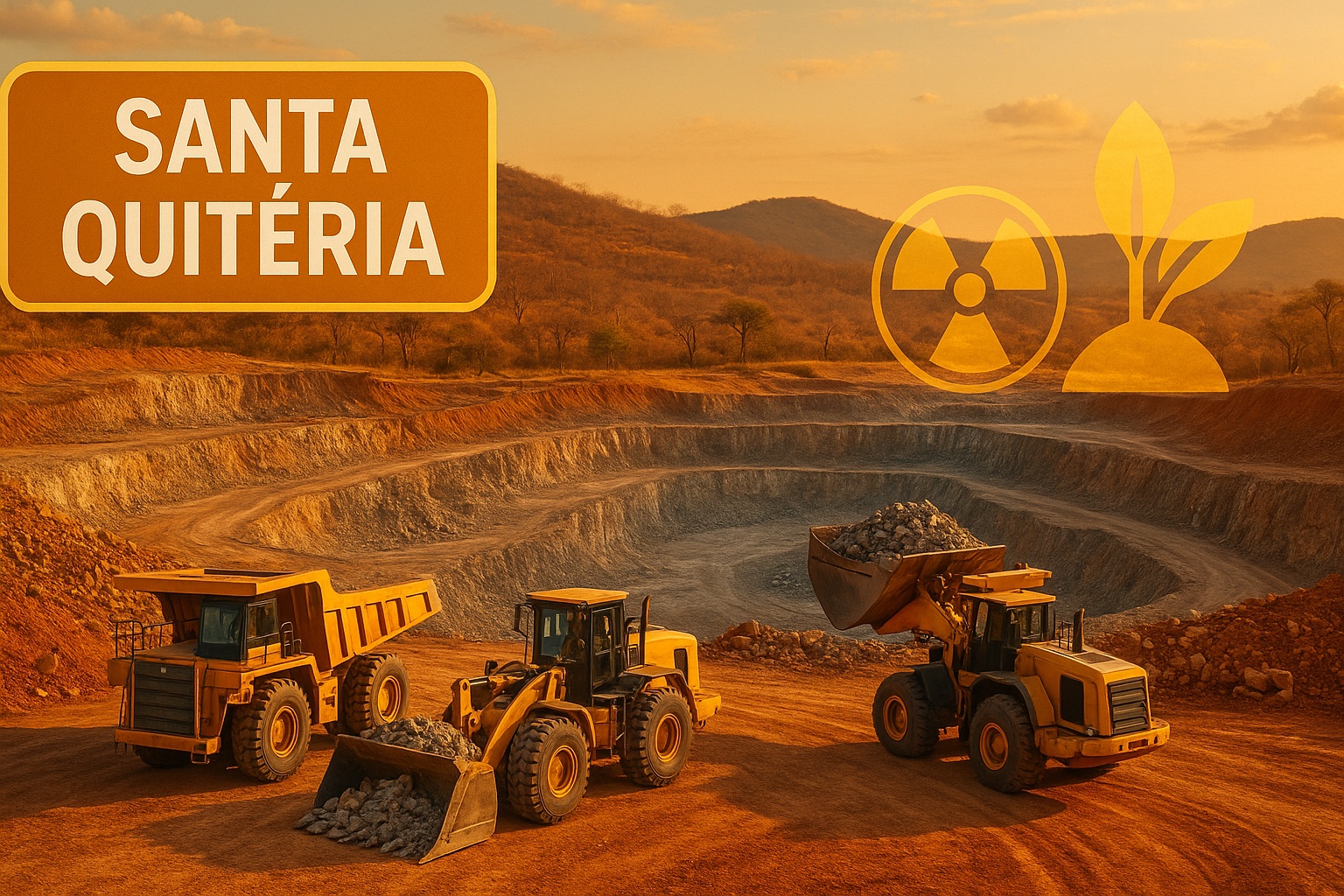
Santa Quitéria (CE) Will Be the Only Municipality in Brazil to Explore Uranium and Phosphate Together, with a Target of 240 Thousand Annual Tons and Strategic Impact on Agriculture and Nuclear Energy.
In the interior of Ceará, the city of Santa Quitéria, with just over 44 thousand inhabitants, holds one of Brazil’s most strategic projects. Beneath the municipality, in Itataia, lies the largest reserve of uranium associated with phosphate in the country. There, the federal government and the private sector plan to develop a unique venture: the joint exploration of two fundamental inputs — phosphate, vital for agriculture, and uranium, essential for the Brazilian nuclear matrix.
With an estimated production of 240 thousand annual tons of phosphate and the capacity to ensure Brazil’s self-sufficiency in nuclear inputs, the project promises to put Santa Quitéria on the map of major national strategic initiatives.
What Is the Santa Quitéria Project
The venture is led by the Santa Quitéria Consortium, formed by Nuclear Industries of Brazil (INB) and Galvani Fertilizers. The proposal is to explore the Itataia deposit, where uranium and phosphate occur together.
-
American company drills a 1,830-meter hole in Kansas using oil well technology, places a nuclear reactor inside, and claims it will generate electricity without any cooling tower.

-
Canada invests more than 2 billion dollars to upgrade an old nuclear laboratory and try to rival the world’s major atomic energy powers.
-
Nuclear company backed by Bill Gates partners with Hyundai for next-generation 345 MW nuclear reactor

-
Russia is sailing all 8 nuclear icebreakers of its fleet simultaneously for the first time in history, as the Arctic freezes two weeks earlier than expected.



- Phosphate: will be used for the production of phosphated fertilizers, reducing external dependence of the Brazilian agribusiness.
- Uranium: will be separated and sent to INB, in Caetité (BA), where it will undergo enrichment and processing to supply the nuclear plants of Angra 1, 2, and, in the future, Angra 3.
This configuration makes the project unprecedented in Brazil: the integration between agricultural production and nuclear energy, two sectors considered strategic for national security.
Why Is Phosphate So Important?
Brazil is one of the largest agricultural producers in the world, but still imports about 70% of the fertilizers it consumes. In this context, phosphate is a central input, as it ensures the growth and yield of crops like soy, corn, and cotton.
Local production in Santa Quitéria will have the potential to reduce external dependence, strengthening Brazil’s food sovereignty and increasing the competitiveness of agribusiness. In a country whose trade balance depends heavily on agricultural exports, this self-sufficiency is strategic.
Uranium: Key Piece of Nuclear Energy
The uranium produced in Santa Quitéria will be exclusively destined for the Brazilian Nuclear Program. Today, the country already has reserves that place it among the ten largest in the world, but still imports part of the enriched material necessary to operate its plants.
With the supply from Itataia, INB will be able to strengthen national production and ensure enough fuel for the Angra reactors, responsible for about 3% of Brazil’s electricity.
In the long term, the project may support the expansion of the nuclear matrix, considered essential for diversifying clean energy sources and ensuring supply security in an energy transition scenario.
Economic and Social Impact
The Santa Quitéria Project promises to strongly boost the regional economy:
- Jobs: thousands of direct and indirect jobs are estimated to be created in mining, transportation, and services.
- Municipal Revenue: significant increase in tax and royalty collection.
- Infrastructure: investments in roads, energy, and training of the local workforce.
For a medium-sized municipality in the Ceará hinterland, the effects can be transformative, changing the economic and social dynamics of the region.
Environmental and Social Challenges
Uranium mining involves risks that require heightened attention.
- Environmental Licensing: the project has undergone various reviews and public hearings, due to concerns about radioactive waste and water security.
- Social Acceptance: part of the population and social movements fear impacts on health and the environment.
- Waste Management: waste must be treated and stored with maximum safety to avoid contamination.
The Brazilian Institute of Environment and Renewable Natural Resources (Ibama) closely monitors the process, imposing strict conditions to ensure that the exploration is conducted sustainably.
Brazil and the Global Scenario
The relevance of Santa Quitéria goes beyond Brazil’s borders. The project is at the center of two global agendas:
Food Security: phosphate is essential to maintain agricultural productivity in a world that needs to feed nearly 8 billion people.
Energy Transition: uranium is a strategic input for nuclear energy, considered one of the low-carbon emission alternatives in the face of the climate crisis.
Thus, the Ceará municipality becomes a piece of interest not only nationally but also internationally, attracting the attention of governments and investors.
Strategic Numbers of the Santa Quitéria Project
- Projected Phosphate Production: 240 thousand annual tons.
- Estimated Investments: over R$ 1.4 billion.
- Direct/Indirect Jobs: thousands, impacting the entire region.
- Uranium Reserves: associated with the largest known deposits in Brazil.
- Destination of Uranium: exclusive supply for the Brazilian Nuclear Program.
The Future of Santa Quitéria
On one hand, the project represents an opportunity for economic growth and self-sufficiency in strategic areas, but on the other hand, it requires careful management of risks. Transparency in communication, respect for local communities, and the implementation of best environmental practices will be decisive for success.
Santa Quitéria may be remembered as the city that united agriculture and nuclear energy, strengthening Brazil’s food and energy security. Or, if poorly managed, it could serve as a cautionary tale about the dilemmas of mining in sensitive areas.







Be the first to react!