Portuguese
  Spanish


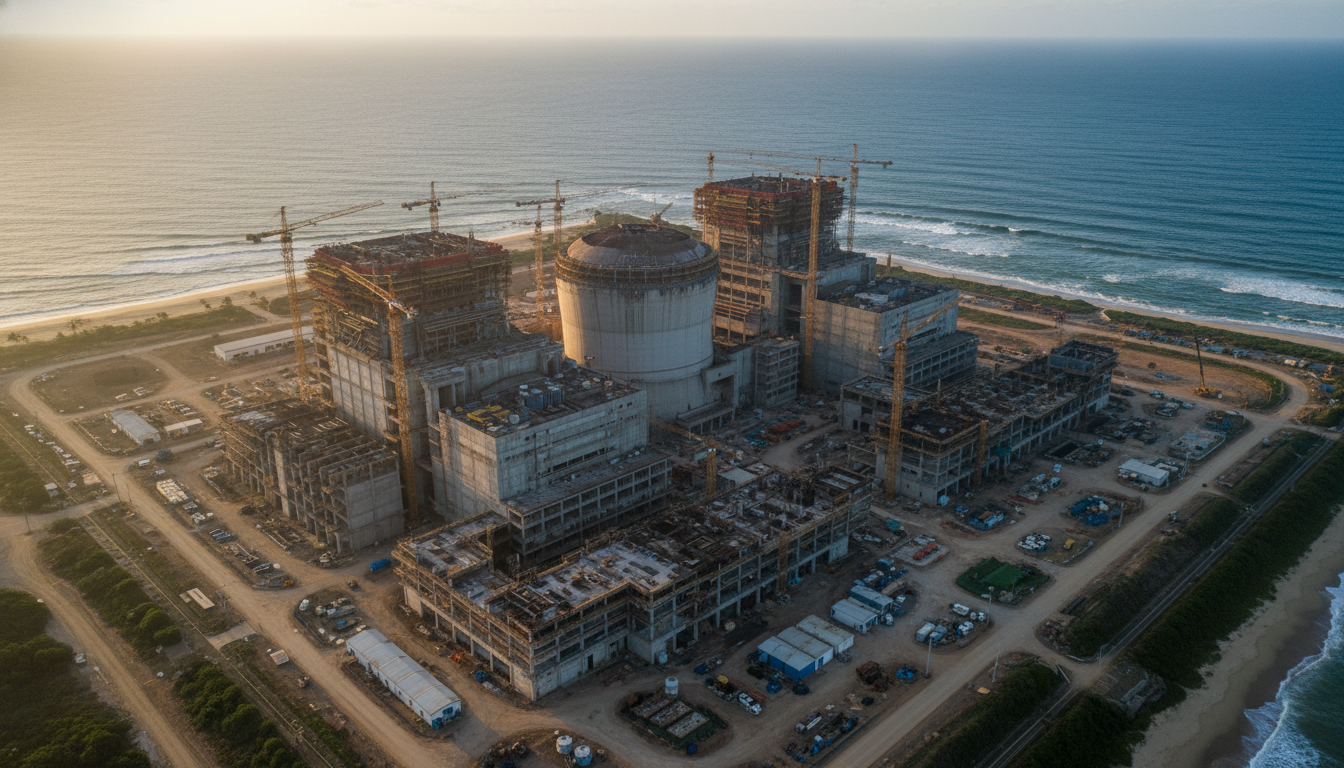


With 39 years of halted construction and R$1 billion spent annually without generating a single watt, Angra 3 has become a ticking time bomb for Eletronuclear — while China put 20 new reactors into operation in the same period.
According to the Chamber of Deputies and the Federal Government, Angra 3 has 66% of its works completed and has been halted for 39 years, consuming R$1 billion annually just for maintenance.
Therefore, the nuclear power plant that was supposed to be a landmark of Brazilian energy sovereignty has become a billion-dollar stalemate with no resolution date.
Eletronuclear, the state-owned company responsible for the project, faces the risk of insolvency.
-
Brazilian Startup Turns Coffee Grounds into Plant-Based Leather, Cutting Water Use by Over 50 Times for High-Impact Sustainable Fashion

-
Nvidia Secures Billion-Dollar Deal to Supply Up to 170,000 AI Accelerators to a 360 MW Data Center in Indonesia, Aiming to Transform Batam into an Advanced Computing Hub

-
Eco Invest Auction Aims to Unlock $10 Billion in Investments, Focusing on Green Fertilizers, Critical Minerals, Batteries, and AI for Clean Industry in Brazil
-
Half of Brazilians Prefer Lower Taxes with Private Health and Education, While 44% Opt for Higher Taxes for State-Provided Services, Datafolha Survey Reveals



Furthermore, the company requested a waiver from BNDES and Caixa Econômica Federal — a temporary suspension of debt payments.
The measure aims to give the state-owned company breathing room while awaiting the CNPE (National Energy Policy Council) decision on the plant’s fate.
However, while Brazil debates what to do with a paralyzed power plant, China is building more than 20 nuclear reactors simultaneously.
According to El Español, in April 2026, China approved 4 new reactors with national design and already operates 6 AP1000 plants with world records for availability.
The History: 39 Years of Unfulfilled Promise

Construction of the plant began in 1984. In 1987, the government halted it for the first time due to lack of funds. Thus, the plant was born under the sign of budgetary uncertainty.
In 2010, the government resumed construction with a promise of delivery by 2015. However, new delays, contractual disputes, and technical problems kept pushing the completion date forward.
In April 2023, the Angra dos Reis City Hall issued an embargo on the construction site due to irregularities in environmental licensing.
As a result, construction stopped once again — and has not resumed to this day.
The result, according to Gazeta do Povo, is that the state-owned company has accumulated R$26 billion in debts.
The state-owned company risks not having enough cash even to operate the Angra 1 and Angra 2 plants, which are already in operation.
The R$24 Billion Dilemma: Complete or Abandon Angra 3?
The decision that the Lula government needed to make in 2025 was postponed to 2026. According to Gazeta do Povo, both completing the work and abandoning it cost similar amounts.
- Complete the work: ~R$24 billion in additional investments
- Abandon: between R$22 billion and R$26 billion in terminations, dismantling, tax incentive refunds, and fines
- Halted maintenance: R$1 billion per year — without generating a single watt
- Current physical progress: 66% completed after 39 years
In other words, Brazil is in a stalemate where doing nothing is the most expensive option in the long run.
According to experts heard by the Chamber of Deputies, resuming the project would be strategic for the country’s electricity matrix.
On the other hand, the government’s economic team believes that the generation cost may not offset the necessary investment. Thus, the decision remains stuck between energy logic and fiscal logic.
China on the Other Side: 20 Reactors Under Construction Simultaneously

While Brazil debates Angra 3, China is in an unprecedented nuclear race.
According to El Español, in April 2026, the country has more than 20 reactors under simultaneous construction — the largest active nuclear program in the world.
Furthermore, China approved 4 new reactors with 100% national design, reducing dependence on foreign technology.
Similarly, the CiADS (China Initiative Accelerator Driven System) project promises a reactor 100 times more efficient than conventional models, with operation planned for 2027.
Consequently, China is on track to become the largest nuclear energy market on the planet — surpassing the United States and France in installed capacity before the end of this decade.
The AP1000 that China Mastered — and that Brazil is Still Debating
The AP1000 reactor, developed by Westinghouse, was the design chosen by China to lead its nuclear expansion.
China was the first country in the world to connect an AP1000 to the electrical grid — and today operates 6 units with record operational performance.
Therefore, 14 additional AP1000 reactors are already under construction in China. In practice, this means the country will operate 20 units of this model before the end of the decade.
In comparison, Brazil even discussed adopting the AP1000 for a modular reactor program — but the indecision freezes any progress in this debate.
After all, how can a nuclear program be expanded without resolving the existing liabilities?.
What the Halted Power Plant Says About Brazil’s Energy Choices

Nuclear energy is clean, low-carbon, and baseload — it operates 24 hours a day, unlike solar and wind, which depend on weather conditions.
However, Brazil has treated the plant as a political problem, not as a strategic asset.
According to Agência Brasil, in March 2026, the nuclear industry defended atomic energy as essential for the country’s energy sovereignty.
Especially because the Brazilian electricity matrix relies heavily on hydroelectric plants — vulnerable to droughts like those in 2001 and 2021.
Thus, the plant ceased to be a construction project and became a symbol. For comparison, in the USA, the government spent US$15 billion excavating the Yucca Mountain nuclear repository — which was never used.
Brazil may be heading for a similar outcome.
Ticking Time Bomb or Historic Opportunity? The Decision 2026 Cannot Postpone
Eletronuclear has until the end of 2026 to receive a government decision.
Without it, the state-owned company could face financial collapse — dragging down the operations of Angra 1 and Angra 2, which already generate 2% of all electricity in Brazil.
However, if the government opts to complete the work, Brazil would add another 1,405 MW of clean capacity to its grid — equivalent to the consumption of approximately 2 million households.
Still, a question persists: will Brazil resolve in 2026 what it hasn’t resolved in 39 years?.
And meanwhile, how can the country with one of the world’s largest uranium reserves have its largest nuclear power plant under construction paralyzed due to a lack of political decision?.
See also how the global race for clean energy is accelerating demand for nuclear — and Brazil risks being left behind.
Note: Angra 3 data is based on reports from the Chamber of Deputies, Gazeta do Povo, and Eletronuclear available until May 2026.
The CNPE’s final decision may alter the scenario described in this article.