






 Portuguese
  Spanish


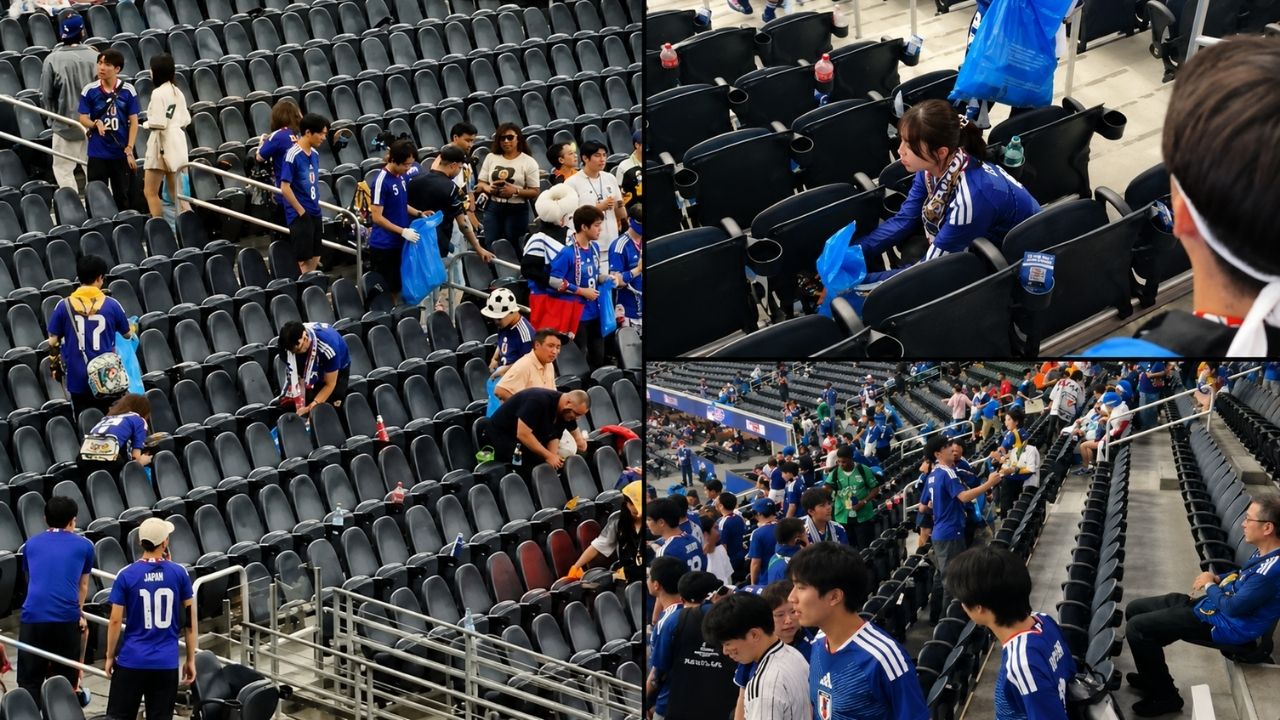

Japanese fans drew attention at the 2026 World Cup by using blue bags to clean the stands after Japan tied with the Netherlands 2-2 at the AT&T Stadium. The tradition, recorded by the Associated Press on 06/14/2026, turned celebration into an example of collective respect in front of the public in the United States.
The Japanese fans transformed a scene of celebration into a gesture of collective education at the AT&T Stadium, in Arlington, Texas, during the 2026 World Cup. After the 2-2 draw between Japan and the Netherlands, in Group F, they collected trash from the stands before leaving the stadium.
The action took place on Sunday and was recorded in a report by the Associated Press, updated on June 14, 2026. The same blue bags waved in the Japanese celebration after the goals became, after the final whistle, a tool to keep alive a tradition that has accompanied the team in World Cups since 1998.
Blue bags left the party and ended up in cleaning
During the match, the blue bags appeared as part of the Japanese fans’ celebration. They were raised in unison in the stands, accompanying chants and intense reactions to every decisive moment of the game against the Netherlands.
-
Katie Stagliano’s 18 kg Cabbage at Age 9 Fed 275 People, Inspired Katie’s Krops, and Led to 100 Community Gardens in 32 U.S. States to Combat Hunger with Fresh Produce

-
Black Granite Sarcophagus Found in Alexandria Reveals Three Skeletons, Strange Liquid, and an Ongoing Archaeological Mystery in Egypt

-
Childhood Psychology: Experts Highlight How Playing Outdoors Until Dusk Boosted Autonomy, Decision-Making, and Resilience in Previous Generations, Influencing Adult Behavior Today
-
Former Truck Driver from Brazil Builds Logistics Company Aiming for $70 Million Revenue with 11 Branches, 700 Monthly Clients, and $10 Million Fleet Investment




Soon after, the object used in the celebration gained another function. The bags that waved in the air during the excitement of the draw were used to collect the trash left in the stadium, in a scene that drew attention for mixing football, discipline, and respect for public space.
Dramatic draw helped to amplify the symbolism of the scene
The game ended in a 2-2 draw. According to the AP, Keito Nakamura scored at the beginning of the second half and equalized the match at 1-1, giving new energy to the Japanese team against the Netherlands.
The most dramatic moment came at 88 minutes, when Daichi Kamada scored with a header after a corner kick by Koki Ogawa. The celebration was intense, but what came after the final whistle ended up gaining as much attention as the result on the field.
AT&T Stadium became the stage for a Japanese tradition
The scene of the action was the AT&T Stadium, home of the Dallas Cowboys, an NFL franchise. On normal days of major events, stadium staff usually deal with a considerable volume of waste left by the public after games.
This time, the image was different. Japanese fans collected and swept the trash from the stands before leaving. The AP highlighted that they left their mark on the stadium but did not leave trash behind.
Tradition became known worldwide since 1998
The practice didn’t start now. The scenes of Japanese fans cleaning stadiums caught the public’s attention for the first time at the 1998 World Cup in France, when the Japanese team played its first World Cup.
Since then, the action has been repeated every four years. It was also seen in Qatar in 2022, reinforcing an image associated with the collective behavior of Japanese fans in international competitions.
Simple gesture became an example of education in football


The impact of the scene lies precisely in its simplicity. There was no complex campaign, large structure, or official speech. The gesture was born from the stands, with fans using their own bags to clean the area they occupied during the match.
In an environment where the emotion of football usually takes over everything, the attitude showed that celebration and care can go hand in hand. The stadium received celebration, shouts, tension, and joy, but it also received a public demonstration of collective responsibility.
Scene gained strength by happening in a World Cup in the United States
The 2026 World Cup takes place in venues in the United States, Mexico, and Canada. In the case of the match between Japan and the Netherlands, the game was played in Arlington, a city in Texas that hosts one of the most well-known stadiums in American sports.
This context made the scene even more symbolic. An NFL stadium, accustomed to large crowds and high-impact events, became a global showcase for a collective cleaning attitude by visiting fans.
The behavior also resonates with Japan’s identity
A cleaning of the stands by Japanese fans is often associated with values of discipline, respect for the collective, and care for shared spaces. Although each society has its own practices, the repetition of this gesture in World Cups has helped build an internationally recognized image.
The episode in Arlington reinforced this perception. The blue bags, which once symbolized celebration and support for the team, also came to represent organization and responsibility. The same fans who cheered for the draw decided to end the night leaving the place better than they found it.
Result on the field shared space with attitude off it
The draw against the Netherlands had sporting significance for Japan in Group F, especially due to the way it came, with a goal at the end of the match. But the behavior in the stands shared space with the score in international repercussion.
This happens because the World Cup does not only produce stories within the four lines. World Cups also reveal habits, cultures, and different ways of experiencing football, and the Japanese fans once again transformed an everyday action into a global image.
Staff would have less work after the fans’ departure
The AP report observed that the AT&T Stadium usually requires a lot of cleaning work after games. However, with the action of the Japanese fans, the section occupied by the Japanese fans ended up without trash scattered in the stands.
This detail helps explain why the episode resonates so much. In major sporting events, the behavior of the public can directly influence organization, operational costs, and the experience of those working behind the scenes.
Blue bags became a symbol beyond celebration
The blue bags played two roles in the same game. First, they helped create a strong visual in the stands, especially after the goals by Nakamura and Kamada. Then, they were used to collect waste and keep the stadium clean.
This contrast gave strength to the scene: what was a celebration turned into a tool of care. Instead of ending the match only with chants and a hasty exit, the fans concluded their participation with a collective action that crossed into sports news.
Japanese example reignites debate on behavior in stadiums
The attitude of the Japanese fans reignites a discussion that goes beyond the 2026 World Cup. In many countries, cleaning stadiums after games is seen as the exclusive responsibility of maintenance teams, not the public.
The Japanese gesture shows another possibility: each fan can participate in caring for the space they use. It’s not about replacing cleaning professionals, but about reducing the impact left by the crowd and demonstrating respect for the common environment.
A small scene with a global impact
The draw between Japan and the Netherlands will be remembered for the score, the goals, and the excitement at the end. But the image of blue bags collecting trash in the stands may be one of the most remembered scenes off the field.
In the 2026 World Cup, Japanese fans once again showed that football can set examples beyond the rolling ball. Do you think fans from other countries should adopt this habit of cleaning the stands after games? Leave your opinion in the comments.




Hello Everyone, I want to quickly use this medium opportunity to share a testimony on how I was directed to a Legit and real illuminati member who has transformed my life from grass to grace, from being poor to a rich man who can now boast of a healthy and wealthy life without stress or financial difficulties. After so many months of trying to be a member of the illuminati and i was scammed the sum of $7,000 i became so desperate in being a member online who will not add to my pains, then i decided to contact a friend of mine who recently became a member, we discussed about the issue and to our conclusion she called me a man about Mr Afred who is great in the Africa. So I applied to become a member of illuminati easily without stress and all the preparations were made concerning how to become a member in two(2) days I became a member and the sum of $5,000,000 (five million dollars) was deposited into my bank account and many benefits, so I want to advise anyone who wants to become a member of him call or WhatsApp should: +2349136873640 For more information…..