Portuguese
  Spanish


A 9-meter tall nuclear reactor inserted into a 75-centimeter diameter tube almost 2 km deep: the bet that could forever change the cost and size of a nuclear plant.
In the heart of Kansas, less than a year from the most daring goal of the global energy sector, workers are drilling the ground with equipment that the oil world knows by heart. But this time, what will go down the well is not a drill in search of oil — it’s a state-of-the-art nuclear reactor, intended to operate 1,830 meters below the Earth’s surface.
The company behind the project is called Deep Fission, headquartered in Berkeley, California, and was founded in 2023 by physicist Richard Muller and his daughter, CEO Liz Muller. What they propose does not exist anywhere else on the planet: a nuclear plant that operates inside a hole in the ground.
The “Gravity” Reactor: small, deep, and unprecedented
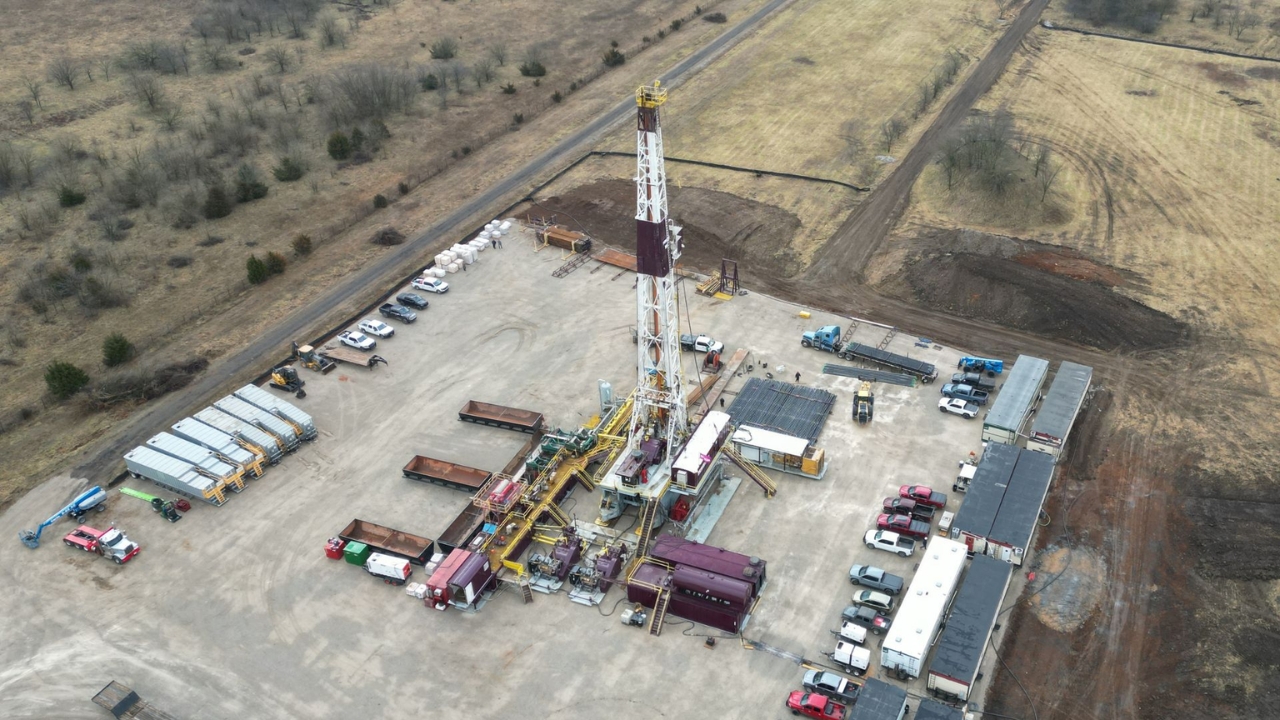
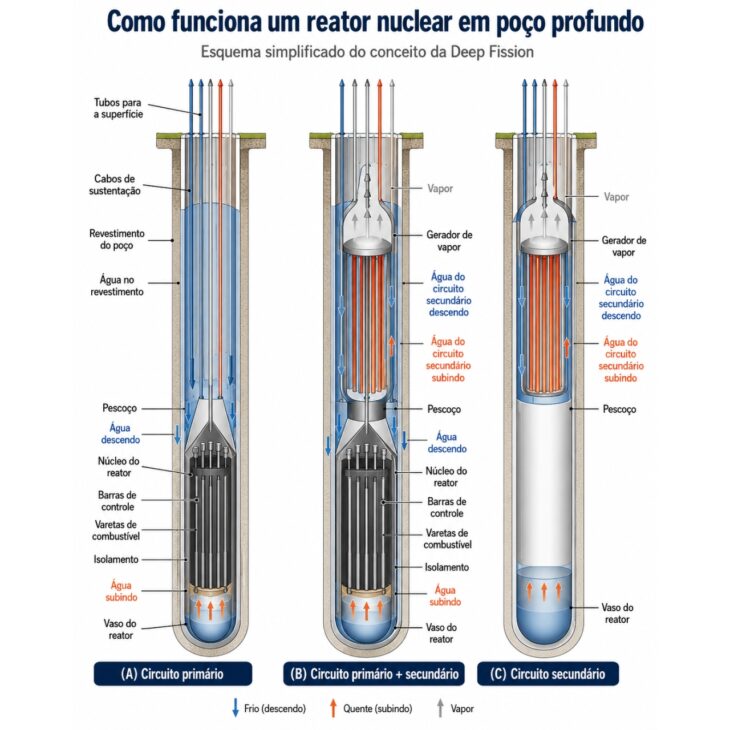
According to IEEE Spectrum, Deep Fission’s SMR (small modular reactor) is called Gravity — and the name is no coincidence. With 9 meters in height and wide enough to fit in a well only 75 centimeters in diameter, the reactor is inserted underground by permanent cables and operates autonomously there.
-
Berries, Strawberries, and Blueberries Could Transform Agriculture in Northeastern Brazil, New Tests Reveal

-
Danish Resident Discovers Six Viking Gold Bracelets Weighing 762.5 Grams, Third Largest Gold Treasure in Denmark

-
Over 200 Cities in Southern Brazil on Storm Alert as Cyclone Near Uruguay Brings Heavy Rain, Hail, and Winds Up to 100 km/h

-
Archaeologists Discover 2,300-Year-Old Beer in Sealed Bronze Vessel from Ancient Chinese Tomb



The depth is not just a logistical choice. The 1.6 km water column naturally generates about 160 atmospheres of pressure — exactly the same internal condition of a conventional nuclear reactor. This eliminates the need for the expensive and monumental containment structures that increase the cost of any surface nuclear plant.
Each Gravity reactor generates 15 megawatts electric (MWe). It may seem small, but the logic is of scale: 10 reactors on the same site produce 150 MWe, and 100 units reach 1.5 gigawatts — all occupying a minimal fraction of the space of a conventional plant, as reported by Power Magazine.
Oil engineering at the service of the atom
Here is the detail that no other nuclear energy company in the world has managed to combine: Deep Fission did not invent anything from scratch. It took three mature and already mastered technologies from the industrial sector and united them in an unprecedented way.
The first is deep well drilling, a technique developed and perfected over decades by the oil and gas industry. The second is geothermal heat transfer, which brings the energy produced underground to the turbines on the surface. The third is the pressurized water reactor (PWR) itself, the most tested and regulated nuclear design in the world.
“We are unique for having combined three mature technologies in a way that no one had thought of before,” said Liz Muller, CEO and co-founder of the company, in an interview with IEEE Spectrum.
The practical result: the company estimates that its approach can reduce construction costs by up to 80% compared to traditional nuclear projects — a number that, if confirmed, completely redefines the economics of nuclear energy.
Kansas, July 2026 and a race against the clock
On December 9, 2025, Deep Fission held the groundbreaking ceremony for the pilot project at the Great Plains Industrial Park in Parsons, Kansas, as announced by World Nuclear News. Since March 2026, the drilling of the data acquisition wells has been underway — three in total, each 1,830 meters deep and 20 centimeters in diameter, to collect geological, hydrological, and thermal data before the actual installation of the reactor.
The official goal, subject to authorization from the U.S. Department of Energy (DOE), is to achieve nuclear criticality by July 4, 2026 — American Independence Day. The project is part of the DOE’s Reactor Pilot Program, a U.S. government initiative to accelerate the licensing of advanced nuclear technologies, according to ANS Nuclear Newswire.
The discreet retreat that no one noticed
In March 2026, CEO Liz Muller herself admitted in an interview with public radio KCUR that the company has not yet committed to the size of the commercial project, and that the current focus is on the data acquisition phase — a considerable retreat from the bombastic announcement in December. The goal of criticality in July remains, but now carries a much heavier “subject to DOE authorization” than before.
$80 million, guaranteed uranium, and 12.5 GW in contracts
Despite operational caution, the financial numbers are robust. In February 2026, Deep Fission raised $80 million in a new round of financing, as per the official statement published by Business Wire. In the same month, it signed a supply agreement for lightly enriched uranium (LEU) with Urenco USA, a global giant in uranium enrichment, with supply from the plant in New Mexico.
The portfolio of clients in letters of intent already totals 12.5 gigawatts of planned nuclear capacity — a demand fueled by the explosion of artificial intelligence data centers in the US, urgently seeking clean and reliable energy sources.
The regulatory void that worries experts
No country in the world currently has a specific regulatory framework for deep well reactors. According to an analysis by IEEE Spectrum, the US Nuclear Regulatory Commission (NRC) will need to develop supplementary guidelines to evaluate a reactor installed underground, dependent on geology as containment and remotely monitored — areas that current legislation simply does not cover.
In Kansas, there is also an additional legal block: the state law prohibits direct energy sales to large consumers like data centers. According to KCUR, Deep Fission is negotiating with the utility Evergy for a solution to this impasse, with no defined deadline.
The resistance from the local community is real. A resident of Parsons openly declared: “My fear is that the project will fail and they will decide to fill the well with nuclear waste.” Community leaders have not even voted on the project — their only participation was signing a letter of support.
What’s at stake beyond Kansas
If Deep Fission proves that its concept works, the impact goes far beyond a city in the American interior. The combination of oil technology with nuclear energy could pave the way for countries with extensive drilling expertise — like Brazil, with its history of the pre-salt — to enter the modular nuclear race in a completely unexpected way.
The Gravity reactor represents, at its core, a radical bet: that the next energy revolution will not come from giant installations on the surface, but from silent wells drilled kilometers beneath our feet.