






 Portuguese
  Spanish


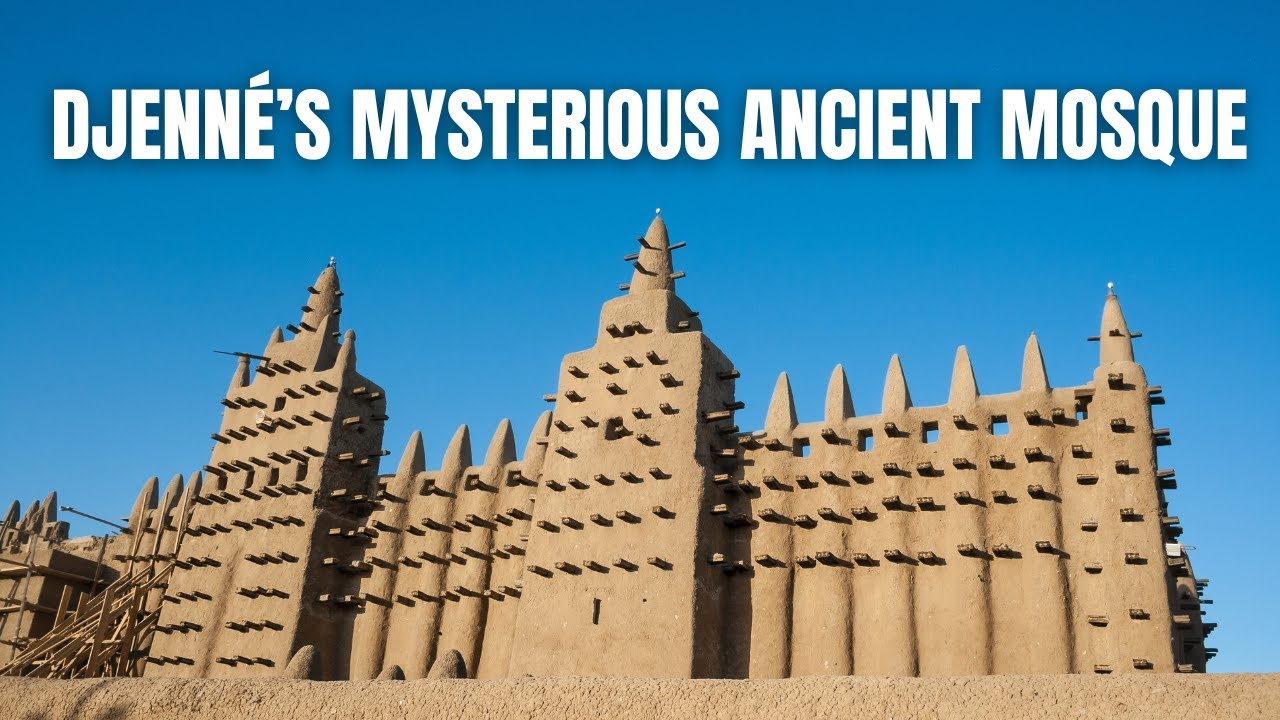

With Adobe Walls up to 3 Meters, 20-Meter Towers and 75-Meter Length, the Great Mosque of Djenné Requires Annual Maintenance to Sustain the Largest Adobe Building in the World.
According to historical records, studies of African vernacular architecture, and UNESCO documentation, the Great Mosque of Djenné, located in Mali, is one of the most extreme examples of how physical dimensions, primitive material, and recurring maintenance can form a functional construction system on a monumental scale. Unlike modern buildings, whose durability relies on industrialized materials, the mosque exists due to a delicate balance between mass, geometry, and continuous human intervention.
Reconstructed in its current form in 1907 on older foundations, the mosque occupies an approximately square footprint, with about 75 meters per side, forming a compact mass of clay that stands out against the flat landscape of the inland delta of the Niger River. This simple geometry is not accidental: it reduces bending efforts and better distributes the weight of the structure itself.
Walls up to 3 Meters Thick as the Main Structural Element
The most important technical detail of the mosque is the thickness of its walls, which can reach up to 3 meters at the base. In a construction made entirely of adobe, this mass is not excessive — it is a condition for stability.
-
Brazilian Fishing Couple Spends 4 Years Building Solar-Powered Floating Home on the Paraguay River, Now a Navy-Approved Vessel with Leisure Area and Tour Demand

-
While the World Opens New Airports and High-Speed Trains, Brazil Rushes to Complete Projects Stalled for 40 Years
-
Brazil Invests in Massive Waterway to Transport Soybeans by Barge, Reducing Costly Truck Reliance
-
Bridge Rebuilt in Just One Year Reconnects Two Brazilian States



Adobe has high compressive strength but very low tensile strength and water erosion resistance. To compensate for these limitations, builders resorted to:
- extremely thick walls,
- reduction of free spans,
- and increased self-weight to ensure global stability.
In practice, the mosque functions as a monolithic block of earth, where gravity itself is the main structural ally.
Towers up to 20 Meters Shaped from Raw Clay
The three main towers, which function as minarets and ventilation elements, reach about 20 meters in height. In terms of adobe construction, this height is exceptional. To make this possible, each tower features:
- a base wider than the top,
- gentle sloping walls,
- and direct continuity with the lower structural walls.
There are no independent internal columns or hidden metal frameworks. Stability comes exclusively from pyramidal geometry and the mass of the material, a solution that harks back to techniques used millennia ago in earth constructions in the Sahel.
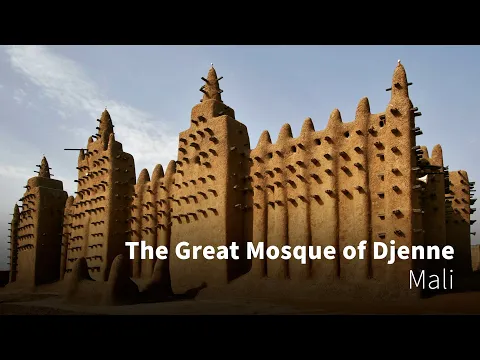
Torons: Structural Reinforcement and Permanent Scaffolding
An essential technical detail is the torons, wooden beams that project from the exterior walls. These elements serve multiple functions:
- they help to anchor the clay coating,
- act as small local structural reinforcements,
- and function as permanent scaffolding during annual maintenance.
Without these torons, accessing the high surfaces of the mosque for regular repairs would be practically impossible.
The Annual Coating as Part of the Construction System
The mosque is not only built of clay; it is superficially rebuilt every year. Before the rainy season, the people of Djenné participate in the crépissage, applying a new layer of clay mortar to the exterior walls. From a technical standpoint, this process:
- repairs cracks and eroded areas,
- restores surface impermeability,
- and prevents rainwater from penetrating the structural core of the walls.
Without this periodic coating, rain would gradually dissolve the adobe, leading to the collapse of the structure within a few years.
Living Architecture Based on Recurring Maintenance
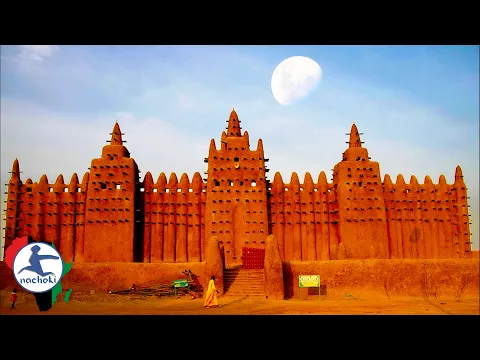
Unlike modern buildings, designed to minimize maintenance, the Great Mosque of Djenné was conceived as a living architecture, whose longevity relies on the constant repetition of the same constructive gesture.
Technically, this means that:
- durability lies not in the material, but in the process,
- maintenance is not an exception, but a rule,
- and the structure is never “finished” in a definitive way.
This construction model transforms the entire city into part of the engineering system.
Thermal Behavior and Climate Adaptation
In addition to stability, the mass of clay offers excellent thermal inertia. During the day, the thick walls absorb heat slowly; at night, they release that energy gradually, keeping the interior relatively stable even under extreme Sahel temperatures.
The small openings and compact volume reduce direct solar exposure, while natural ventilation through the towers aids in the renewal of internal air.
A Primitive Building on an Urban Scale
Although built with one of humanity’s oldest materials, the Great Mosque of Djenné operates on a rare urban scale for adobe constructions. Very few buildings worldwide combine:
- dimensions exceeding 70 meters,
- heights close to 20 meters,
- walls several meters thick,
- and total reliance on annual manual maintenance.
This makes the mosque not just a temple but an extreme case of vernacular engineering applied on a large scale.
Engineering without Steel, Concrete, or Cement
From a contemporary standpoint, the mosque challenges modern notions of engineering. There is no:
- steel,
- reinforced concrete,
- modern deep foundations.
Still, the structure has remained functional for over a century in its current form, supported by basic principles of mass, geometry, and recurring maintenance.
A Monument Supported by the Community Itself
In the end, the Great Mosque of Djenné stands not only because of its thick walls or tall towers, but because the construction system includes the community as an essential part of the engineering.
Without annual coating, the technical data loses meaning; with it, one of the largest clay constructions in the world continues to withstand the test of time, rain, and extreme heat.
It is proof that, in certain contexts, engineering is not just material or calculation, but also a continuous process applied on a monumental scale.


