Portuguese
  Spanish


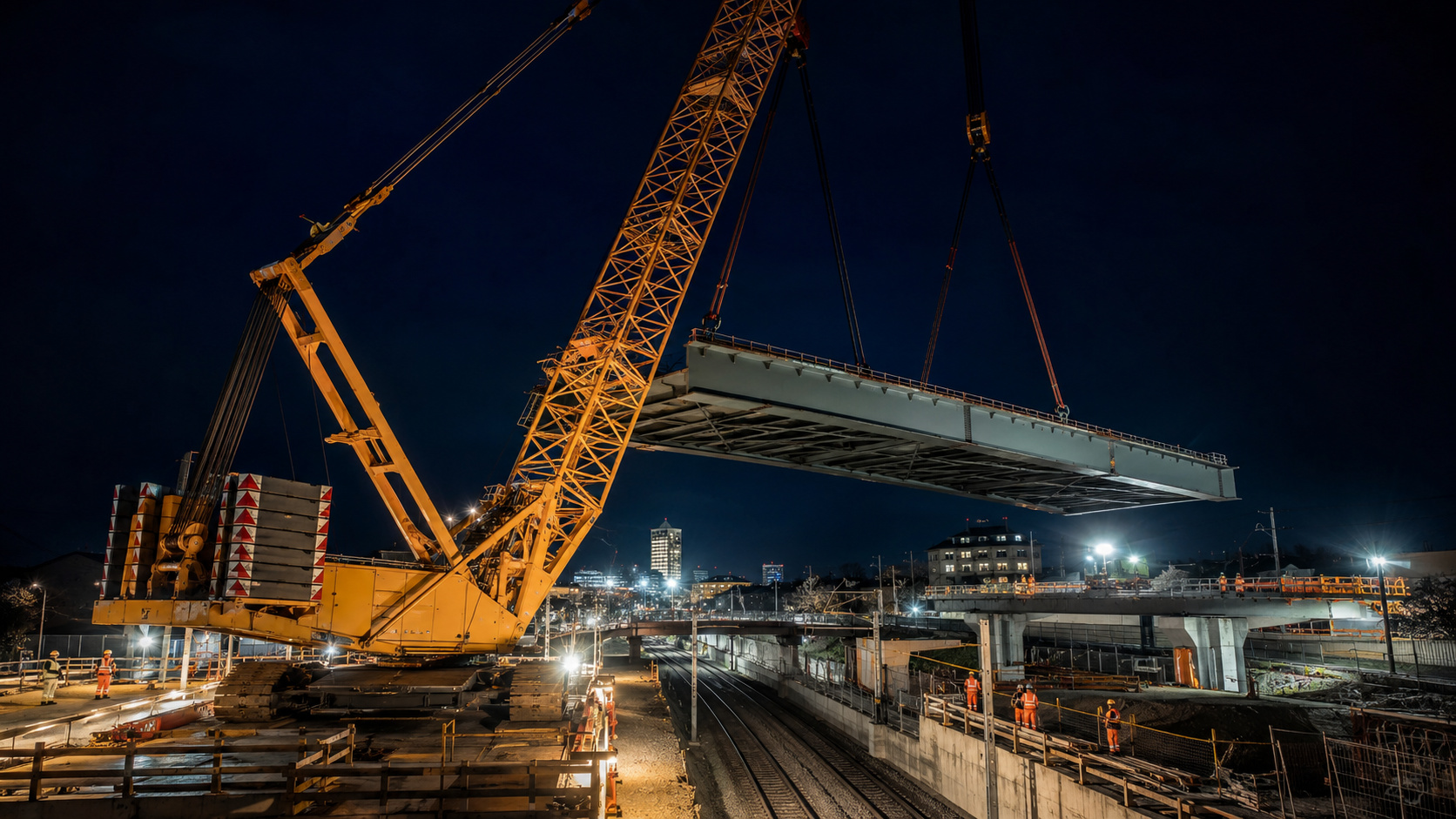


In Münchenstein, the installation of the 255-ton bridge mobilized a 1,000-ton crane, required nighttime operation, work at a 53-meter radius, and showed how large projects can progress without paralyzing the city for long periods, even in a delicate stage of structure replacement.
While the city slept in Switzerland, a 255-ton bridge was lifted in the dark by a 1,000-ton crane in a nighttime operation that drew attention for the size of the structure and the level of precision required. The movement took place in Münchenstein, Switzerland, on the night between August 4 and 5, 2025, marking the third and final major lift of the bridge replacement.
The information was released by EMIL EGGER AG, a Swiss logistics and heavy transport company. The work involved a Liebherr LR 11000 and took place with the equipment operating at a 53-meter radius, a detail that helps show the size of the challenge.
The practical impact of this choice is on the functioning of the city. Projects of this magnitude are usually carried out at night to reduce traffic disruptions and minimize the effect on the local routine. At the same time, this type of service requires strong lighting, precise communication, and constant control of local conditions.
-
While the World Opens New Airports and High-Speed Trains, Brazil Rushes to Complete Projects Stalled for 40 Years

-
Brazil Invests in Massive Waterway to Transport Soybeans by Barge, Reducing Costly Truck Reliance
-
Bridge Rebuilt in Just One Year Reconnects Two Brazilian States
-
Custom Furniture Costs in Brazil Expected to Range from $350 to Over $1,450 per Square Meter by 2026, with Kitchens, Closets, and Laundries Highlighting the Impact of Premium Features


How a 1,000-ton crane can lift a 255-ton bridge
A large crane does not work with force alone. It relies on calculation, balance, and correct positioning. In the case of the project in Münchenstein, the 1,000-ton crane was used to lift a heavy structure in an area that required maximum attention.


The weight of the new bridge was 255 tons, but the challenge was not only in that. The machine needed to operate at a 53-meter radius, which means the load was at a considerable distance from the center of the equipment. The greater this distance, the more delicate the control of the movement becomes.
The use of a crawler crane also makes a difference. This type of equipment offers stability and helps to better distribute the weight on the ground, which is important when the operation involves giant structures and limited workspace.
Why the night operation was essential for the bridge replacement in Switzerland
The choice for night operation was not a minor detail. In heavy construction, working during the early hours helps to reduce the impact on streets, vehicle circulation, and movement of people around the area.
This type of decision also facilitates site control. With less flow, the team can better isolate the space and focus on each stage of the hoisting. In a project with a 255-ton bridge, this makes a difference from start to finish.
At the same time, operating at night increases technical demands. The team needs to rely on good lighting, alignment among professionals, and continuous monitoring of the environment. Small errors can compromise the fitting of the structure.
What millimetric precision means in a 255-ton bridge
The expression millimetric precision means that the bridge needs to reach the exact point with a very small level of variation. In a structure of this size, this is crucial for the installation to occur without misalignments.
It is not enough to lift the load. The bridge must be slowly guided to the exact position, respecting the design and the supports prepared to receive the new piece. This control avoids rework and reduces risks for the structure and the team.
EMIL EGGER AG, a Swiss logistics and heavy transport company, detailed the key points of this stage. The emphasis on precision shows that the operation depended as much on the crane’s capacity as on the coordination among all the professionals involved.
How an old bridge is replaced without paralyzing the city for months
The replacement of a bridge of this size usually happens in phases. This allows for the removal of old structures, preparation of the area, and installation of new elements without concentrating everything in a single long and heavier intervention for the city.
In the case of Münchenstein, the hoisting of the new bridge marked the third major lift of the project. This data shows that the structure replacement was organized in stages, which helps to keep the schedule under control and reduces urban impact.
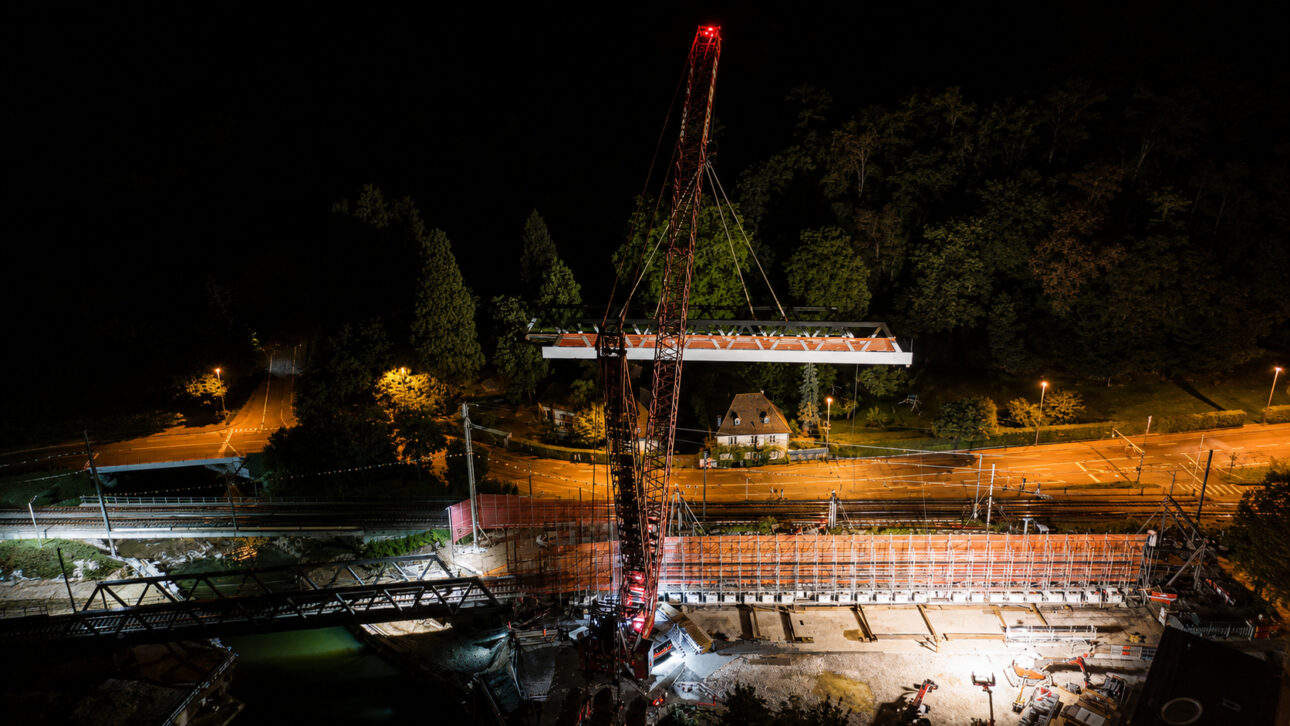
For those viewing from the outside, the scene is impressive due to the size of the equipment and the weight of the bridge. For engineering, the most important aspect is the combination of planning, correct sequence of actions, and careful execution.
What this construction shows about large engineering operations
The installation of the new bridge in Switzerland draws attention because it brings together three strong points in a single operation: 255 tons, 1,000-ton crane, and night work with millimetric precision. It’s the kind of construction that transforms a technical task into a powerful image for the public.
It also becomes clear why this type of service requires extreme planning. When an entire bridge needs to be placed during the early hours, every detail counts, from the position of the machine to team communication.
In the end, the operation in Münchenstein shows how large cities can renew important structures without completely stopping the surrounding routine. It’s a solution that mixes strength, calculation, and organization at a high level.
Do you think giant constructions like this should happen more often at night to reduce impacts on the city, or do the risk and complexity make this type of operation too impressive to go unnoticed?