Portuguese
  Spanish


World Cup 2026 has Spain as the main favorite in a study based on artificial intelligence and statistical analysis.
World Cup 2026: researchers used artificial intelligence and the analysis of large volumes of data to estimate the chances of each of the 48 participating teams. The survey, conducted by scientists from the University of Innsbruck in Austria, identified Spain as the team most likely to win the tournament, although the numbers indicate a very balanced competition.
The study used information about the teams’ international performance, individual player evaluations, market values of the squads, and sports betting data. Based on this set of information, a computer system simulated the possible matches of the competition and calculated the chances of advancement at each stage.
How was the projection for the World Cup made?
Unlike traditional predictions, the research was based on statistical calculations and machine learning, a technology known for identifying patterns in large databases.
-
Explore the History, Architecture, and Unique Features of Arena Fonte Nova, One of Brazil’s Most Iconic and Modern Football Stadiums

-
Indian School in Assam Expands Enrollment by Accepting Plastic Waste as Tuition Payment

-
Parintins Festival 2026 Celebrates Amazonian Tradition with Three Nights of Competition Between Caprichoso and Garantido, Highlighting Its Cultural Significance in Brazil
-
Brazilian Mayor Goes Undercover as a Person with Disability, Exposes Public Service Flaws



The model created by the researchers evaluated all possible scenarios among the teams qualified for the competition. From this, it estimated how many goals each team could score in different matches and projected the paths to the final.
The goal was not to predict exact results, but to indicate trends based on the data currently available.
Spain leads the favorites ranking
Among all the teams evaluated, Spain appeared in the first position of the survey.
Even so, the advantage over the closest competitors is not wide. England, France, and Germany appear right behind, forming a group that holds the highest probabilities of lifting the trophy.
Check out the percentages presented by the researchers:
- Spain — 14.5%
- England — 12.4%
- France — 12.4%
- Germany — 11.2%
- Portugal — 8.9%
- Argentina — 8.2%
- Netherlands — 5.6%
- Brazil — 4.7%
The numbers reinforce the balanced scenario highlighted by the research authors.
Brazil appears among the candidates for the trophy
Although not among the top four in the study, Brazil is in the group of teams that still have significant chances of winning the competition.
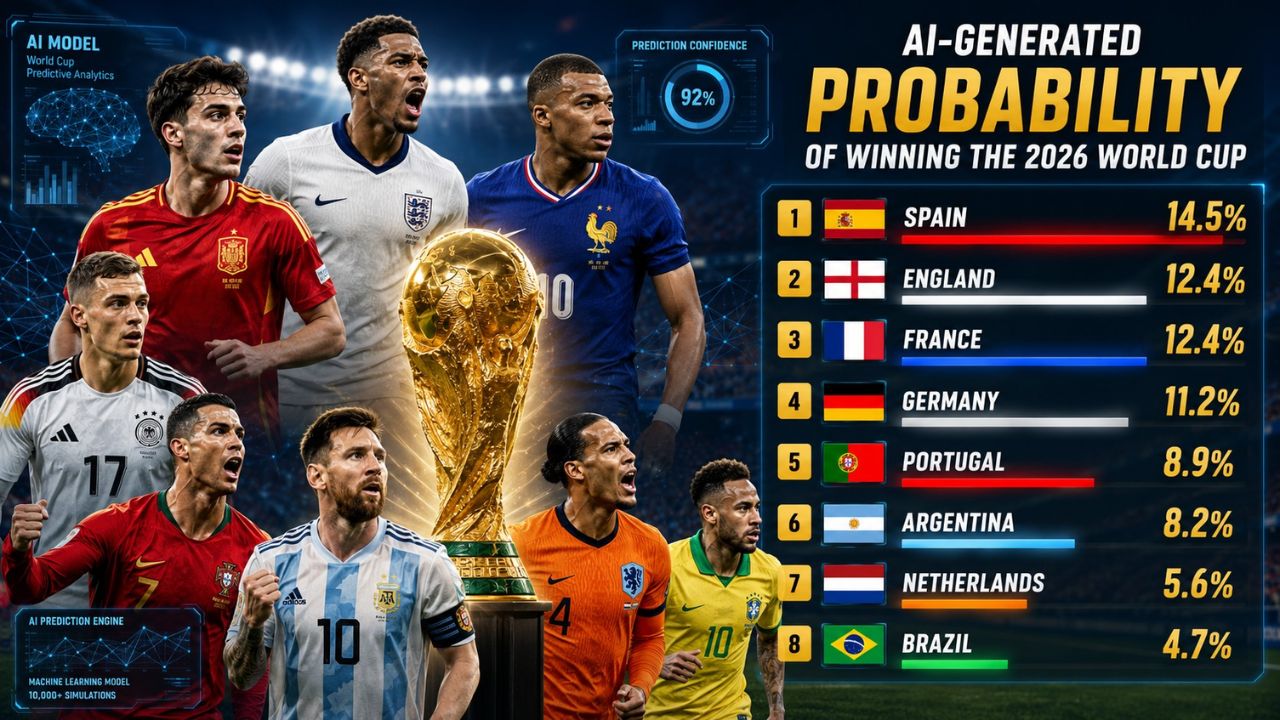
The Brazilian team received a probability of 4.7%, behind European teams like Portugal and the Netherlands, as well as the current world champion Argentina.
On the other hand, the survey highlights that relatively small differences can be altered as new results and changes in squads occur until the start of the tournament.
Balance is the main hallmark of this edition
One of the aspects that most caught the researchers’ attention was the closeness between the favorites.
Achim Zeileis, a member of the team responsible for the work, stated that the race for the title is more open than in recent editions.
According to him, the race for the cup presents a high level of balance compared to previous tournaments.
This assessment is reinforced by the percentages found. Even the best-positioned team does not reach a 15% probability of winning.
The study authors emphasize that football maintains a high degree of unpredictability. Andreas Groll, another author of the research, noted that not even the team pointed out as the favorite manages to reach a 20% real chance of winning the title.
In practice, this means that unexpected events continue to have significant weight throughout the competition.
Injuries, performance in decisive moments, and surprising results can completely alter the scenario projected by statistical models.
Teams with the lowest probabilities of winning the 2026 World Cup
While some teams appear as contenders for the trophy, others occupy the last positions in the survey.

Among the teams with the least chance of winning the World Cup are:
- Jordan;
- Qatar;
- Iraq;
- South Africa;
- Curaçao.
The researchers emphasize, however, that these projections represent only probabilities calculated from the data currently available.
History gives credibility to the model
Although the authors themselves reinforce that no projection can predict the future with certainty, the group responsible for the study has a relevant track record in international competitions.
According to the information released, similar models developed by the researchers correctly predicted the champions of the 2010 World Cup, the 2012 Euro Cup, and also the 2019 Women’s World Cup.
This track record helps explain the interest sparked by the new survey. Even so, the scientists make a point of highlighting that the research should be seen as a trend analysis tool and not as a definitive prediction of the results.
With the 2026 World Cup approaching, the study points to Spain as the leader in the race for the title. However, the numbers themselves reveal that no team has a comfortable advantage, a scenario that keeps the possibility of surprises open throughout the competition.
Source: Época Negócios and DailyMail