






 Portuguese
  Spanish


The construction of the Cairo monorail shows how an elevated urban transport line can transform ordinary streets into heavy construction sites, with mobile cranes, giant concrete beams, traffic blockages, and repeated operations over one of Egypt’s busiest cities.
To build a suspended train, Cairo had to lift 80 to 100-ton beams over busy streets. The Cairo monorail advances as an elevated construction, supported by enormous pieces and assembled with mobile cranes.
This information was published by Construction Briefing, an international publication specializing in the construction sector. The project involves $5.5 billion, nearly 100 km of elevated structure, and a routine of roadblocks so that the beams can be safely hoisted.
The impact goes beyond engineering. Each piece lifted temporarily changes the city’s routine because the crane takes up space, the street needs to be controlled, and the beam cannot deform during hoisting.
-
17-Story Building with 112 Apartments Opens in Australia to House Homeless Population, Offering Fully Equipped Units with Daily On-Site Support

-
81-Meter Bridge Made from Over 7 Tons of Recycled Plastic Connects Isolated Communities in Panama Canal Basin, Allowing Safe Passage for Over 300 Residents
-
Australia’s First Two-Story 3D-Printed House Built in 18 Hours, 22% Cheaper Than Traditional Methods, Uses Concrete That Hardens in 3 Minutes
-
Architect Converts 1955 Grain Silo into 31m² Home with Full Amenities, Including Kitchen, Bathroom, Curved Living Room, and Loft Bedroom




Why the beams of the Cairo monorail reach 80 and 100 tons
The monorail does not operate like a regular train on two steel tracks. It uses an elevated guide beam, which serves as both a path and support for the vehicle to travel.
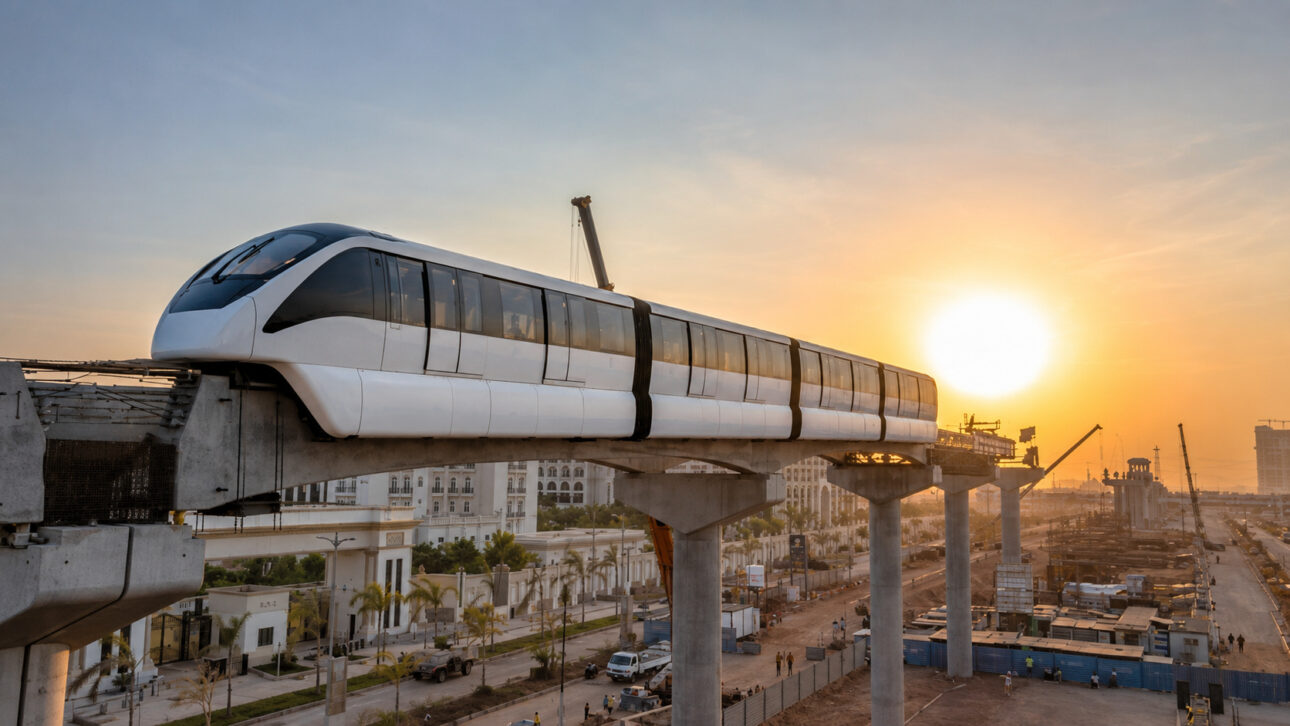
This explains the weight of the pieces. The beam is not just a part of the construction. It is the very path of the suspended train. Therefore, it needs to be strong, aligned, and capable of receiving the passage of vehicles.
In Cairo, the beams reach 80 to 100 tons. For the reader to imagine, each piece requires its own operation, with transportation, crane positioning, and control of the surrounding space.
The greatest care is in the deformation. In simple terms, the piece cannot bend while being lifted. If this happens, the fit may be compromised and the structure may lose precision.
How mobile cranes manage to lift such heavy pieces in the middle of the city
A mobile crane is a machine designed to arrive at the construction site, deploy its supports, and lift heavy loads. On a busy avenue, this task becomes more difficult because there is little free space.
Before hoisting, the area needs to be prepared. The machine must be well-positioned, the ground must support the weight of the equipment, and the load must be lifted without swaying dangerously.
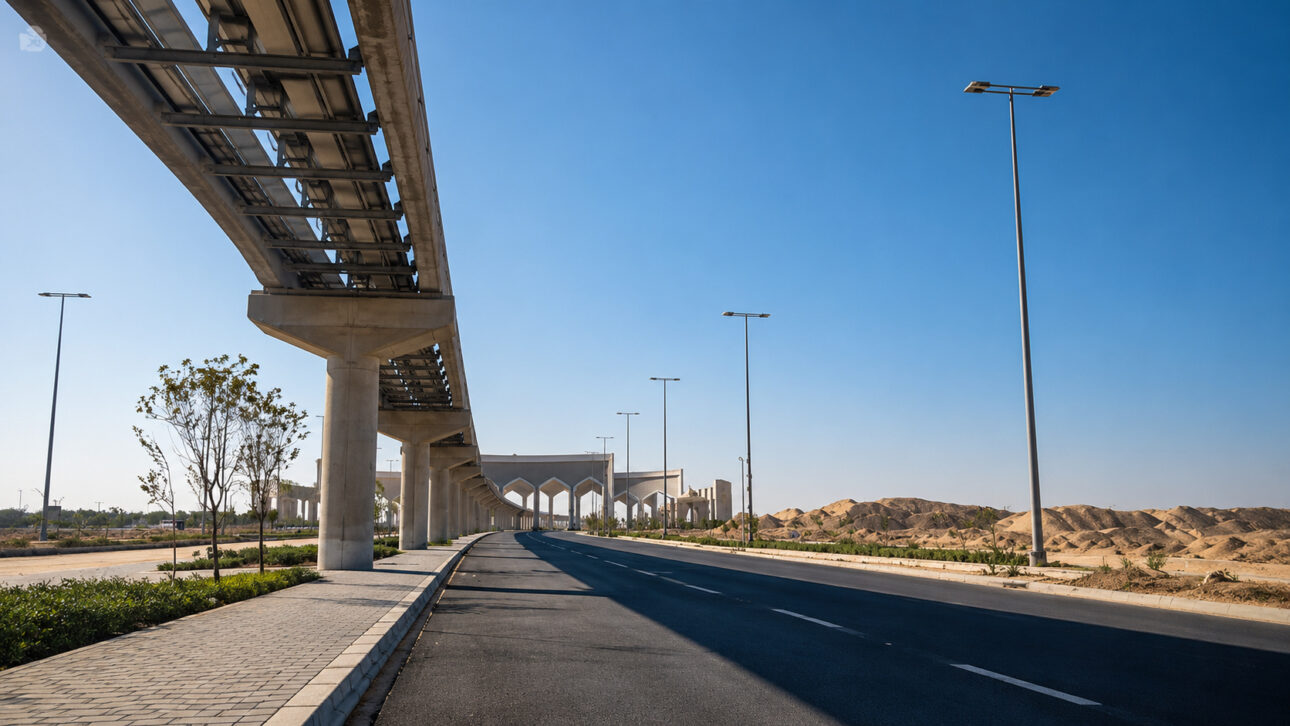
On the Cairo monorail, this work is repeated over almost 100 km. Each elevated section depends on large pieces and a well-controlled sequence for the line to advance.
The difficulty increases because Cairo has 10 million residents and coexists with 3.3 million cars, buses, taxis, and minibuses circulating daily. The construction needs to happen within this intense routine.
Why streets need to be blocked during the lifting of beams
When a beam of 80 to 100 tons is suspended, the street ceases to be just a passageway. It becomes a controlled risk area, with space reserved for machines, workers, and equipment.
The blockage is not an exaggeration. It protects those working on the construction and also those passing near the site. A load of this size cannot share space with regular traffic.
Construction Briefing, an international publication specializing in the construction sector, contextualizes the operation in a report published on March 28, 2024, within the Cairo monorail project, a construction underway since 2019. The report outlines the transportation of pre-molded beams before installation during nighttime windows, between midnight and 3 AM, a period used to reduce conflict with the heavy traffic of the Egyptian capital.
Even so, the operation remains complex. The crane needs space to maneuver, the team requires clear communication, and the beam must reach the right point without losing stability.
What changes for those living and circulating in Cairo
For the population, the first effect appears in traffic. Detours, blockages, and large machines are part of the routine when an elevated structure of this scale passes through urban areas.
The expected benefit comes later, when the system starts functioning as mass transit. Mass transit is a service designed to carry many people at once, reducing the dependence on cars for urban travel.
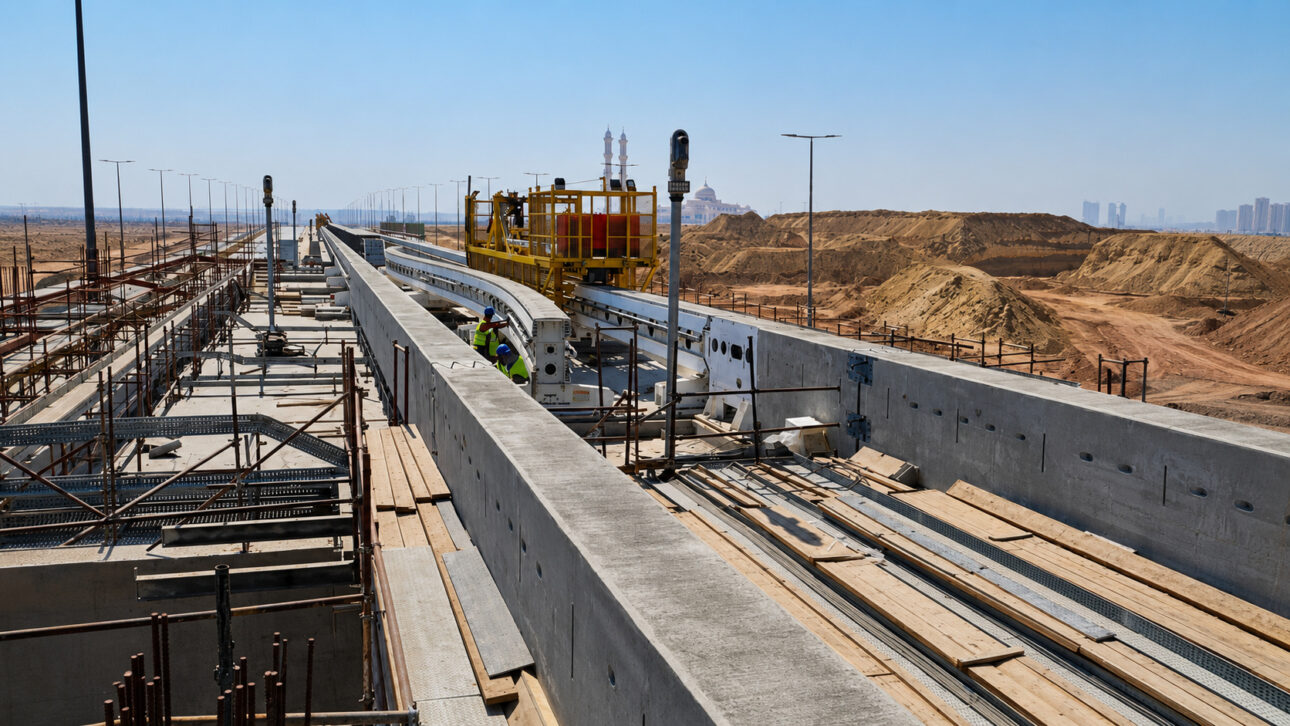
Still, the inconvenience of the construction is immediate. The city feels the weight of the construction before experiencing the benefits of the operation. This is one of the reasons why urban megaprojects divide opinions.
In Cairo, the construction catches attention precisely because of this contrast. While it can create a new transport corridor, it requires heavy interventions on streets already pressured by traffic.
Why monorails divide opinions in large cities
Monorails tend to impress because they pass over the city and occupy less ground space than some traditional solutions. However, the construction of the elevated track requires heavy machinery, foundations, columns, and huge beams.
This combination generates debate. For part of the population, the construction may represent progress in transportation. For others, the blockages and visual impact weigh during the construction.
In the case of Cairo, the value of US$ 5.5 billion and the extension of almost 100 km increase the attention on the project. The larger the construction, the greater the expectation for the result.
Waleed Abdel Fattah, regional president of Hill International for the Middle East and North Africa, stated: “We never stopped work on the monorail.” The phrase shows the scale of a project that needs to advance on several fronts simultaneously.
What this construction reveals about heavy engineering within a metropolis
The Cairo monorail shows that building urban transport is not just about buying trains and putting passengers inside them. Before that, it is necessary to set up a massive base over the city.
Each elevated section depends on concrete, steel, cranes, special transport, and teams prepared to work in tight spaces. The construction is done in parts, but it needs to function as a continuous line.
The strongest image is of a city that continues to move while pieces weighing 80 to 100 tons are lifted above the streets. This requires precision, patience, and constant control.
The project also reveals how modern urban engineering needs to tackle two challenges at once. It needs to build the future of transportation without completely paralyzing city life.
Cairo’s $5.5 billion monorail encompasses nearly 100 km of elevated structure, massive beams, mobile cranes, and roadblocks. It is a project that draws attention due to its size and impact on daily life.
In the end, the suspended train only comes into existence after each heavy piece finds its place over the city. Before the passenger boards, there is an engineering operation that transforms streets into giant construction sites.
Do you think a project capable of changing a city’s transportation is worth years of roadblocks, machinery, and disruptions in the streets? Leave your opinion in the comments.








An absolutely agreeable inconvenience.. for the future generations of the city of Cairo and its future growth!!.My humble opinion ..My apologies to those who disagree…Still friends 🧡