






 Portuguese
  Spanish
  5 min of reading
  2 comments


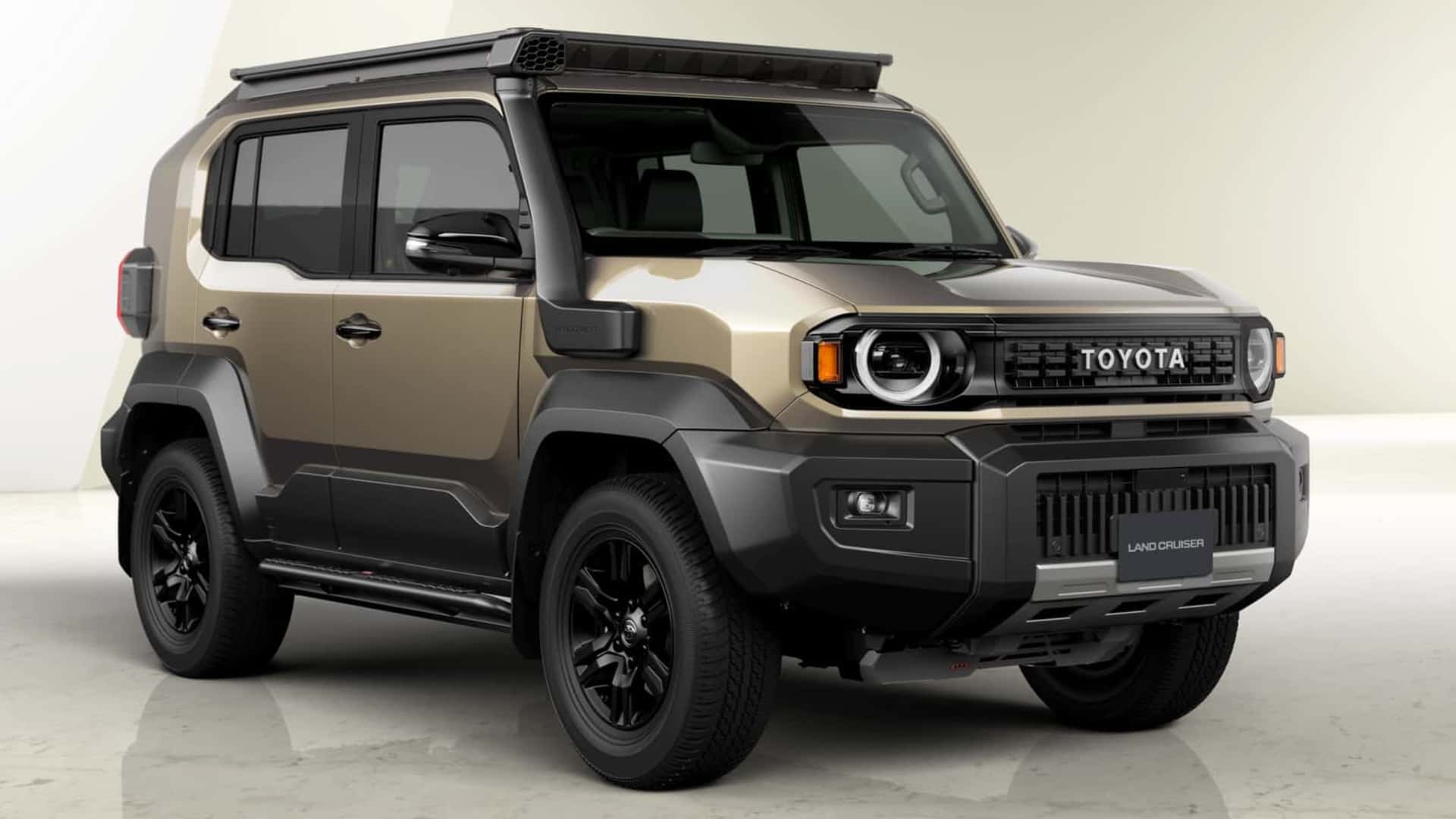


Toyota Confirms New Land Cruiser FJ, Compact SUV with Sturdy Chassis, 4×4 Drive, and Global Launch Expected in 2026. Discover the Technical Details.
Toyota has officially confirmed the development of a new compact SUV with the true DNA of the Land Cruiser line. Named Land Cruiser FJ, the model was introduced as part of the global expansion of the Land Cruiser family and marks the return of the FJ badge to a utility vehicle focused on structural strength and off-road capability. Unlike urban SUVs with purely aesthetic adventurous appeal, the new FJ is built on a traditional body-on-frame architecture with 4×4 drive, reinforcing its proposal to be a true off-road vehicle in more compact dimensions. Production is expected to begin in 2026 in Asia, with an initial launch in selected markets.
Toyota’s strategy is clear: to fill a niche between urban models like the Corolla Cross and larger mid-size utilities from the Land Cruiser line, delivering mechanical robustness in a more accessible package.
New Land Cruiser FJ Bets on Body-on-Frame Structure and Classic Heritage
The Land Cruiser FJ utilizes the IMV architecture, the same structural base that supports models like the Hilux in various markets. This is a body-on-frame construction, where the body and chassis are independent, a configuration traditionally associated with greater torsional strength and capability for severe use.
-
Used Civic and Corolla have been stuck in stock for months. “People are preferring Chinese cars,” says the car dealership owner.

-
Toyota Sienna becomes a “VIP lounge on wheels” in Brazil after receiving a Chinese luxury kit, seats with massage, Starlink, refrigerator, and a 245 hp hybrid engine, targeting high-income families, artists, and executive transport in an almost million-dollar van.

-
Two new 300cc models from QJ Motor are expected to arrive in Brazil as SBM to target the CB 300F and shake up the low-displacement market, with more power and liquid cooling than Honda.

-
Camaro may reappear in 2027, but not as you remember: Chevrolet prepares the return of the icon with four doors, manual transmission, and an extreme performance version to face the new era of sports cars.


This choice differentiates the FJ from most current compact SUVs, which use unibody platforms primarily aimed at urban comfort.


Measuring approximately 4.57 meters in length, 1.85 meters in width, and about 1.96 meters in height, the FJ is smaller than traditional Land Cruisers but maintains robust proportions. The wheelbase in the range of 2.58 meters contributes to a balance between stability and maneuverability.
The design reinforces the historical heritage of the Land Cruiser family. The lines are square, with prominent fenders, a vertical front, and an option for an external spare tire on the rear door. The ensemble evokes the classic FJ40 and the FJ Cruiser launched in the 2000s.
2.7 Gasoline Engine Delivers 163 Hp and 4×4 Drive with Low Range
Under the hood, the Land Cruiser FJ will be initially equipped with the well-known 2.7-liter 2TR-FE gasoline engine, a four-cylinder capable of generating approximately 163 hp of power and 246 Nm of torque.
The setup operates with a six-speed automatic transmission and a 4×4 drive system with low range, an essential feature for overcoming more severe obstacles.
The adoption of this well-established engine reinforces the proposal of mechanical reliability, especially in emerging markets where robustness and simple maintenance are valued attributes.
While initial speculations pointed to the use of the 2.8 turbo diesel engine with 204 hp found in larger versions of the line, more recent information suggests that the initial launch will be with the 2.7 gasoline engine. There is no official confirmation of hybrid or diesel versions at this stage, though future variations are not ruled out.
Off-Road Capability is a Priority in the Project
The positioning of the FJ makes it clear that the model will not just be an urban SUV with an adventurous look. The combination of a chassis on rails, selectable all-wheel drive, and low gear reinforces its vocation for off-road use.
The aim is to offer a vehicle more compact than traditional Land Cruisers, but with real capability for trails, rough terrain, and severe conditions.

The high approach angle, generous ground clearance, and reinforced structural construction should position it competitively against compact 4×4 models available in global markets.
Global Strategy: Filling the Gap Below the Traditional Land Cruiser
The launch of the Land Cruiser FJ is part of Toyota’s reorganization of its global lineup. In recent years, the brand has strengthened the identity of the Land Cruiser family with versions 250 and 300, focused on robustness and tradition.
With the FJ, Toyota aims to attract an audience that desires the Land Cruiser heritage but does not need — or cannot invest in larger and more expensive models.
The model is expected to be produced initially in Thailand, one of Toyota’s main industrial hubs for utilities and pickups. From there, it will be exported to markets in Asia, Africa, the Middle East, and possibly Latin America.
So far, there is no official confirmation regarding sales in Europe or the United States.
Name FJ Rescues Historical Tradition
The FJ badge carries historical weight within Toyota. It harkens back to the early generations of the Land Cruiser, especially the iconic FJ40, known for its durability and capability in extreme environments.
By reviving this nomenclature, Toyota signals that the new model will not be just an ordinary compact SUV, but a utility vehicle that honors the tradition of mechanical strength associated with the line.
This decision also strengthens the emotional appeal of the product, connecting past and present in a market where brand heritage strongly influences purchasing decisions.
The 4×4 Compact SUV Market Continues to Expand
The segment of compact SUVs with all-wheel drive has shown steady growth in various markets, driven by consumers seeking versatility.
Unlike purely urban utilities, these models offer greater freedom of use, especially in regions with irregular infrastructure or unpaved roads.
Toyota, traditionally recognized for durability and reliability, positions the FJ as a robust alternative within this niche, without directly competing with the brand’s larger mid-size SUVs.
Launch Expected in 2026
Production of the Land Cruiser FJ is expected to begin in 2026, with a gradual launch in the brand’s strategic markets.
The timeline reinforces Toyota’s medium-term strategy, which has been balancing progressive electrification with the maintenance of traditional structural models in regions where the classic 4×4 is still a priority.
The FJ thus emerges as a strategic piece in the brand’s global transition: maintaining classic mechanical heritage while allowing space for possible future technological evolutions.
Traditional Robustness on a More Accessible Scale
The new Land Cruiser FJ represents a clear response from Toyota to the demand for compact SUVs with real off-road capability.
With a chassis on rails, 4×4 drive with low range, a reliable engine, and a design that brings back historical icons, the model fills a gap between urban SUVs and larger traditional utilities.
More than just a “baby Land Cruiser”, the FJ is born as a legitimate extension of the family, adapted to current demands for size, cost, and global versatility.






O que eu não entendi foi a comparação com o Suzuki Jimni. Se for comprar com a Suzuki, pelas dimensões, a coerência é com o Gran Vitara, um fora de estrada “com terno e gravata”.
Lembrar também que o fiel público que usava o poderoso Mitsubishi TR4 pode ainda migrar para um veículo com essas características propostas do FJ. Tomara que venha ao nosso país.