






 Portuguese
  Spanish
  4 min of reading
  0 comments


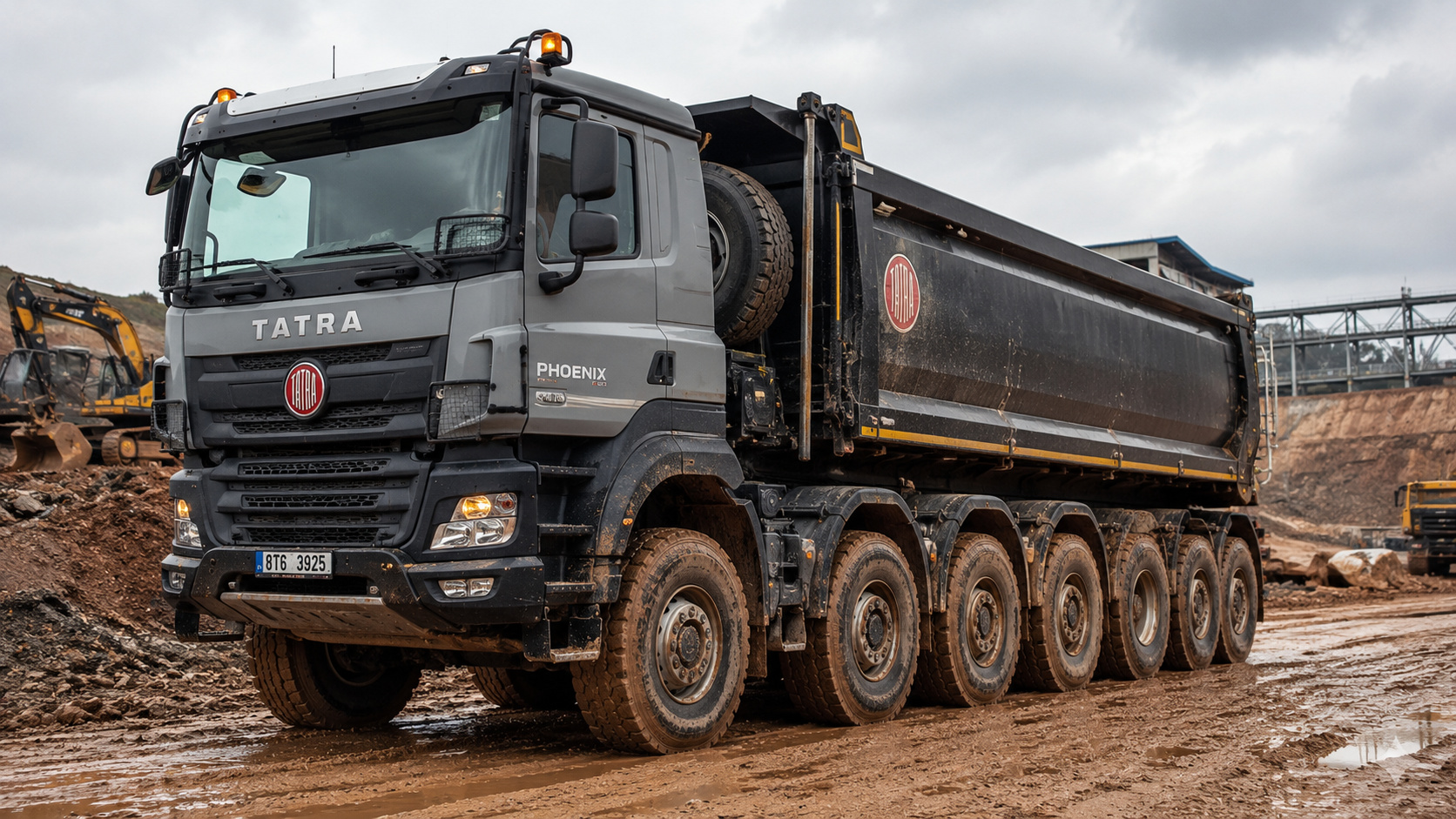
Extreme model with eight axles and all-wheel drive was created to face scenarios where stability is vital, revealing how heavy engineering can overcome challenges in construction, mining, and maintenance of complex structures
There is a type of vehicle that is not born to please the eye, but to solve extremely complex problems. And, precisely for this reason, the result can look like something straight out of a science fiction — or even horror — movie. This is exactly the case with the impressive Tatra Phoenix 16×16 truck, an engineering giant that earned the curious nickname “centipede” due to its unusual appearance and impressive number of wheels.
The information was released by specialized automotive and industrial portals, which highlighted the model as one of the most extreme vehicles ever produced for heavy-duty applications, reinforcing its importance in operations where stability, strength, and traction are fundamental.
Right from the start, what stands out most about the Tatra Phoenix 16×16 is its structure with eight axles and 16×16 all-wheel drive. This means all 16 wheels receive power from the engine, which is essential to ensure performance on challenging terrains. Furthermore, its silhouette clearly resembles a multi-legged insect, which perfectly explains the nickname adopted by the manufacturer itself: “Centipede.”
-
Uber Faces Shareholder Scrutiny as Board Accused of Ignoring Safety, Compliance, and Harassment Warnings Amid Over 3,500 U.S. Lawsuits

-
Ferrari’s First Electric Car Divides Fans, Priced at $630,000, Amid Concerns Over Limited Editions; Brand Clarifies It’s Not Just for Future Perks
-
BYD Dolphin Mini: The Electric Car That Defies Depreciation, Losing Only 3.58% in a Year and Becoming the Best-Selling Retail Model Under $22,000

-
Electric Car JAC E-JS4 Loses $19,000 in Value in One Year, Leading Record Depreciation of Used Cars in Brazil Due to Expensive Battery and New Models


Why the Tatra Phoenix 16×16 looks like a centipede and what its practical function is
The truck’s peculiar appearance is not just aesthetic, but a direct result of engineering designed to solve real problems. Unlike conventional trucks, the Tatra Phoenix does not have a long hood. Instead, its advanced cab is positioned directly over the engine, which reduces frontal length and improves weight distribution.
Consequently, when viewing the vehicle from the side, the sequence of aligned axles creates a visual effect reminiscent of an animal with multiple legs about to move. This configuration, though unusual, is extremely functional.
Furthermore, Tatra itself recognizes this characteristic and uses the term “Centipedes” to refer to its multi-axle vehicles. According to the manufacturer, these models serve as robust platforms for special superstructures.
In practice, this means the truck is not the final product, but rather the base for advanced industrial applications. It can accommodate equipment such as cranes, drilling systems, and aerial platforms, being used in sectors like heavy construction, mining, and maintenance of large structures.
A real-world example of this is a model sent to Australia, equipped with a Bronto Skylift aerial platform. This type of equipment is used for maintaining tall buildings and even wind turbines, where ground stability is absolutely essential.
Therefore, when work takes place at great heights, the base needs to be extremely reliable. And that’s precisely where the Tatra Phoenix’s 16 wheels come in, distributing weight more efficiently, creating a kind of “mobile foundation.”
Extreme performance on difficult terrain and technology for maneuverability
Another point that differentiates the Tatra Phoenix 16×16 is its ability to operate in terrains where conventional vehicles simply cannot. Thanks to traction on all axles, the truck offers superior performance on surfaces such as mud, grass, and uneven ground.
Additionally, weight distribution across multiple axles reduces the risk of sinking, making the vehicle more predictable in critical situations. However, it is important to note that this does not mean the vehicle is invincible. In extremely waterlogged soils, the total weight can still compromise operation, which reinforces the need for planning and common sense.
To ensure all this capability, the model uses Paccar turbodiesel engines. The text specifically mentions a 12.9-liter engine, but the Phoenix line can also be equipped with 6.7-liter and 10.8-liter versions, depending on the application.
However, a truck with eight axles naturally raises an important question: how does it behave in curves and confined spaces?
Tatra’s answer is a rather aggressive engineering solution. The model was designed with eight steerable wheels, which allows the truck to “fold” its own length during maneuvers.
As a result, even though it is an extremely long vehicle, it can make turns with a radius smaller than a football field. This significantly reduces the difficulty of operation on construction sites and in industrial environments.
Engineering that redefines limits in heavy industry
Ultimately, the Tatra Phoenix 16×16 might seem strange at first glance, but its design makes complete sense when analyzed from a functional perspective.
Every detail was designed to ensure stability, traction, and adaptability to extreme scenarios. And that’s exactly why it becomes indispensable in operations where there is no room for error.
Furthermore, the nickname “centipede” ceases to be just a curiosity and comes to represent its main characteristic: a vehicle with multiple support points, capable of facing challenges that few trucks in the world can overcome.
Would you dare to drive a “monster” like this on extreme terrain, or does just looking at it give you a chill?





-

1 person reacted to this.