Portuguese
  Spanish


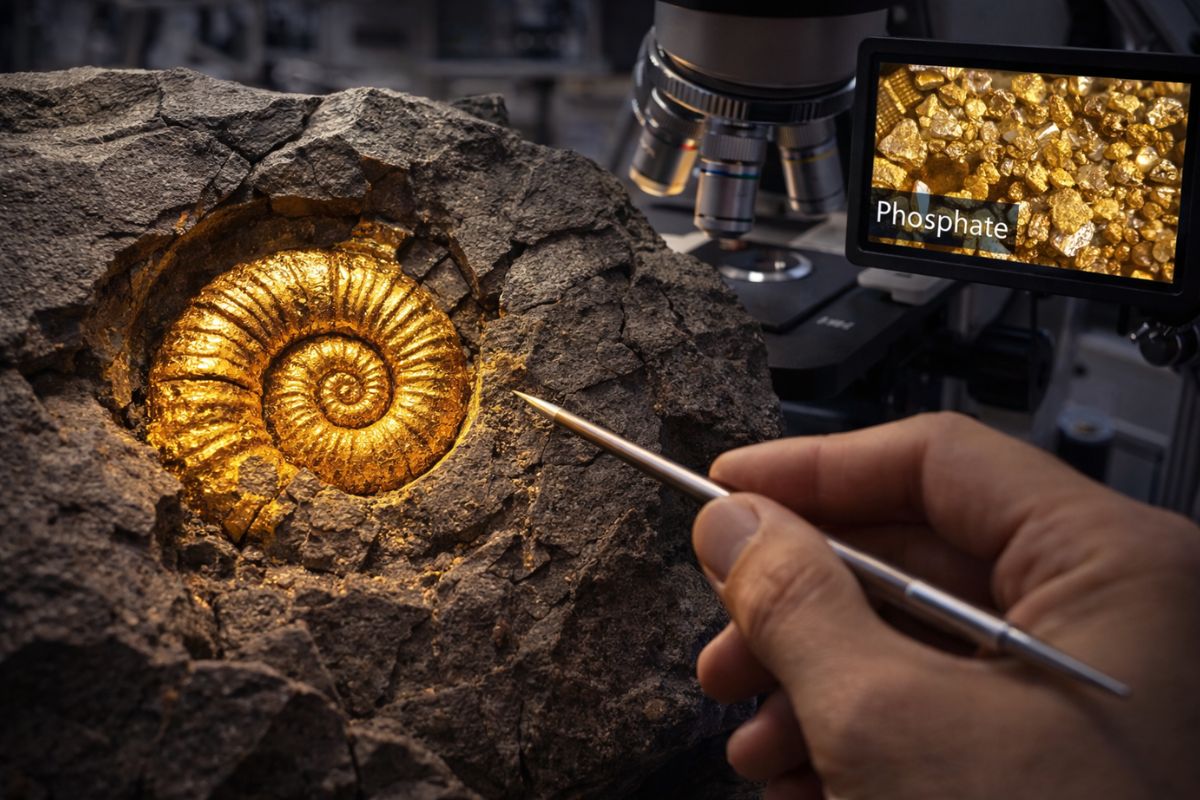


Researchers from the University of Texas at Austin analyzed dozens of Jurassic fossils preserved in the Posidonia Shale in southwest Germany and discovered that the metallic glow that looked like fool’s gold is actually phosphate mineral, while real pyrite is concentrated in the rock around and not inside the fossil.
Break a slab of black shale from the Holzmaden region and you might find a 183-million-year-old ammonite shell that reflects light like a newly polished coin. For decades, collectors and even scientific interpretations treated these fossils as classic examples of pyritization, the process in which pyrite replaces the original biological material. The problem is that when the team placed the specimens under a scanning electron microscope, they found almost no pyrite inside them. The study was published in the journal Earth-Science Reviews.
The discovery forces a rewrite of the preservation history of one of the world’s most famous fossil deposits and opens a window to understand how oxygen behaved in ancient oceans during an extreme climate event.
If it’s not pyrite, where does the golden glow of the fossil come from?

The answer lies in two different places. Inside the fossil, the biological material was preserved through phosphatization, a chemical process in which phosphate minerals replace tissues and shells before they decompose.
-
She spent 73 years breathing inside an iron lung, survived the aftereffects of polio, and became the last woman in the United States dependent on the equipment before dying at 78 years old.

-
Brazilian students created a $1 filter using pine bark, cotton, and 3D-printed parts to clean cassava wastewater, reduce the toxicity of a hazardous waste, and transform contaminated water into biofertilizer.

-
Astronaut from Artemis II steps down after mission to the Moon and decision surprises after a record of 406,771 km, a historic 10-day journey, and an unprecedented achievement for Canada.

-
A fossil kept for years in a small museum in Montreal concealed 450-million-year-old soft tissue, a discovery that has only happened once before in history.


This type of preservation is one of the rarest and most valuable in paleontology because it can keep delicate structures intact for hundreds of millions of years.
The metallic glow comes from outside. The rock surrounding the fossil is filled with framboids, microscopic clusters of pyrite shaped like raspberries that reflect and scatter light.
Researcher Sinjini Sinha, a doctoral student on the team, counted 800 framboids in the rock matrix around a single specimen and found only 3 or 4 in the fossil itself.
The contrast is stark: the “gold” that the human eye sees is an optical effect created by the neighborhood of the rock, not by the internal composition of the fossil.
What does a 183-million-year-old fossil reveal about ocean oxygen?

The Posidonia Shale formed during the Toarcian Oceanic Anoxic Event, a period when large portions of the oceans had very low oxygen levels.
This oxygen-free environment slowed decomposition and kept predators away, which partly explains why so many fossils have been so well preserved in this formation.
But the research argues that the lack of oxygen alone does not explain everything.
The data suggest that short pulses of oxygenation were essential to trigger the chemical reactions that transformed biological tissues into phosphate before they disintegrated.
It’s almost counterintuitive: oxygen normally destroys organic material, but in small and temporary doses it may have helped lock in preservation instead of accelerating decomposition.
Why does this correction matter beyond paleontology?
The study connects the chemistry of 183 million years ago with a current problem. The oceans are losing oxygen.
According to the IPCC, the global stock of oceanic oxygen has dropped by about 2% since 1960.
Low-oxygen zones compress marine habitats, force fish and other animals into narrower bands of water, and can intensify die-offs in vulnerable areas.
Understanding how oxygen boundaries behaved in the past helps scientists calibrate models that predict what will happen in the seas of the future.
The Jurassic is not a perfect mirror of the present, but studies like this show how chemistry can change rapidly when conditions shift.
And if a golden fossil managed to deceive entire generations of researchers about its own composition, perhaps today’s oceans also hide surprises that we have yet to learn to see.
And you, have you ever seen a fossil with a metallic shine and thought it was fool’s gold? Did you know that most of the famous “golden” fossils may have been misclassified for decades? Share your thoughts.