Portuguese
  Spanish


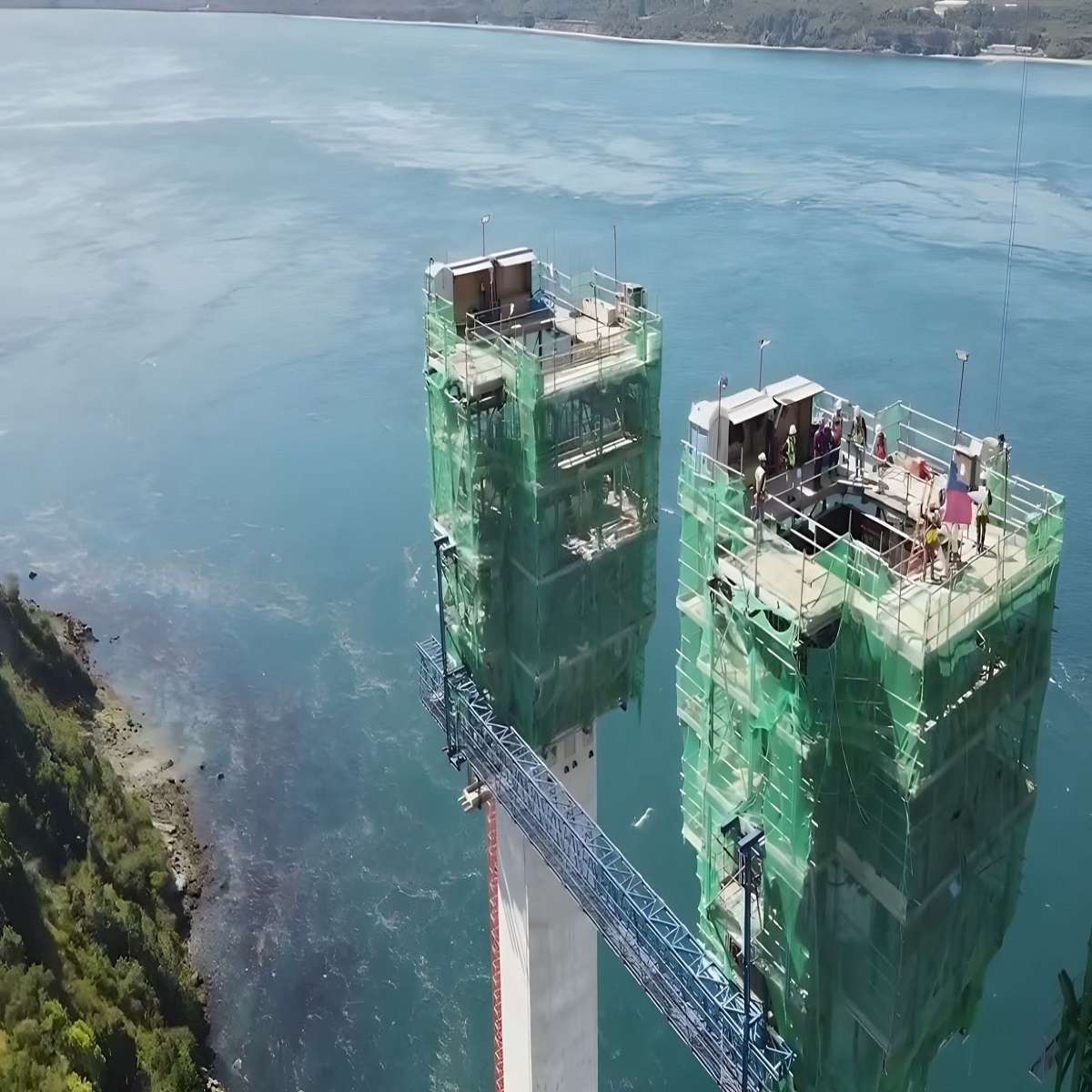


Chacao Bridge advances in Chile with 2,750 meters over the sea and billion-dollar investment to connect Chiloé to the continent.
In the far south of Chile, one of the most challenging infrastructure projects in Latin America is underway: the Chacao Bridge. The work, coordinated by the Ministry of Public Works, aims to create the first permanent link between the Big Island of Chiloé and the continent, replacing decades of dependence on ferry crossings. With 2,750 meters in length over the Chacao Channel, the bridge is not just a crossing but a structural intervention in one of the most complex regions geographically and climatically in the country.
According to official documents presented in 2025 by the Chilean government, the project has already surpassed half of its physical execution and is expected to be completed by the end of the decade.
Chacao Channel imposes extreme challenges of wind, current, and geology
The construction of the bridge takes place in one of the most challenging environments in Chile. The Chacao Channel presents intense sea currents, strong winds, and variable weather conditions, as well as complex geological features on the seabed.
-
U.S. City Builds Tiny Home Village on Water Company Land to House 136 Homeless People: Inside the Social Housing Units

-
Woman Turns Shipping Container into Home, Embraces Rural Life to Cut Monthly Expenses to Just Over $330
-
France Revamps 530 Social Housing Units with Large Balconies and Glass Facades Without Demolishing Existing Buildings

-
Facing high rent, couple transforms parents’ garage into a fully functional apartment, creating a complete home at a fraction of the market cost.




These factors require advanced engineering solutions, from deep foundations to structures capable of withstanding constant dynamic forces.
The region is also subject to seismic activity, adding another level of complexity to the project.
Suspended structure with three towers seeks balance between stability and strength
The Chacao Bridge was designed as a suspended bridge with three main towers. This configuration allows for more efficient load distribution throughout the structure, especially in an environment with adverse conditions.
The towers are strategically positioned to support the main span and ensure stability against winds and currents.
The engineering of the bridge was developed to withstand not only the weight of the structure but also continuous environmental forces, such as gusts of wind and water movement.
Billion-dollar investment reflects technical complexity and strategic importance
The cost of the project exceeds 1 trillion Chilean pesos, reflecting the scale and complexity of the work. This investment involves not only the construction of the bridge but also:
- Access infrastructure
- Security systems
- Structural monitoring
- Integration with existing highways
The high value is directly linked to the technical challenges and the strategic importance of the connection, which alters the transportation dynamics in the region.
End of ferries may reduce crossing time and increase regional integration
Currently, the crossing between the continent and Chiloé Island depends on ferries. This system is subject to weather conditions, schedules, and operational limitations.

With the completion of the bridge, the crossing can be made continuously by vehicles. This represents a significant change in mobility, reducing travel time and increasing transportation predictability.
The permanent link is also expected to impact economic activities, tourism, and logistics.
Chiloé Island gains direct connection with the continent for the first time
The Big Island of Chiloé has always had a distinct geographical relationship with the rest of the country. Despite its cultural and economic importance, limited access influenced the flow of people and goods.
The bridge represents the first direct physical connection with the mainland, altering a historical pattern of relative isolation. This type of change tends to generate structural transformations in the region.
The execution of the work involves large-scale operations. Among the challenges are:
- Transportation of heavy materials
- Installation of foundations on the seabed
- Assembly of structures in an open environment
The logistics of construction must deal with variable environmental conditions, which requires detailed planning and the use of specific technologies.
Specialized equipment is used to ensure precision and safety in the most critical stages.
Project is part of a broader infrastructure strategy in Chile
The Chacao Bridge is part of a set of initiatives aimed at improving infrastructure in the country. The goal is to increase connectivity between regions, reduce logistical costs, and improve access to more remote areas.

This type of investment has a direct impact on regional development, especially in areas with geographical limitations.
What is at stake with the construction of one of the largest maritime bridges in Latin America
The bridge is not just an engineering work, but a territorial transformation. It alters routes, reduces dependencies, and creates new possibilities for economic and social integration.
At the same time, it represents an example of how large projects face technical, financial, and environmental challenges.
The Chacao Bridge raises a relevant question about the role of infrastructure. When a natural barrier is overcome by engineering, the impacts go beyond transportation and affect the economy, culture, and social dynamics.
The work is still ongoing, but it already represents one of the largest structural interventions in the region. The question that remains is straightforward: to what extent can a single project transform the way an entire region connects to the rest of the country.