Portuguese
  Spanish


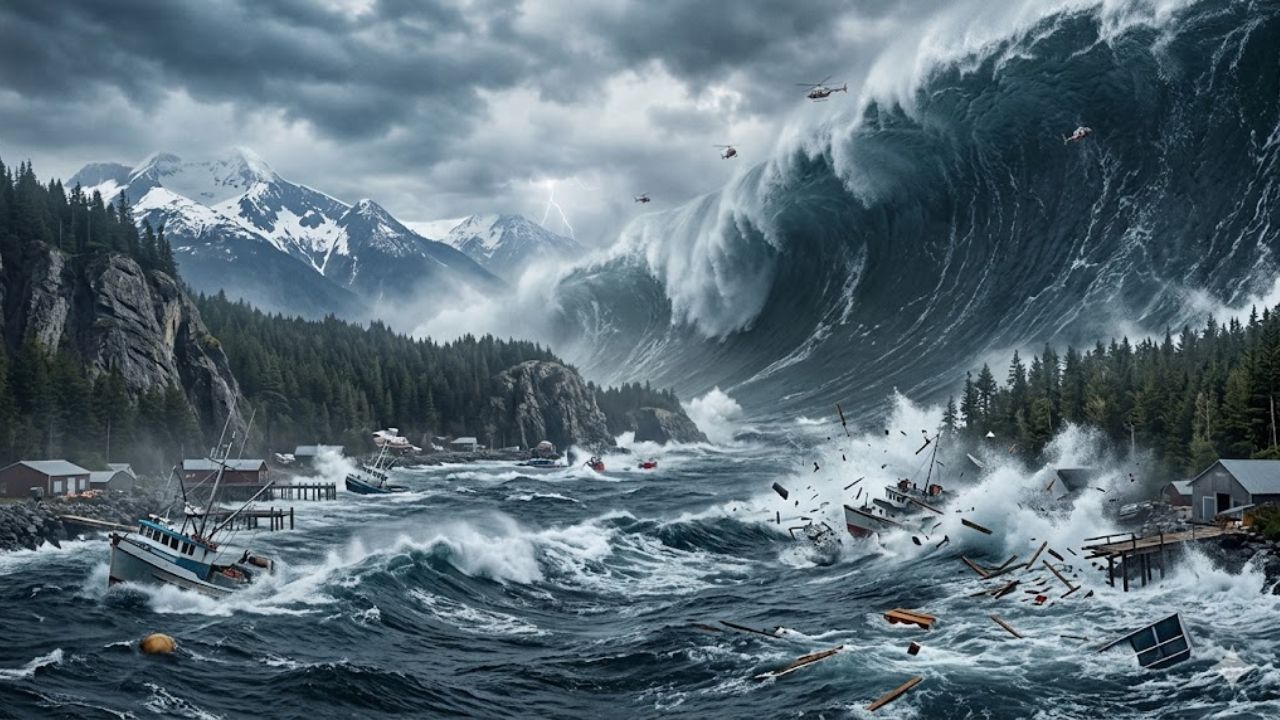

A 481-meter tsunami hit Tracy Arm fjord in Alaska. Learn how glacier retreat caused the wave and why cruises had to change their routes.
The tourism industry in Alaska faces immediate operational changes after a colossal tsunami hit Tracy Arm fjord in August 2025. The phenomenon, which reached a height of 481 meters — equivalent to 1.5 times the Eiffel Tower — forced about six cruise companies to seek alternative routes to avoid new risks.
According to UCL, the disaster was caused by the collapse of a mountain that, without the support of a retreating glacier, discharged a mass of rock equivalent to 24 Giza Pyramids into the region’s waters, surprising scientists and visitors.
Operational Impact and Survival in Tracy Arm
Safety became the top priority after the event occurred at 5:30 AM. Although the gigantic wave did not directly hit any large vessel, the waters became extremely turbulent, as reported by crew members of a cruise ship anchored at the fjord’s entrance.
-
From matches sold by bicycle at age 5 to a global furniture empire: the lumberjack’s son founded IKEA at 17 in his uncle’s kitchen and transformed a small company into the largest furniture retailer on the planet.

-
The mansion in Flamengo, built in 1865 for the Baron of São Clemente and closed for 20 years, has become a spa, event hall, and gym for “Symphony,” a luxury condominium that sold 70% of its gross development value in the first month on the R$ 60 million land of the former Bennett College.

-
The Ipiranga convent, a 1924 building adjacent to the Museum that remained vacant for a decade and became home to dozens of cats, is reborn as “Alma Mater,” a luxury development worth R$ 130 million with a pool in the courtyard and a clubhouse in the former nuns’ chapel.

-
An empty pool of almost 3 meters turned into tilapia farming in the backyard after a family transformed the dangerous space for children into an urban greenhouse with eggs and organic food.




The force of the water was felt most dramatically by a group of kayakers on land; around 5:45 AM, they were awakened by a flood that swept away tents and camping equipment.

The megatsunami in Alaska serves as a laboratory for global predictions. The study brings a severe warning for Europe: experts state with full certainty that a large-scale wave will form in the Mediterranean Sea in the next 30 years.
Unlike the remote region of Alaska, an event in the Mediterranean could hit southern France in just 10 minutes after its formation.
Thus, researchers hope that the tragedy avoided in Tracy Arm will motivate authorities and industries to take preventive measures against the unpredictable effects of global ice melt.
Warning signs: Earthquakes and rock stability
The study led by Dr. Dan Shugar revealed that, although the collapse showed no obvious visual signs in the preceding weeks, nature issued invisible warnings. Frequent small earthquakes were recorded in the days leading up to the landslide, indicating that the mountain’s structure was under critical stress.
Unlike other avalanches, this one did not present the common superficial cracks. Technical analysis points to crucial factors:
- Mass Volume: The fall was estimated on a monumental scale, compared to the weight of dozens of pyramids.
- Loss of Support: A glacier supporting the mountain’s base retreated 500 meters in a few weeks.
- Absence of Visual Warning: The event occurred without the traditional signs of falling debris.
The science behind the wave and climate change in Tracy Arm, Alaska
Experts are emphatic in linking the emergence of this monumental wave to global warming. Dr. Stephen Hicks, co-author of the research, explains that the accelerated ice retreat leaves previously stable areas on the “front line” of danger.
As tourism in these glacier regions has grown significantly, the risk to people has become real and immediate in areas previously not labeled as dangerous.


Therefore, the focus now is on implementing modern monitoring systems. Researchers suggest that investing in technology that identifies previous seismic tremors can offer a warning window of hours or even days for evacuations and ship maneuvers.
With information from the website Aventuras na História and UCL