Portuguese
  Spanish



According to the Specialist, Although a Tractor Can Spray About 100 to 200 Hectares Per Day, It Is Possible to Spray About 1,200 Hectares via Aircraft.
The 2022/2023 agricultural year begins with the prospect of a good harvest for the Brazilian agribusiness and, consequently, for agricultural aviation, which has been gaining importance in the agricultural sector. The agricultural aviation industry, which started in the country in 1947, is one of the main proponents of technological advancement, especially in the areas of pest control, crop management, and time optimization.
Although agricultural aviation is not a recent phenomenon in the country’s fields, it is becoming an increasingly common and profitable practice for the national agribusiness.
Brazil Has the Second Largest Agricultural Aircraft Fleet in the World
Brazil, for example, has the second largest agricultural aircraft fleet in the world, with 2,409 aircraft, only behind the United States, which has 3,600 agricultural aircraft. The survey also reveals that Goiás has the fourth largest fleet of agricultural aircraft in the country, with 295 aircraft, only behind Mato Grosso, which has the largest fleet with over 600 agricultural aircraft, or 24.67% of the national fleet.
-
Brazil Welcomes Spanish Wamos Air and Nigerian Air Peace, Potentially Transforming International Routes and Increasing Competition

-
Why can the crane operator only obey the correct signalman on the construction site: among dozens of workers, a hand raised by the wrong person can confuse the maneuver and turn a load of tons into an immediate risk.
-
What changes with the new public transportation rules that can reduce pressure on fares and pave the way for zero fare in Brazil?
-
Offshore air transport soars in Brazil, surpasses 2.5 million passengers, and reveals how oil has transformed Rio’s airports into key pieces of national logistics.





Rodrigo Neiva, an entrepreneur and one of the founders of Antares Polo Aeronáutico, claims that agricultural aviation is essential for optimizing producers’ time.
“Aviation stands out for several reasons, including: planting work, fertilizer application, spraying to combat pests in vast fields; fighting wildfires and, of course, time and logistics optimization that can be achieved through aviation,” he stated.
Agricultural Planes Are Much More Productive Than Tractors
Additionally, Rodrigo Neiva notes that although a tractor can handle 100 to 200 hectares per day, it is possible to handle 1,200 hectares via air. “The speed at which enormous areas can be treated in a short time allows for significant time savings. Therefore, I assert that this is a vital instrument in agriculture,” he explained.
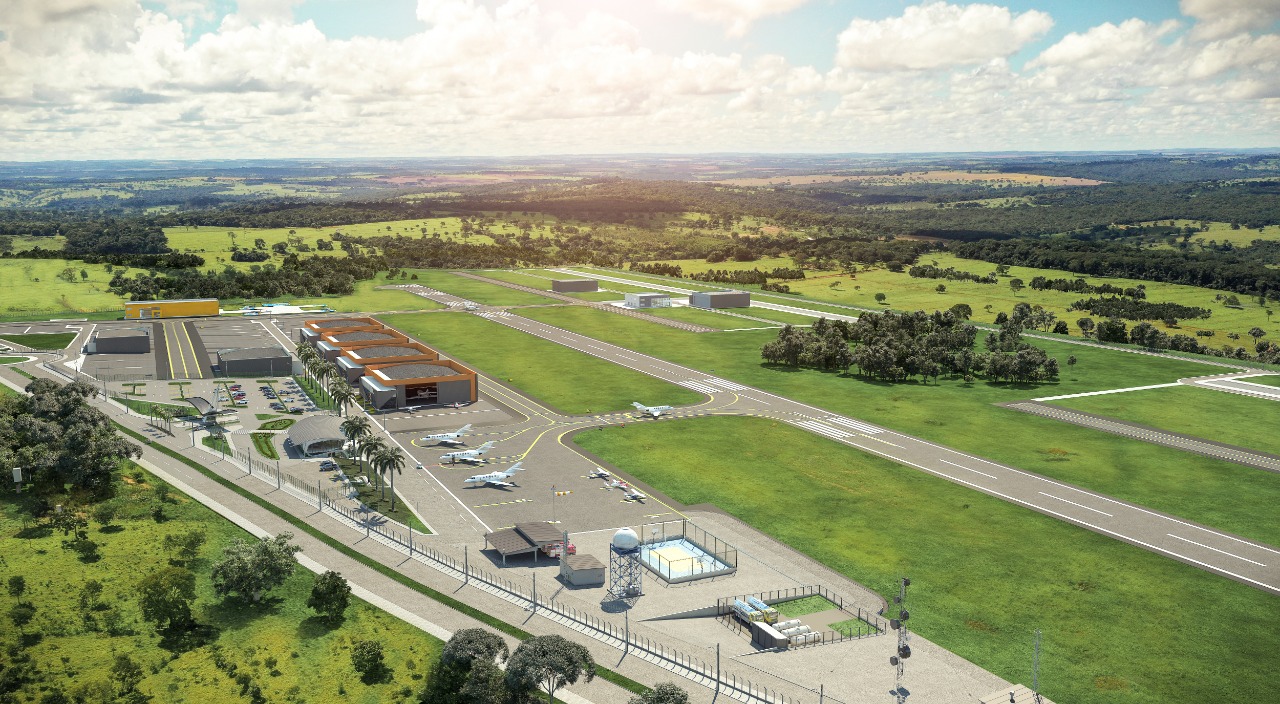
A consortium of entrepreneurs from Goiás formed by six companies is building, in the metropolitan region of Goiânia, the largest general aviation infrastructure in the Midwest and one of the largest in Brazil.
The Antares Polo Aeronáutico will focus on so-called general aviation, which includes executive aviation, aeromedical services, air cargo transportation, agricultural aviation, regional flights, and aircraft maintenance, with investments of around R$ 100 million. “The project is divided into five phases, with the first phase expected to be completed in 2024, including an airport, boarding and disembarking area, and all the hangar infrastructure already ready.
Rodrigo Neiva, developer and one of the founders of Antares Polo Aeronáutico, explains that the company’s mission is to serve companies from all areas of general aviation, including the agribusiness sector, which stands out in Goiás and throughout the Midwest.