Portuguese
  Spanish


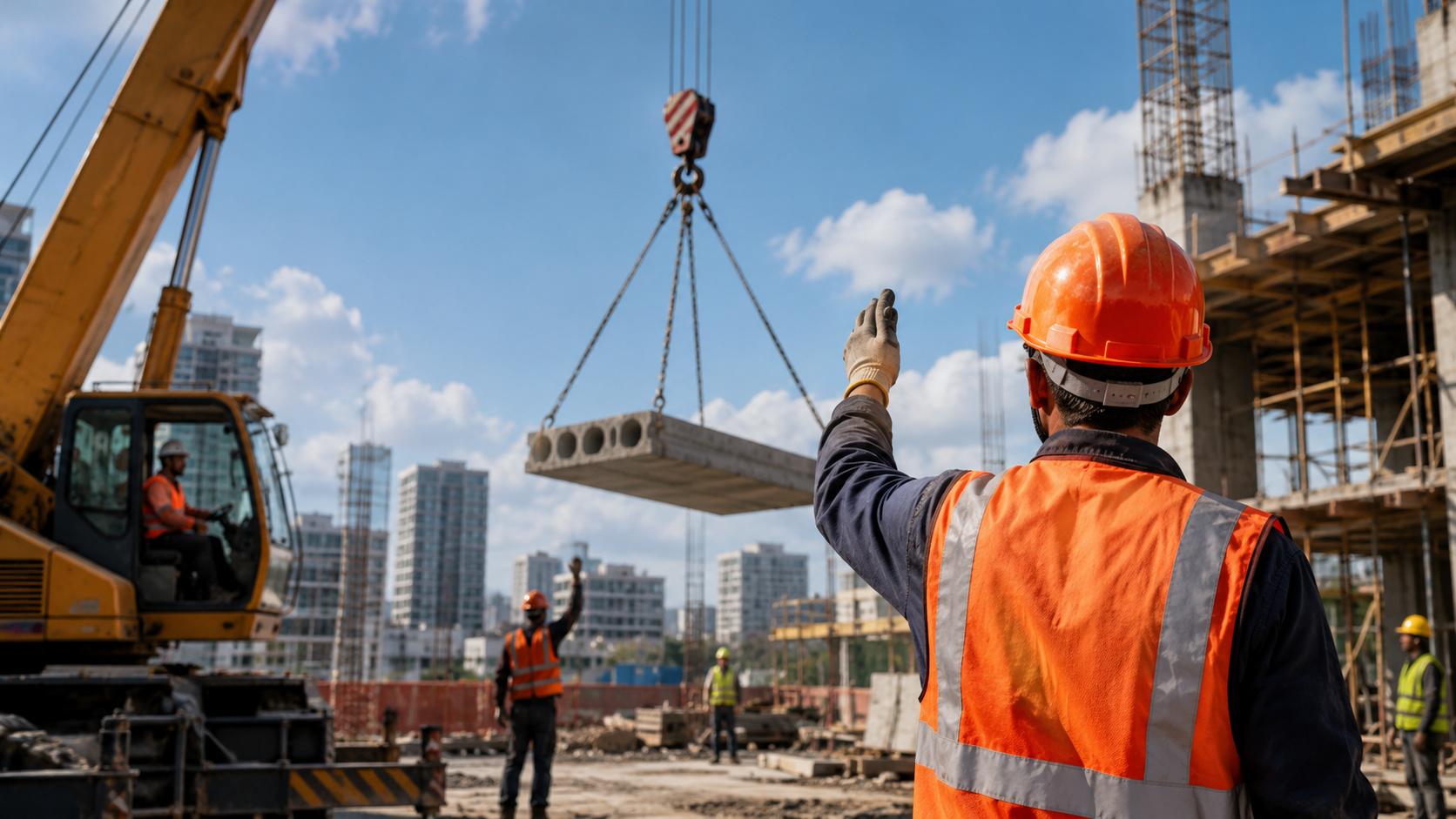

Orange helmet on the construction site does not indicate leadership: it exists so that the crane operator knows exactly who can command a suspended load and avoids a mistake that could end in tragedy
On a construction site, few colors have a function as critical as the orange helmet. It does not exist to show hierarchy, tenure, or seniority. Its function is much more direct: to identify, without a doubt, the person authorized to guide load lifting operations. According to the HSE Blog, orange is used as the color of exclusive communication in operations where the crane operator relies on a single professional on the ground to know where the load is, where it should go, and what is around it.
According to Civil Engineer Mag, this helmet is often associated with lifting operatives, bank-man slingers, signalers, and traffic marshals precisely so that the operator can distinguish them from other workers. In a lifting operation, following the gesture of the wrong person can mean moving tons of material to the wrong point, with a real risk of a serious accident.
Crane operator works with blind spots and relies on a single signaler
The central point of the problem is visual. According to the HSE Blog, the crane operator often becomes “blind” to much of the load during the maneuver. From the cabin, he often cannot see the exact landing point, nor what is below the load, nor the people near the movement area.
-
Latin America’s Largest Port Invests $400 Million in Rail System with Trains Up to 2.4 Kilometers Long
-
New Smart Radar Begins Issuing Fines to Solo Drivers in Carpool Lanes, Uses Cameras to Count Occupants, Changing Traffic Enforcement Rules on Busy European Roads

-
What changes with the new public transportation rules that can reduce pressure on fares and pave the way for zero fare in Brazil?
-
Argentina confirms Belgian giant to lead strategic Paraná River waterway and promises to reduce logistical costs on one of South America’s most important routes



This is why the signaler becomes essential. He acts as the operator’s eyes on the ground, observing the path of the load, the surroundings, and the positioning location. This system only works safely if there is instant and unequivocal identification of who is authorized to give commands.
When the operator spots the orange helmet, he knows from whom to accept signals. Without this visual filter, the construction site environment becomes noise: several people walking, gesturing, pointing, and moving at the same time, without it being clear which gesture is a command and which gesture is unrelated to the operation.
Orange helmet solves a problem that radio and voice alone cannot eliminate
It may seem that radio communication would solve everything, but the practice on site shows that it is not so simple. The construction site is a noisy environment, with machines, vehicles, teams in motion, and multiple tasks happening at the same time. In this reality, visual communication remains decisive.
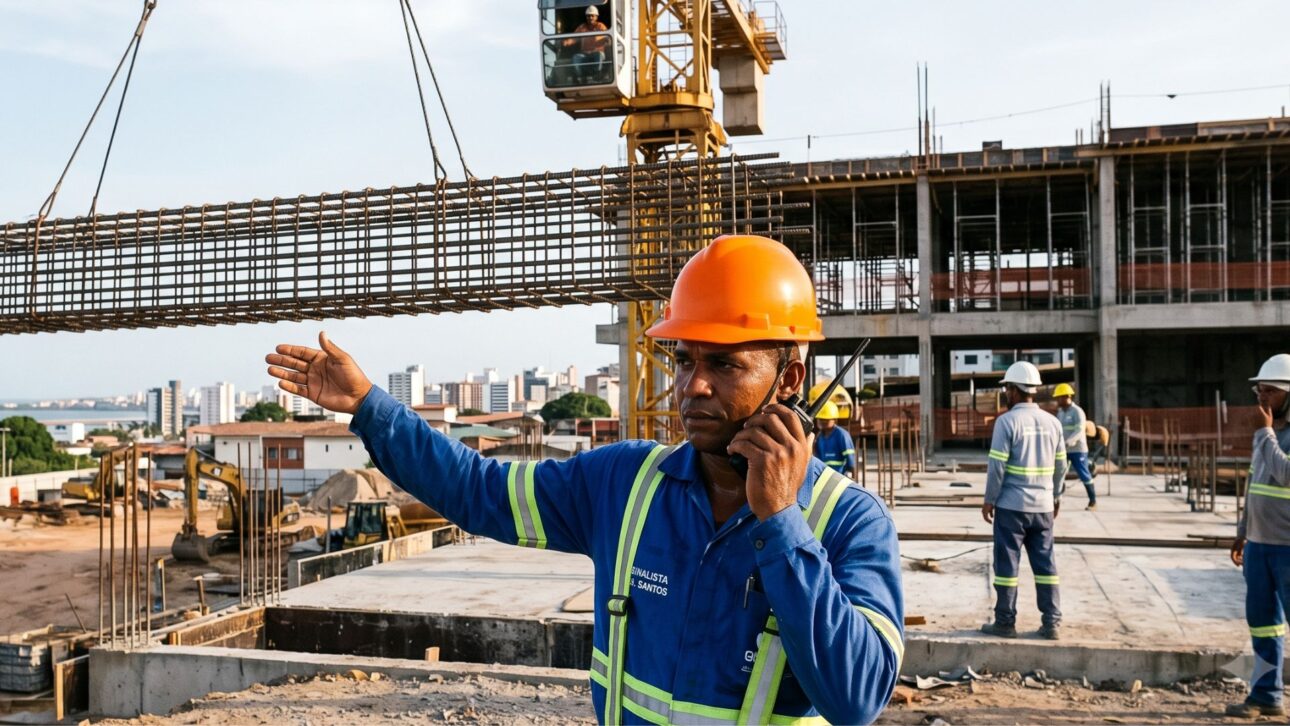
According to the HSE Blog, hand signals remain the primary method in many operations precisely because they are direct, universal, and independent of audio quality. But these signals only work if the operator knows from whom to accept them. This is where the orange helmet comes in as an absolute visual marker.
The Civil Engineer Mag reinforces this logic by pointing out that orange allows the operator to quickly differentiate the lifting professional or the traffic marshal from other workers. In other words, the color transforms a specific person into the only reliable visual channel for that maneuver.
Orange was chosen because it is also a high-visibility color on site
The choice of orange is not random. Besides identifying the signaler, the color has strong visual contrast in construction environments. It stands out easily against concrete, earth, asphalt, steel, vegetation, and temporary site structures.
According to the Civil Engineer Mag, the orange helmet is also used by professionals operating in higher-risk zones, such as lifting areas and machine circulation. This means that the color not only guides the crane operator but also helps the rest of the team to realize that this person is part of a critical operation that requires distance, attention, and discipline.
This dual function is what makes orange so important. It serves simultaneously as a functional identifier and as a visual safety alert, reducing ambiguity in an environment where seconds and centimeters can make a difference.
Color code helps transform the site into a visually readable environment
The use of the orange helmet is part of a broader logic of visual organization. According to the HSE Blog, although different sites adopt their own codes, color standardization is considered a good practice because it helps prevent unauthorized work, speeds up decision-making, and improves incident response.

Instead of relying solely on badges, verbal briefings, or personal recognition, the site adopts a language visible from a distance. This reduces human error in critical situations, especially in operations involving suspended loads, heavy vehicles, and areas with multiple workers.
In the case of the signalman, this logic reaches its most important point. The orange helmet is not an aesthetic detail or a random site custom. It is a safety resource created to ensure that, among dozens of people, the crane operator can immediately recognize the only professional who can conduct that maneuver.
Why the orange helmet can prevent a fatal error in lifting operations
On a site, not every risk comes from something invisible or complex. Sometimes, the danger lies precisely in a simple situation: the operator looks in the wrong direction, interprets the wrong gesture, and moves the load to the wrong point. In operations with beams, metal structures, precast concrete, or heavy equipment, this type of error can have immediate consequences.
That’s why the orange helmet has gained this specific role. It concentrates operational authority, reduces ambiguity, and creates an exclusive visual channel between the cabin and the ground. In an environment full of noise, dust, movement, and pressure, this simplicity saves time and can save lives.
In the end, the logic is straightforward: when tons are suspended in the air, the operator cannot guess. They need to know exactly who is guiding the operation. And, on many sites, that answer is visible from afar in the same color: orange.