Portuguese
  Spanish


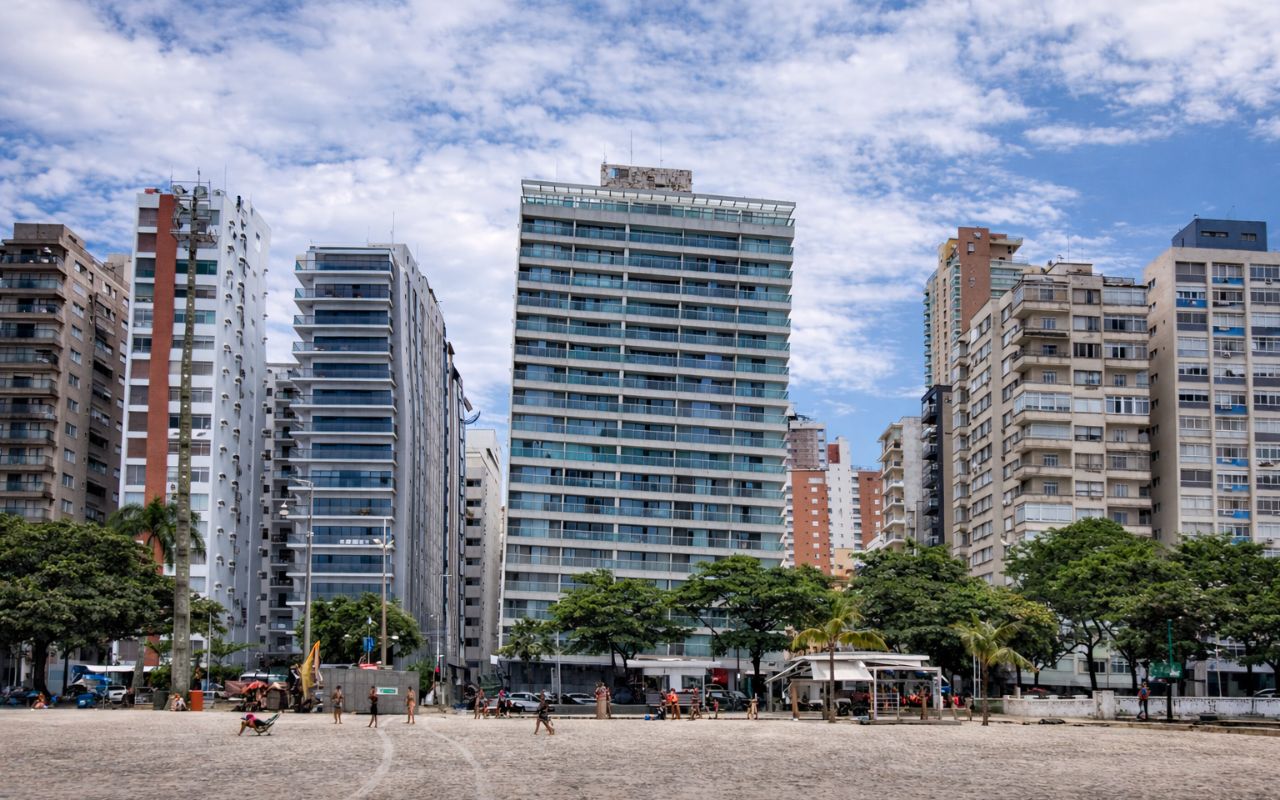

Understand why so many leaning buildings in Santos, how the soil and urban growth influenced the tilt of 319 buildings, and how engineering responds.
The waterfront of Santos holds a characteristic that goes beyond the beauty of the beach: dozens of leaning buildings, known as leaning buildings, spark curiosity and technical debates.
The phenomenon began to appear more intensely between the 1940s and 1970s, when the city underwent a period of accelerated real estate growth on sandy soil.
Much more than a visual curiosity, the leaning building in Santos reflects the interaction between urban development, complex soil, and the advances of engineering in responding to a problem that has persisted for decades.
-
Neon Blue Glow in Brazilian Waters Captivates Locals and Goes Viral, Unveiling Rare “Sea Fire” Phenomenon

-
Forgotten Map Leads Diver to Shipwreck with Gold, Rare Jewels, and Secrets Hidden for Nearly 350 Years
-
Furong: The 2,000-Year-Old Chinese City Built on a 60-Meter Waterfall Becomes a Global Tourist Phenomenon

-
YouTube Inventor Dubbed “Real-Life Tony Stark” Builds Robotic Legs for Father’s Day, Creating a Wheelchair That Conquers Stairs and Rough Terrain




Leaning buildings in Santos: Accelerated urbanization and its effects on the soil
The urban expansion that transformed the waterfront of Santos began in the post-war period, when construction gained momentum.
With easier access provided by the Anchieta Highway, inaugurated in 1947, the city attracted tourists, workers, and new residents.
The real estate market quickly prioritized large residential constructions. Thus, buildings emerged close to the beach, in valued areas.
What was lacking, however, was a thorough geotechnical study before each construction.
Fragile soil: an unexpected component
Part of the problem lies beneath the feet of those walking through the city. The soil of Santos is composed of layers of sand and soft clay that, although appearing stable at the surface, respond differently when subjected to high loads.
In such terrains, foundations need to reach firmer and deeper layers to ensure stability.
But at the time when many buildings were erected, this stability guarantee was not made.
Leaning buildings in Santos: 319 tilted buildings
Currently, 319 buildings in Santos exhibit some degree of tilt, ranging from slight to noticeable.
Of these, 65 properties have been identified with a more pronounced deviation, capable of catching the attention of passersby.
This monitoring is based on technical parameters that assess structural stability and the behavior of constructions over time.
Even when the tilt is evident, many buildings remain inhabited, as long as they undergo proper inspections and maintenance.


How does engineering respond to the challenge?
With the advancement of technology, solutions have been developed to deal with buildings that already show inclination.
Among the most used techniques are:
- Foundation reinforcement, which increases the load-bearing capacity of the building;
- Structural leveling, which aims to gradually correct the angle of the building.
These procedures require detailed studies and specialized labor. Although they are not simple, they demonstrate how engineering has evolved since the first cases.
A unique urban identity
Interestingly, the presence of tilted buildings has become a visual identity element of the city.
Residents live daily with this scenario, and tourists are surprised to notice slightly “tilted” facades along the waterfront.
More than an attraction, the phenomenon is a constant reminder of the importance of soil studies before any construction.
It also stimulates debates on how to balance urban development and structural safety.
The case of the tilted buildings in Santos leaves a clear lesson: the construction industry needs to adapt to the natural conditions of each territory.
And over time, engineering’s response has shown that it is possible to face complex challenges with innovation and technique.
Therefore, the tilted buildings are not just curious landmarks in the landscape. They tell a story of urban growth, adaptation, and learning — and continue to challenge the way we understand the relationship between city and soil.
Source: Diário do Litoral