Portuguese
  Spanish


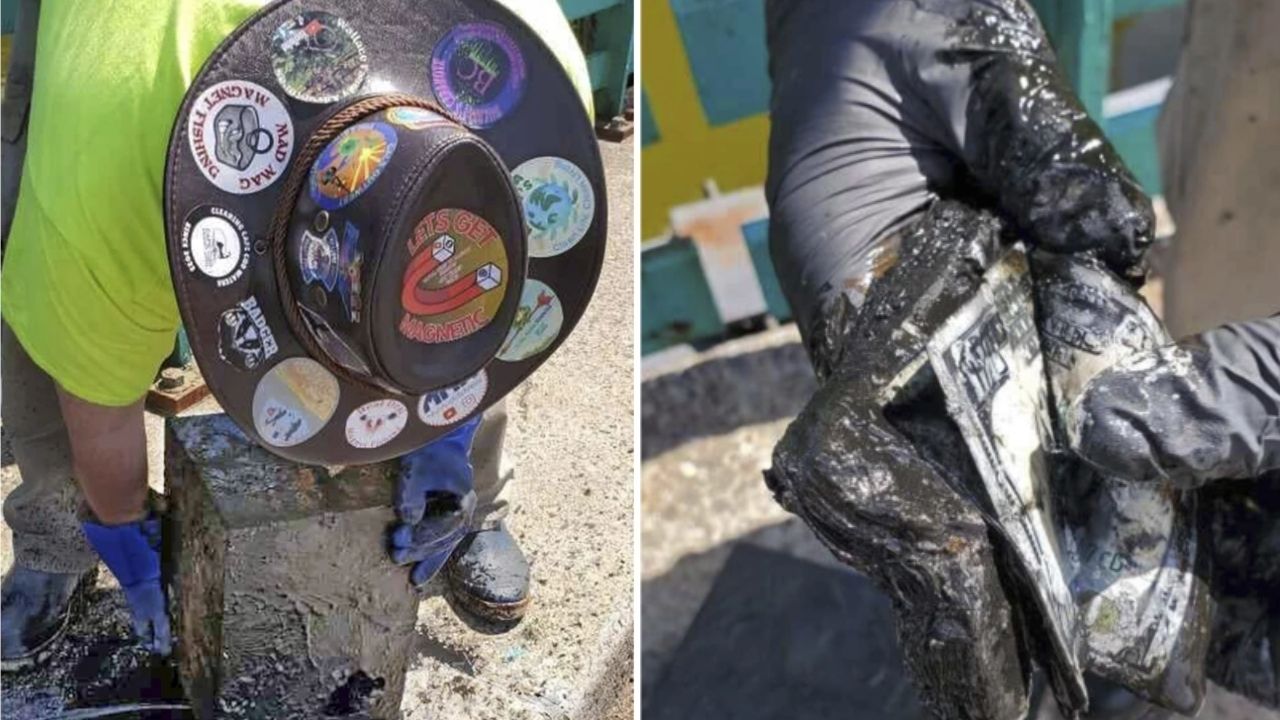

Magnet fishing led James Kane and Barbi Agostini to retrieve a safe full of 100-dollar bills from a lake in New York, in May 2024, after the couple found damaged money, called the police, and heard they could keep the found amount.
Magnet fishing by James Kane, 40, and Barbi Agostini, 39, ended with an unusual find at Flushing Meadows Corona Park, in Queens, New York. On May 31, 2024, the couple pulled a slimy safe from a lake, which they said contained up to $100,000 in soaked 100-dollar bills.
The information was published by the Associated Press, in a report updated on June 4, 2024, and also reported by The Guardian on June 2, 2024. According to the sources, the couple called the New York police and were informed that there was no evidence of a crime nor identification of the safe’s owner.
Safe appeared in the lake during magnet fishing

James Kane had already retrieved bicycles, guns, grenades, jewelry, and other objects from New York waters using magnet fishing. The hobby consists of throwing a rope with a powerful magnet into the water and pulling out metallic objects hidden at the bottom.
-
Daughter accepted her father’s request to reopen a guava paste factory that had been shut down in the countryside of Rio de Janeiro, found the structure in need of improvements, recovered the family’s traditional recipe, and transformed Sítio Taipabas into a rural tourism business with guided tours, tastings, and artisanal production.

-
The government of Dubai launched “bread for all,” a vending machine that operates 24 hours a day, seven days a week, and distributes freshly baked bread for free to those in need, and also accepts donations from those who want to help feed the city.

-
Two Palestinian sisters created reusable blocks from rubble in Gaza, using clay, ash, and glass powder in a simple and low-cost process, and were chosen among the 35 best teams in the world for an environmental award for young people aged 13 to 19.
-
Pink Himalayan salt comes from dark tunnels in Pakistan with explosions, tractors, and giant blocks, supplying more than 80 countries and becoming an expensive product in Western markets, despite studies indicating microplastics, heavy metals, and health promises without solid scientific evidence.


This time, however, the object found was very different. The couple pulled a mud-covered safe from Flushing Meadows Corona Park, an area known for hosting the 1939 and 1964 World’s Fairs. What seemed like just another search for scrap turned into a discovery capable of attracting international attention.
100-dollar bills were wet and damaged

Inside the safe, Kane and Agostini found bags with bundles of 100-dollar bills. The money was soaked, partially deteriorated, and stuck together because of the water, but the couple estimated that the value could reach US$ 100,000.
According to the Associated Press, the bills had 3D security tape, indicating they were relatively recent. Even so, the condition of the material prevented a simple confirmation of value and authenticity. The money existed, but recovering it fully would be another challenge.
Police were called after the discovery
After opening the safe and realizing the contents, the couple contacted the New York police to report the find. According to Kane and Agostini, the officers informed them that there were no signs of a crime related to the material found.
The New York Police Department stated that the value and authenticity of the supposed currency could not be determined due to the severe deterioration of the bills. Still, as the safe did not provide clues about the owner, the couple said they were informed they could keep the money.
Without an identified owner, couple heard unexpected response
The most surprising detail of the story was the absence of identification in the safe. There were no documents, marks, or clues that could point to who the rightful owner of the money found in the lake might be.
Kane summed up the situation by saying he received the practical version of “finders keepers.” The phrase became the most curious point of the story, as it turned a suspicious and muddy discovery into a possible unexpected reward for two magnet fishing enthusiasts.
Hobby grew with videos on social media
Magnet fishing gained popularity precisely because it mixes adventure, cleaning of rivers and lakes, controlled risk, and the possibility of unexpected finds. Many enthusiasts post videos on YouTube, TikTok, and Instagram showing objects retrieved from canals, streams, and ponds.
Kane and Agostini also share their discoveries on social media. Before the safe with money, they had already documented dangerous and unusual objects, including weapons and an old grenade, cases in which they called the police to collect the material as possible evidence.
Finds can range from trash to dangerous items
Although it seems like a treasure hunt, magnet fishing doesn’t always end with valuable objects. Often, the result is metallic trash, parts of bicycles, rusty tools, or equipment discarded in urban canals.
In other cases, the finds can be dangerous. The Associated Press cited episodes involving a human skull attached to a dumbbell in New Orleans and a rifle found in a creek in Georgia. Therefore, experts and authorities recommend caution when the object retrieved appears to be a weapon, explosive, or criminal evidence.
Powerful magnets can pull heavy objects

The hobby relies on strong magnets attached to long ropes. Some pieces used by practitioners can latch onto very heavy objects, allowing them to drag materials that would remain invisible to those passing by the water’s surface.
This strength explains why safes, weapons, bicycles, and metal parts can appear in urban fishing. In the New York case, the safe was submerged in the park’s lake, covered in sludge, until it was pulled by Kane during the activity.
Money still needed to be recovered
Finding the safe didn’t mean the couple could immediately use the entire estimated amount. The bills were wet and damaged, which would require evaluation and possible recovery by the agency responsible for damaged currency in the United States.
Kane said he intended to take the money to the Bureau of Engraving and Printing in Washington to try to recover the possible value. Even with authorization to keep the find, some of the bills might be too deteriorated to be converted.
Couple was already thinking about what to do with the amount

According to the Associated Press, Kane and Agostini already had ideas for using the money they might eventually recover. Among the plans mentioned were buying a new vehicle and improving the equipment used to produce content.
The reaction draws attention because the estimated value is high but uncertain. The safe could contain up to $100,000, but the actual usable amount would depend on the condition of the bills and the official analysis. Between the euphoria of the discovery and the available money, there was still a bureaucratic path.
Case reignited doubts about viral discoveries
Magnet fishing videos often generate millions of views but also attract skeptics. In online forums, some question whether some discoveries are real or staged to attract attention.
In the case of Kane and Agostini, coverage by the Associated Press and the Guardian gave journalistic weight to the episode. Even so, the very improbable nature of the find helps explain why the story went viral: a safe, money, mud, police, and the possibility of keeping it all form a sequence hard to ignore.
Queens Lake became an urban treasure hunt scene


Flushing Meadows Corona Park is one of the most well-known spaces in Queens, New York. In the episode, the park ceased to be just a leisure area and became the scene of an improbable discovery made during a low-cost activity.
Kane told the Guardian that he and Agostini started practicing magnet fishing due to the fascination of treasure hunting without having to spend much money on equipment. The discovery of the safe showed exactly why this hobby captivates the imagination of those who follow the videos.
Find mixes luck, risk, and public curiosity
The New York safe story brings together elements that capture attention: an ordinary couple, an urban lake, a magnet, damaged money, and the absence of an identified owner. At the same time, it also shows the limits of this type of adventure, as many finds may involve risk, investigation, or total loss of the material found.
Magnet fishing may seem like a game, but it has already removed dangerous objects, old trash, and in this case, a safe with an estimated fortune from urban waters. Do you think it’s fair for the couple to keep the money after calling the police and no owner being identified, or should the amount have another destination? Share your opinion.