






 Portuguese
  Spanish


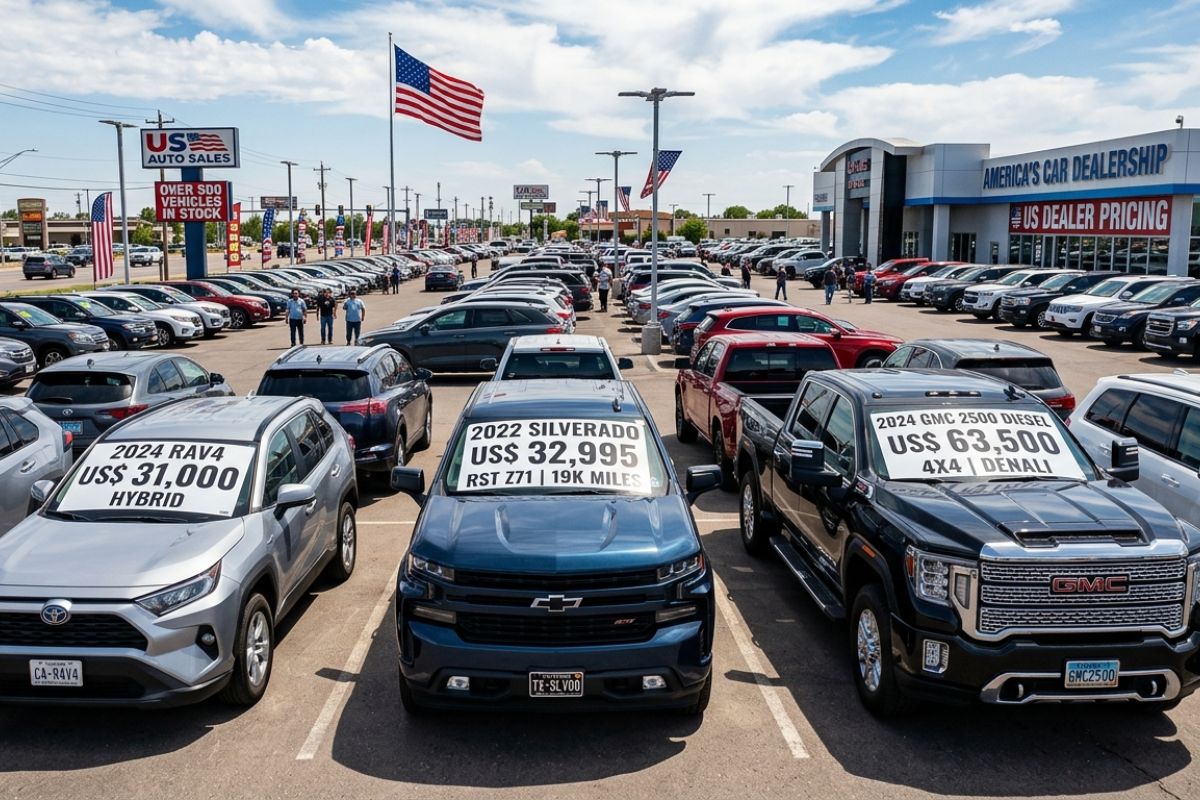

At a dealership, the contrast appears in SUVs and pickups with prices in dollars and low installments, while equivalent models in Brazil are much more expensive
Pickups have become the perfect thermometer to understand why so many people are shocked when they enter a dealership in the United States. In the account, a tour of the cars in the lot shows prices like the 2024 RAV4 for $31,000 and the 2022 Silverado for $32,000, numbers that, according to him, seem “unreal” when compared to what is paid in Brazil.
The central point is not just the price on the sticker, but the feeling of accessibility. He insists that pickups and SUVs “disappear” next to other even larger machines and that, even so, they come with much easier purchasing conditions, with installments that he cites as low for the local income standard, while in Brazil the same category becomes a luxury item.
Pickups as a showcase of price shock
Right at the beginning, he points out a 2024 RAV4 for $31,000 and treats the model as a “large SUV in Brazil”, but small compared to the cars around it. The comparison becomes the trigger: the same type of car, in different markets, generates completely different perceptions of value.
-
Sales of Brazil’s Cheapest Electric Car Halted Before First Deliveries: E-Motors Suspends Emova Easy Due to Import Tax Increase and Rising Freight Costs

-
Nissan Discontinues Qashqai SUV Amid Cost-Cutting, Chinese Competition, and Product Line Review

-
BYD Patents Revolutionary System Using Computer Vision to Detect Animals Under Cars Before Starting, Preventing Tragedies

-
Study Reveals Why Cars Are More Expensive to Produce and Buy in Brazil Compared to Mexico, Highlighting Taxes, Logistics, and Industrial Costs as Key Factors.



Next, pickups dominate the scene, because it is here that the contrast becomes more aggressive. He shows the Silverado and reinforces the argument that what is found in the American dealership for tens of thousands of dollars becomes, in Brazil, a distant purchase for most.
Silverado in the lot and the “new truck” effect

The first big shock comes with the Silverado. He mentions the 2023 Silverado for $36,000 and highlights a 2022 Silverado for $32,000, described as “ready,” with a nice dashboard and large interior space. His reading is straightforward: a truck of this size in that market seems much more attainable.
He also makes an observation about maintenance, saying that the car “doesn’t break down” like in Brazil due to road and environmental conditions. It’s a narrative detail, but it helps explain why a used pickup can seem so “new” in the lot.
GMC 2500 diesel and the category that changes the game

The climax of the video is when he enters the top shelf: the 2024 GMC 2500 diesel pickup for $63,000. He emphasizes the size, the finish, the gear in the transmission, the space in the back, and the fact that it already comes with a bed liner, treating it as “another story.”
Further on, he mentions a 2025 AT4 version, with a V8 6.6 diesel engine, for $71,000, and also cites units priced between $72,000 and $75,000, depending on the car shown.
The message is that large pickups appear easily in stock, and this alone already contrasts with Brazil.
Brazil enters the conversation with Hilux, Amarok, and prices that shock


To compare with Brazil, he cites Hilux and Amarok as market references and states that there, people would pay very high prices for equivalent pickups.
At one point, he says he saw out of curiosity a truck imported advertised for “R$ 15 million,” treating it as something illogical.
Here, what matters for the text is the perception: in the account, pickups in Brazil appear as a symbol of inflated prices and restricted access, while in the U.S. they appear as a possible purchase, even with financing.
Installments, income, and the idea of “accessibility”
He tries to explain the difference by combining income and financing. He cites the minimum wage around “two thousand and something dollars” and compares it with a much lower amount in Brazil, arguing that the effort to pay would be different.
He also mentions installments of $250 to $300 for some cars and something around $900 to drive away with a higher category truck.
The line of reasoning is simple: it’s not just the absolute price, it’s how much a person can pay per month without destroying their budget. And he uses pickups as the ultimate example of this calculation.
SUVs in the middle of the road reinforce the feeling of “another world”
Even with the focus on pickups, he also goes through large SUVs, like an eight-seater model (mentioned as 2025 for $52,000) and comments that certain sizes are not even common in Brazil. The goal is to reinforce the thesis of the “gap”: it’s not an isolated case, it’s a market pattern.
In the end, he still mentions models like the Ford Bronco for $29,000 and talks about low installments, maintaining the same argument: the lot becomes a showcase for direct comparison between countries.
Quick question for you to comment: seeing these dealership prices, do you think the price gap of pickups between Brazil and the U.S. is more due to taxes, income, or lack of competition?









