






 Portuguese
  Spanish


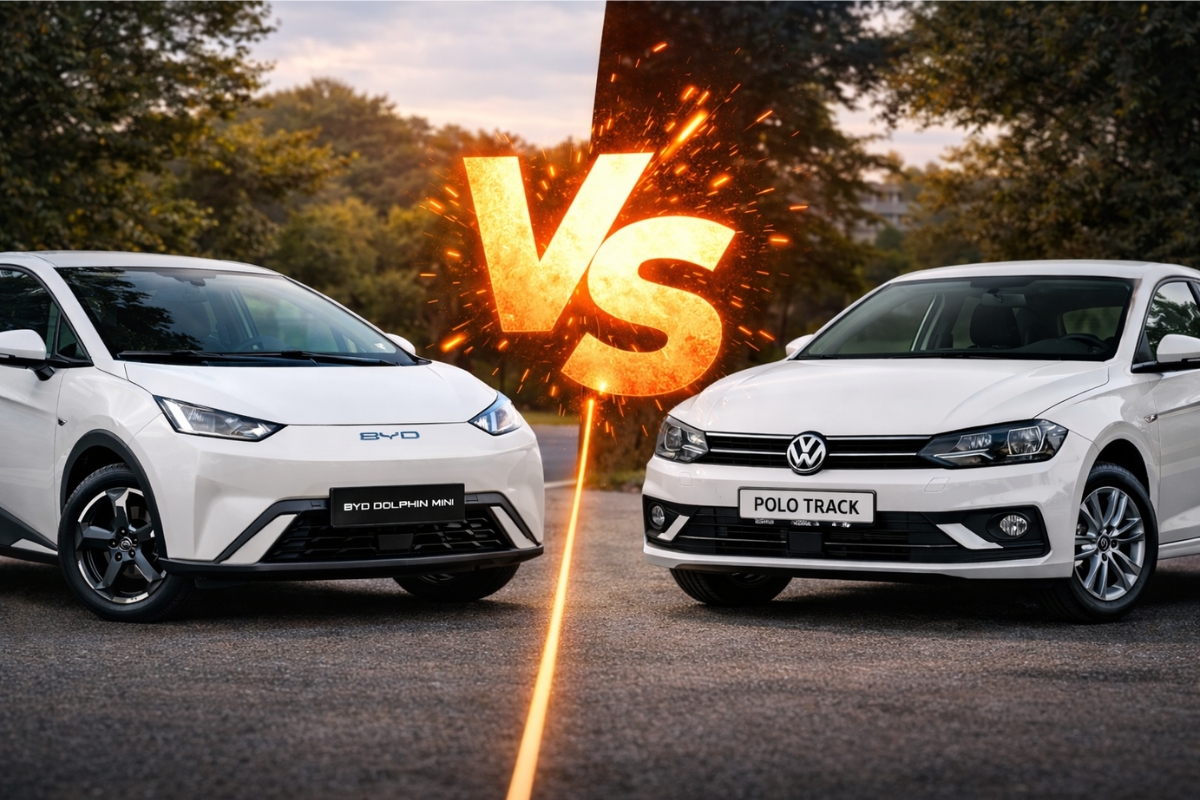


Updated Comparison Shows When Electric Savings Outweigh Price Difference in Practice for Daily Drivers
The advancement of electric cars in Brazil in 2025 raised a direct question for those considering switching from combustion models: how many kilometers need to be driven for the investment to pay off? With updated prices and corrected costs, the answer becomes objective.
When comparing a BYD Dolphin Mini, sold for R$ 118.990, and a VW Polo Track 1.0, priced at R$ 89.429, the initial difference reaches R$ 29.561. This amount is only recovered over time through savings on fuel, maintenance, and taxes.
When these factors are included in the calculation, amortization occurs after approximately 113,600 km driven, at which point the total cost of the electric car becomes lower than that of the combustion model.
-
Discover the 2021 Fiat Cronos 1.3: Affordable Maintenance, Reliable Mechanics, and Fuel Efficiency of Up to 15.6 km/l

-
Cummins Unveils Hydrogen-Powered X15H Engine with Over 800 km Range and 15-Minute Refueling, Challenging Electric Truck Dominance

-
Chevrolet Onix 2026 Priced at R$ 86,790 with Discounts, Underpricing Citroën C3; Features 1.0 Engine, 6 Airbags, 8″ MyLink, Wi-Fi, and OnStar

-
Fiat Mobi Price Nears $18,000 in Brazil: Entry-Level Hatch with 1.0 Firefly Engine, Manual Transmission, and Stability Control Sees $400 Increase.


What Happened and Why It Caught Attention
100% Electric Vehicles, known as BEV, have seen growth since the end of 2023, driven by new compact models and more competitive prices. This has closed the gap with traditional cars and changed the profile of interested consumers.
Instead of just discussing range or technology, the focus has shifted to total cost of ownership. Those who drive less want to know if the return really exists. Those who drive more want to see when savings become evident.
With higher fuel prices and simplified maintenance, the electric car has gained prominence in long-term calculations.

What Goes into the Amortization Calculation
The amortization calculation does not depend on daily use, but on the savings per kilometer driven and the initial price difference between vehicles. As long as these factors remain constant, the total kilometers needed to offset the investment also remains the same.
In comparison, the VW Polo has an average consumption of 13.4 km per liter, while the BYD Dolphin Mini consumes 9.6 kWh per 100 km, equivalent to 0.096 kWh per kilometer.
Maintenance is less of a burden for the electric car, with an estimated cost of R$ 0.029 per km, compared to R$ 0.076 per km for the Polo. Additional costs include 4% IPVA, licensing fee of R$ 160.22, and annual depreciation of 4.95% for the Dolphin and 6% for the Polo.
Why 113,600 km Does Not Change with Usage Type
The number 113,600 km represents the point at which the accumulated savings of the electric vehicle equal and surpass the difference paid at purchase. This figure is fixed because it only reflects how much is saved for each kilometer driven.
What changes is the time required to reach this figure. Those who drive less will take more years. Those who drive more will reach the same point in less time.
This detail helps explain why the electric car tends to be more advantageous for drivers who use the vehicle frequently, even without professional use.

How Daily Use Influences Payback Time
With light usage of 35 km per day, the driver covers about 12,775 km per year. At this rate, 113,600 km would be reached in just under 9 years.
With moderate use of 120 km daily, annual mileage increases to 43,800 km, reducing payback time to about 2.5 years.
In intense usage, such as 200 km per day, common in app-based transport, the 113,600 km mark can be reached in approximately 1.5 years.
What Can Happen from Now On
The trend is for the calculation to become even more favorable to electric vehicles with improvements in infrastructure and an increase in supply. The more stable the energy costs and the lower the maintenance, the more predictable the return becomes.
For consumers, the central takeaway is clear: amortization does not depend on promises, but on mileage. Once reaching around 113,600 km, the BYD Dolphin Mini starts to cost less over time compared to the VW Polo, even starting from a higher initial price.
This number serves as a practical reference for those evaluating a switch and wanting to decide based on actual usage, not just on market trends.




Pelo amor de Deus, vamos aprender a fazer contas.
Gasolina a R$ 6,50l ÷ 13km/l = R$ 0,50km + 0,07 manutenção + 0,10 de IPVA = R$ 0,67/km
Elétrico R$ 0,80kwh = R$ 0,08/km + 0,02 manutenção + IPVA isento = R$ 0,10/km.
Gasolina R$ 0,67
Elétrico. R$ 0,10
Diferença R$ 0,57/km
R$ 29.561 ÷ R$ 0,57/km = 51.860km
Matéria tendenciosa e sem escrúpulos. Pegaram a pior versão do polo e bem básica para fazer o comparativo. Elétrico não tem mão de obra qualificada nem nas concessionárias, pneus um absurdo,sem peça de reposição no mercado ( há quem diga que não quebra). Carro descartável, optem por um Corolla híbrido ( carro de aposentado, mas sobrevive com boas avaliações).
Falou de pneus essa pegou mal em meu SENHOR, esse mito de pneus ja caiu por terra a anos atras F5 aí para sair da idade do balaço baco
É assim mesmo, fala mal quem não tem, kkkkkkk
O desespero das montadoras “tradicionais” é tão grande que falaram mal e agora estão todos lançando carros híbridos, mesmo porque nem têm tecnologia para lançar totalmente elétricos, estão 10 anos atrasados.
Tenho um Song Plus, carro incrível de tudo! Quase 2 toneladas fazendo 100Km/h em 8seg, ando 4.000km por mês com 2,5 tanques de combustível porque carrego em casa num custo baixíssimo.
O povo nem entendeu ainda as diferenças entre os diversos tipos de eletrificação e tem um monte de gente falando do que não conhece.
Mas é isso… opinião, cada um com a sua!
Manutenção do polo não é tão barata e quem bebe é ele. Fizeram a comparação com o motor do track, poderia ter feito com outro.
Polo fazendo 13.5 kml kkkkk não sei onde andaram , pois aqui em Goiânia é impossível.