Portuguese
  Spanish


Analysis from the Motor Oculto channel, with almost 100,000 views, breaks down the engine numbers: 400 horsepower, 1,850 Nm of torque, cost per kilometer up to 23% lower than that of the electric truck, and projected lifespan of 1.6 million kilometers
The hydrogen engine is no longer a laboratory promise, and a video published on June 16, 2026, by the Motor Oculto channel on YouTube explains why the X15H from American company Cummins has become the most uncomfortable topic in the energy transition, with a direct effect on freight costs that also define prices in Brazil. Founded in 1919 in a garage in Columbus, Indiana, the company that always lived away from the spotlight presented an engine that burns pure hydrogen in the cylinders and emits only water vapor from the exhaust.
The detail that changes the game, according to the Motor Oculto channel: the X15H is not a trade show concept; it is already running in real trucks pulling tons of cargo on real roads, with full refueling in less than 15 minutes and immediate range above 800 kilometers.
The giant from 1919 that Wall Street considered dead
The recent history of Cummins seemed like an announced obituary. As the Motor Oculto channel reports, in 2021 the European Union announced aggressive deadlines against combustion engines, the United States injected more than 360 billion dollars in subsidies for electric vehicles, and the financial press openly questioned whether the diesel engine manufacturer would be the next Kodak.
-
Chevrolet Onix 2026 Priced at R$ 86,790 with Discounts, Underpricing Citroën C3; Features 1.0 Engine, 6 Airbags, 8″ MyLink, Wi-Fi, and OnStar

-
Fiat Mobi Price Nears $18,000 in Brazil: Entry-Level Hatch with 1.0 Firefly Engine, Manual Transmission, and Stability Control Sees $400 Increase.

-
F1 Puts Drivers in Lego Cars at Silverstone, but Max Verstappen Criticizes the Idea Directly

-
BYD’s All-Electric Sedan with 530 HP and 0-100 km/h in 3.8 Seconds Becomes a Used Car Bargain After Depreciating by R$ 117,000



Behind the scenes, the company was doing the opposite of dying. As early as 2020, it acquired Canadian company Hydrogenics, owner of fuel cell and hydrogen generation patents, for 290 million dollars, according to the Motor Oculto channel, and later added Meritor to its portfolio. The video also cites the company’s own financial report: more than 2.3 billion dollars invested in zero-emission technologies in a short period of time.
Why the battery fails in the 40-ton truck

Cummins’ bet stems from a stubbornness of physics that the channel Motor Oculto summarizes well: batteries work perfectly for passenger cars that travel 40 kilometers a day, but fail in heavy transport. To give autonomy to a 40-ton truck, the battery set needs to weigh 4 to 5 tons, dead weight that steals load capacity and burns energy carrying itself.
The scale of the problem is geological. The video cites a study from the University of Cambridge with an impressive calculation: electrifying all global heavy transport with lithium batteries would require the equivalent of 75 years of the current world production of the metal. Faced with this, the engineers in Indiana reversed the question: the problem was not the combustion engine, it was the fuel it burned.
The announcement that silenced the audience in New York
The moment of revelation has a date in the video: February 20, 2024, at the company’s Investor Day, in New York, in front of analysts, journalists, and executives from rival automakers. CEO Jennifer Rumsey took the stage and, according to the channel Motor Oculto, opened the speech by returning the provocation: for years they said combustion engines were the past, and the company was there to show why they were wrong.
The market reaction described in the video was immediate: shares soared on the New York Stock Exchange and giants like Paccar, Daimler, and Volvo requested urgent meetings within the next 48 hours, while Tesla maintained public silence. The conceptual difference is the heart of the dispute: instead of using a fuel cell to power an electric motor, the X15H burns hydrogen directly in the cylinders, with the same mechanics that established diesel for over a century.
How the X15H tames the smallest molecule in the universe
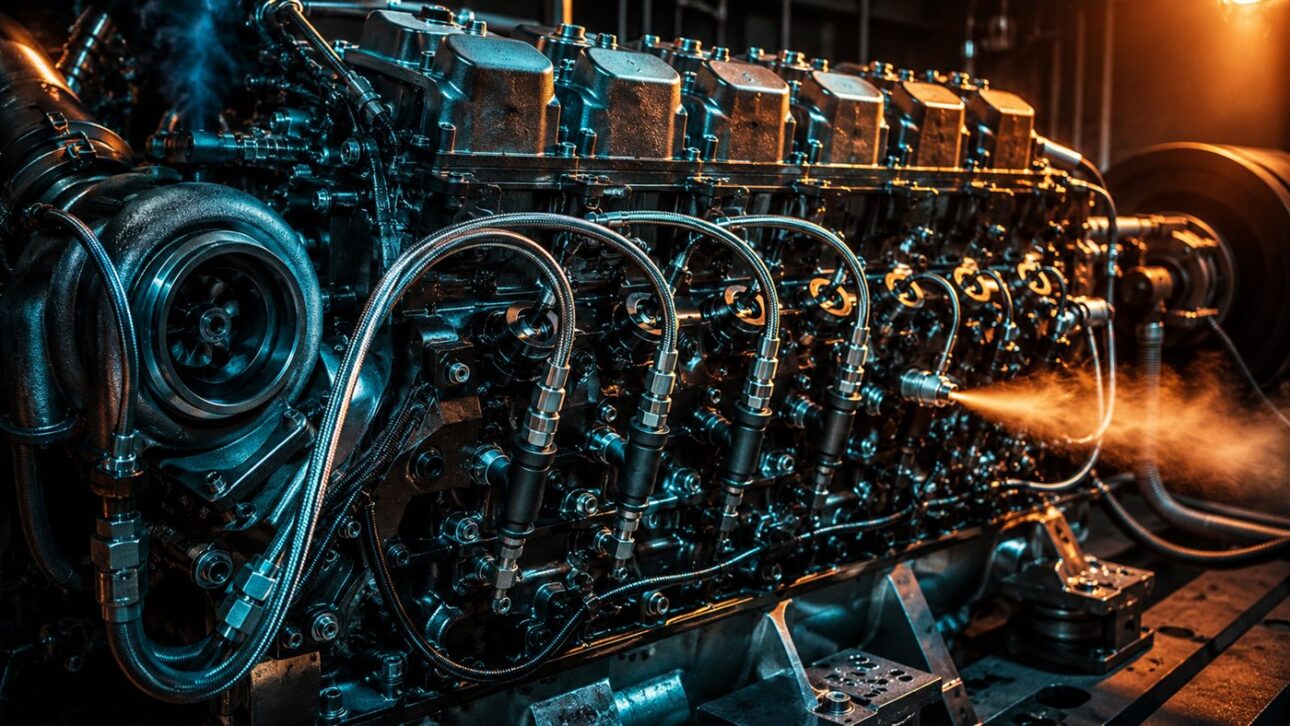
If burning hydrogen were simple, someone would have already done it on a large scale. The channel Motor Oculto explains the technical nightmare: hydrogen is the smallest known molecule, escapes through microscopic gaps in welds and seals, and under high pressure and temperature, penetrates the structure of steel and makes it brittle, the effect known as hydrogen embrittlement. Adapted engines from the past cracked or detonated the pistons in a few hours.
The Cummins solution, as described by the Motor Oculto channel, is a high-pressure direct injection system with millimetric electronic control. The engine only admits pure air and, at the exact moment of maximum piston compression, injects hydrogen into the center of the chamber, ensuring homogeneous combustion, cooling the combustion chamber, and cutting carbon emissions by 99.7%, while almost eliminating all nitrogen oxides, the Achilles’ heel of old hydrogen engine designs.
400 horsepower, 800 km, and 15 minutes at the pump: the numbers
The technical sheet presented in the video explains the competitors’ discomfort: 400 horsepower and 1,850 Nm of torque. Compared to Tesla’s electric truck, which needs 30 to 70 minutes stopped at a mega-charger, the X15H refuels in less than 15 minutes, the same time as a regular diesel, and delivers over 800 kilometers of range.
The financial argument is even more straightforward. According to the Motor Oculto channel, data validated in conjunction with the United States Department of Energy indicate an operational cost per kilometer 18% to 23% lower than that of a pure electric truck, provided the hydrogen comes from clean sources. For the fleet owner, it’s the difference between profit and loss on a spreadsheet of millions of kilometers.
1.6 million kilometers: the durability that seals the deal
Heavy fleets don’t change vehicles every 5 years, and that’s where the diesel legacy becomes an advantage. According to the Motor Oculto channel, Cummins diesel engines are famous for surpassing 1.5 million kilometers with basic maintenance, and the X15H was designed on the same physical platform to last 1.6 million kilometers.
The contrast with the electric alternative shows up in the wallet. If an electric truck’s battery fails out of warranty, replacement can exceed 150 thousand dollars; the X15H block, made with the metallurgical chain the world already masters, costs a fraction of that to recondition, as the Motor Oculto channel compares. And the hydrogen engine infrastructure takes advantage of what’s already there: the same roads, workshops, and trucks, changing only the tank and fuel supply.
The geopolitics of hydrogen and the Saudi partner
The question the video considers most important is not technical: who will control the hydrogen? According to the Motor Oculto channel, more than 60% of the world’s electrolysis technology, the machines that separate hydrogen from water, is concentrated in China and South Korea, and migrating without strategy would be swapping one energy dependency for another.
The response from Cummins was a memorandum of understanding with ACWA Power, a Saudi powerhouse in the energy transition. Saudi Arabia, which built its empire on fossil energy, is investing heavily to become the largest exporter of green hydrogen on the planet, with giant solar plants in the desert, thus ensuring engines ready to consume the fuel it intends to sell. The video also mentions rumors of the so-called Cascade project, a hybrid system that would combine direct combustion and fuel cell to target thermal efficiency of 55% to 60%, compared to about 42% of the best current diesel engines.
Watch the complete analysis of the hydrogen engine in video
The full story, from Indiana’s silent bet to the geopolitical race for the fuel of the future, is in the analysis from the channel Motor Oculto, on YouTube.


For Brazil, which runs on diesel and feels every cent of freight in the price of rice, the question in the video is doubly interesting: if the hydrogen engine delivers diesel autonomy with zero emissions, who will build the infrastructure to supply it here? Tell us in the comments: would you bet on the hydrogen truck or the battery electric one?