Portuguese
  Spanish


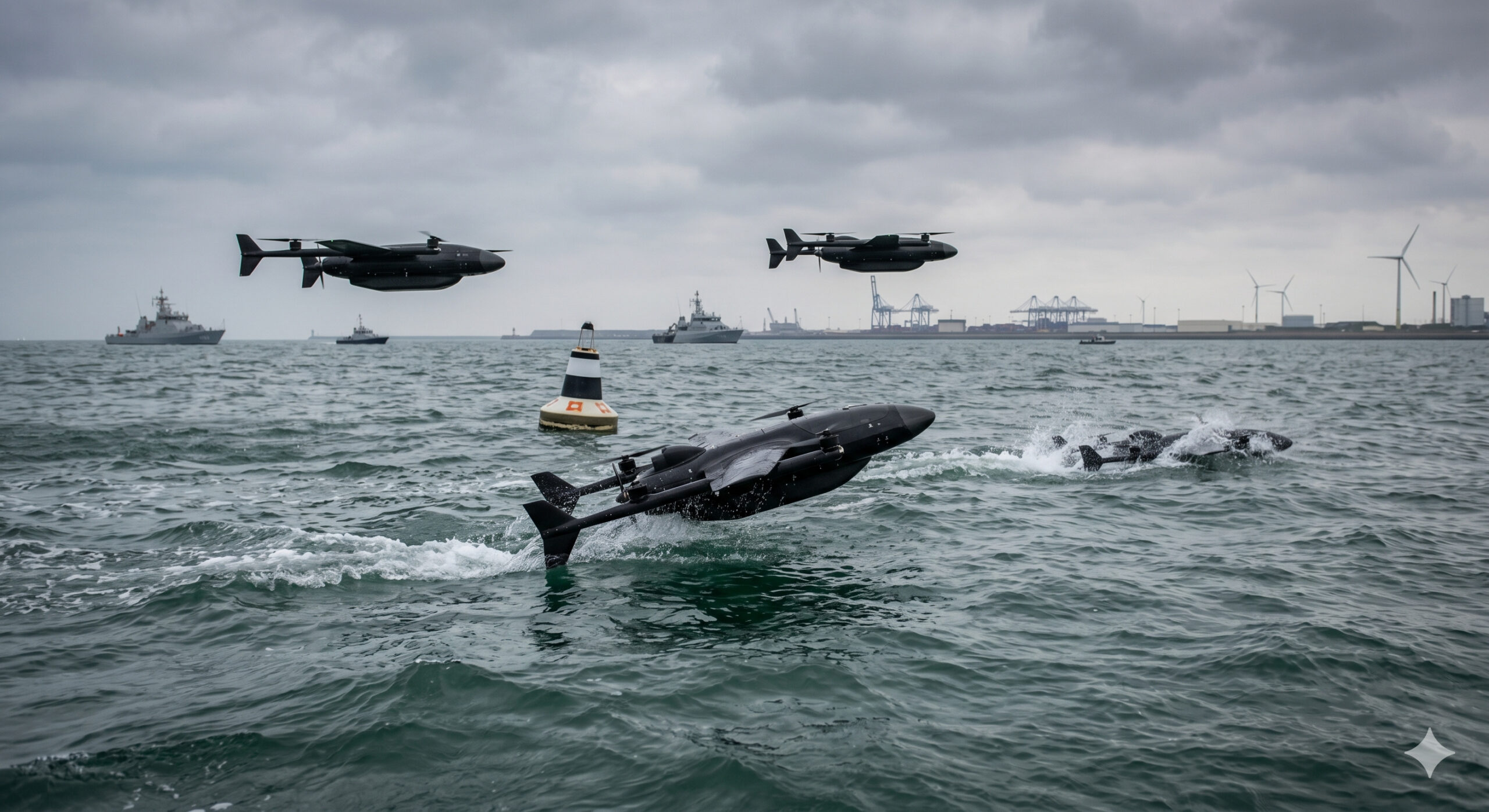


Drone that flies and dives up to 40 meters emerges as a new naval hybrid weapon and could change maritime and coastal warfare strategies.
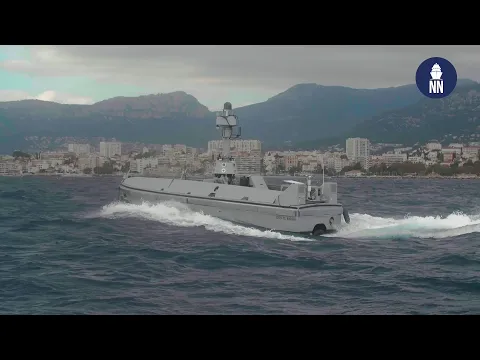
In September 2025, during the Naval Innovation Days (NID) 2025, Naval Group presented the Cormorant, a multi-domain drone developed by Naval Group Belgium in partnership with the Belgian Navy to operate both in the air and underwater. In official material published on September 16, 2025, the company reported that the system can dive up to 40 meters deep, be launched from the surface drone Seaquest S, and resurface to continue the mission, combining capabilities that are traditionally separated between aerial and underwater platforms into a single platform.
The official presentation describes the Cormorant as a platform aimed at surveillance, reconnaissance, and integration of sensors and effectors in complex environments. In another text published by Naval Group on June 24, 2025, the company stated that the project was launched in mid-2022, developed with the Free University of Brussels, and was already ready for industrialization and commercialization after two years of development, indicating that the proposal had advanced beyond the experimental prototype phase.
How the drone that alternates between flight and diving works
The operation of the Cormorant relies on a hybrid architecture that combines elements of aerial drones with technologies typical of unmanned underwater vehicles. Unlike conventional drones, which operate exclusively in the air, this system was designed to withstand underwater pressure, resist water ingress, and maintain structural stability during the transition between the two environments.
-
U.S. Military Intervention Risk in Brazil Raises Alarm, Highlights National Sovereignty Amid Tensions Over Washington’s Terrorist Designation of PCC and Comando Vermelho

-
Brazilian Air Force’s Sole KC-30 Aircraft Completes Strategic Mission to Spain for 105mm Anti-Tank Ammunition for Leopard 1A5 Tanks

-
Brazilian Air Force Seeks to Acquire More Gripen Fighter Jets
-
U.S. Air Force Launches Air-to-Air Missile Project with Range of Up to 1,850 km for Indo-Pacific Operations





As it approaches the water, the drone performs a controlled descent and initiates the dive. At this moment, the propulsion and control systems switch to underwater mode. After completing the mission, the equipment returns to the surface and reactivates its flight systems.
This complete cycle — flying, diving, operating on the bottom, and returning to the air — is what transforms the system into an unprecedented platform in the modern military landscape.
Naval Group reports that the project was developed with a focus on modularity, allowing for the integration of sensors, communication systems, and various payloads.
Swarming capability expands strategic potential
One of the most relevant elements of the system is the possibility of group operation, known as swarm. This concept has already been explored in aerial drones, but its application in a system that also operates underwater significantly increases the level of complexity and strategic potential.
The ability to launch multiple units that can fly, dive, and coordinate actions in different environments creates a new type of threat that is difficult to detect and intercept.
While one drone can act as a sensor, another can play an offensive or distraction role. This distributed behavior increases mission efficiency and reduces the vulnerability of the system as a whole.
Unmanned platform eliminates human risks in critical missions
Another central aspect of the project is that it is a completely unmanned system. This means that the drone can be employed in high-risk environments without direct exposure of human operators.
This type of feature is especially relevant in scenarios such as:
- Monitored coastal areas
- Regions with the presence of naval mines
- Operations near sensitive structures
By eliminating the need for a crew, the system allows for an expanded operational range and reduced operational risks. Additionally, the absence of pilots or onboard operators enables longer and more flexible missions.
Operational invisibility emerges from the combination of air and sea
One of the greatest strategic advantages of the Cormorant lies in its ability to operate in two distinct environments, making it harder to detect.
Conventional radars are designed to identify aerial targets, while sonar systems detect submerged objects. A system that alternates between these two mediums creates an additional challenge for any defense system.
By diving, the drone can disappear from radars and approach the target silently, returning to the surface only when necessary.
This feature enhances infiltration potential and makes the system especially relevant in coastal warfare scenarios and naval operations.
Development indicates a new phase of hybrid warfare
The emergence of systems like the Cormorant is directly linked to a larger trend within the defense industry: the search for hybrid platforms capable of operating across multiple domains.
Traditionally, armed forces operate by separating their means into clear categories:
- Air
- Naval
- Land
- Submarine
However, emerging technologies are beginning to break these boundaries. The Cormorant represents exactly this transition, by combining capabilities that would previously require multiple different equipment into a single platform. This technological convergence has the potential to reduce operational costs and increase mission efficiency.
Applications go beyond direct combat
Although the main appeal lies in military use, the very concept of the system allows for broader applications. Among the potential uses are:
- Maritime monitoring
- Inspection of underwater infrastructure
- Search and rescue missions
- Environmental data collection
This versatility reinforces the innovative nature of the project, which can be adapted for different operational contexts.
System is still in development and validation phase
Despite the impact of the presentation, it is important to highlight that the Cormorant is still in the development and validation phase. The Naval Group presented the system as a platform ready for industrialization, but there is no public confirmation of large-scale use or definitive operational deployment at this time.

This means that, although the technology already exists and has been demonstrated, its full adoption will depend on additional testing, integration with military systems, and validation in real-world scenarios. This stage is common in high-complexity defense projects.
Belgium enters the race for military technologies that seem science fiction
The launch of the Cormorant positions Belgium within a select group of countries that are investing in technologies capable of redefining how military operations are conducted. Instead of focusing solely on increasing firepower, the trend is shifting to:
- Invisibility
- Mobility between environments
- Automation
- Distributed intelligence
This type of approach indicates a profound shift in the logic of modern warfare, where the ability to adapt and operate in multiple domains may be more decisive than isolated brute force.